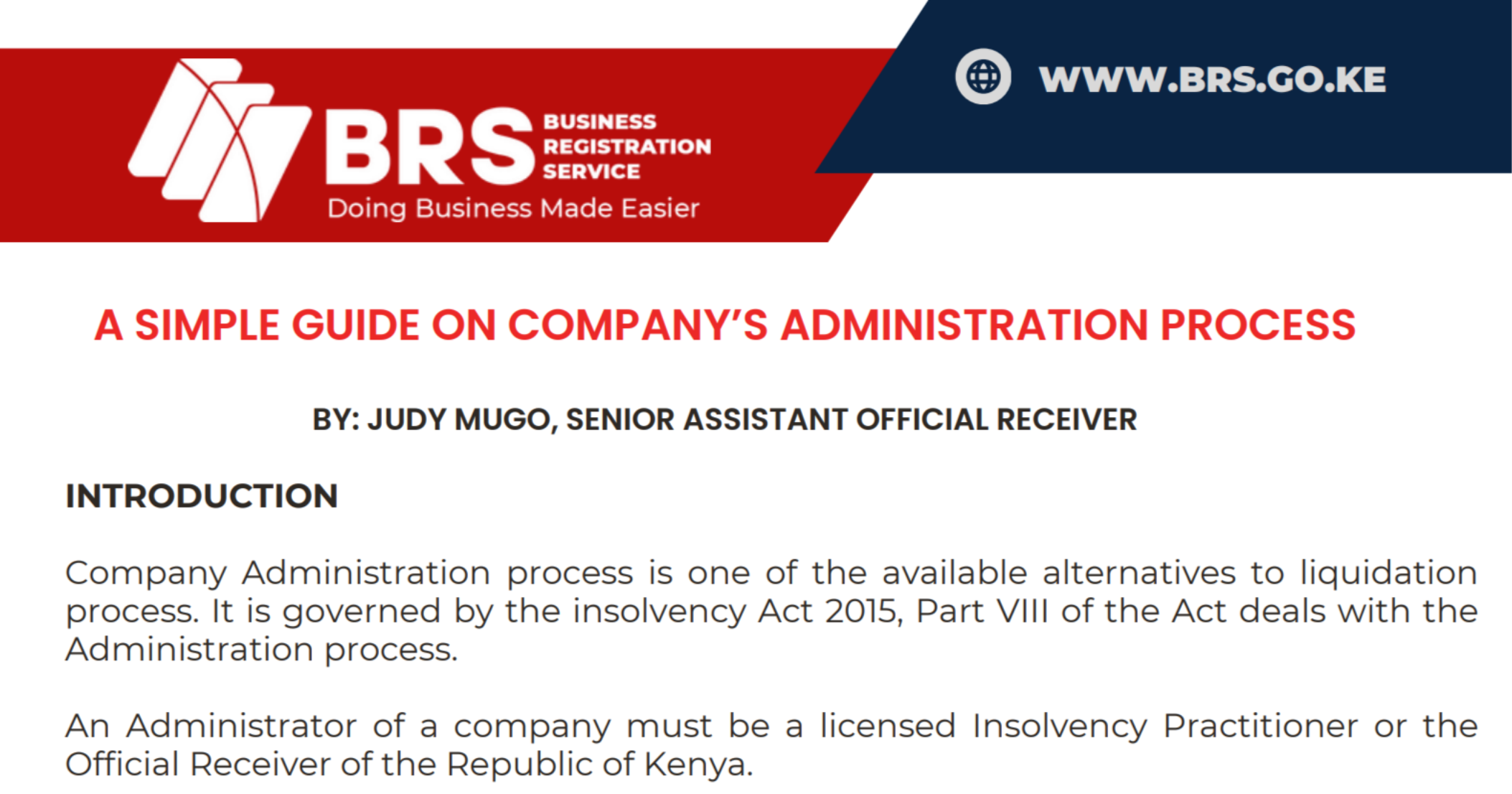
Company Administration Process in Kenya: A Complete Step-by-Step Guide
Learn the company administration process in Kenya under the Insolvency Act 2015, including administrator appointment, creditor rights, administration steps, timelines, and alternatives to liquidation.
The company administration process in Kenya is a legal procedure designed to help financially distressed companies restructure their operations, protect their assets, and explore alternatives to liquidation. Governed by the Insolvency Act, 2015, company administration provides a framework for rescuing struggling businesses, improving outcomes for creditors, and preserving business value where possible.
Understanding the company administration procedure is essential for directors, creditors, shareholders, and business owners facing financial challenges. This guide explains the objectives of administration, the appointment and responsibilities of an administrator, the key administration process steps, applicable legal protections, time limits, and possible outcomes under Kenyan insolvency law. For additional business compliance information, explore our business registration and compliance guides.
What Is the Company Administration Process?
Company administration is a formal insolvency procedure in which a qualified insolvency practitioner or the Official Receiver takes responsibility for managing a company’s affairs, business, and property.
The primary aim is to determine whether the company can continue operating as a going concern, be restructured into a viable business, or be sold in a way that preserves its value. Where business rescue is not achievable, administration may help secure a better financial outcome for creditors than immediate liquidation.
In Kenya, the process is governed by the Insolvency Act, 2015, particularly Part VIII, which establishes the legal framework for company administration. The official Business Registration Service website provides access to government information and business registration resources.
Objectives of Company Administration
The company administration process has three principal objectives:
- Maintaining business continuity: Keeping the company operational where possible and giving it an opportunity to recover from financial difficulties.
- Achieving better outcomes for creditors: Securing a more favourable return for creditors as a whole than would likely be available through immediate liquidation.
- Realising company assets: Selling or otherwise realising company property to facilitate distributions to secured and preferential creditors in accordance with applicable law.
The administrator considers these objectives within the statutory framework and the circumstances of the company. Administration does not guarantee that the business will survive, but it provides a structured opportunity to pursue the most appropriate outcome.
Who Can Appoint an Administrator in Kenya?
The appointment of an administrator is a central stage in the company insolvency process. Under the applicable legal framework, an administrator may be appointed through the following routes.
1. Court Appointment
A court may appoint an administrator where the relevant statutory requirements are satisfied. This route is known as court order administration and may be used when judicial intervention is necessary to address a company’s financial position or protect the interests of relevant stakeholders.
The court considers the applicable legal requirements and the circumstances of the application before making an order.
2. Appointment by a Qualifying Floating Charge Holder
A holder of a qualifying floating charge may be entitled to appoint an administrator if the relevant conditions under the Insolvency Act are met.
A floating charge generally covers a changing pool of company assets. The appointment mechanism can enable a qualifying secured creditor to protect its security interests and support an orderly administration process. Businesses and creditors dealing with secured interests may also consult the Kenyan collateral registry user manual for relevant information about movable property security registration.
3. Appointment by the Company or Its Directors
A company or its directors may initiate administration when the business faces financial difficulties and the statutory requirements for appointment are satisfied.
Early consideration of administration can help directors assess whether restructuring is possible before the company’s financial position deteriorates further. Directors should obtain appropriate legal and insolvency advice to determine the correct procedure and comply with their obligations.
Who Is Qualified to Act as an Administrator?
An administrator must be a licensed insolvency practitioner or the Official Receiver of the Republic of Kenya, as provided for under the applicable legal framework.
The administrator must exercise the powers and perform the duties prescribed by law, taking account of the company’s circumstances and the interests of creditors.
Step-by-Step Company Administration Procedure
The company administration procedure involves several stages, from the appointment of the administrator to the preparation of proposals, creditor consideration, implementation, and eventual termination.
For a more detailed explanation of the applicable process, consult this step-by-step guide to company administration in Kenya.
Step 1: Appoint the Administrator
The process begins with a valid appointment through the appropriate legal route.
Once appointed, the administrator assumes responsibility for managing the company’s affairs, business, and property within the scope of the Insolvency Act.
The administrator must also issue the required appointment notices to the company, known creditors, and the Registrar. Publication of the appointment notice must be undertaken in the applicable local newspaper or the Kenya Gazette, as required by law.
Step 2: Obtain the Company’s Statement of Affairs
The administrator may request a statement of affairs from the relevant person, setting out the company’s financial position.
The statement helps establish the company’s assets, liabilities, creditors, and other information needed to assess its prospects.
Under the procedure outlined by the Business Registration Service, the relevant statement of affairs is provided within 12 days of the request. The applicable statutory requirements and circumstances should be checked when determining the precise deadline.
This information helps the administrator understand the extent of the company’s financial difficulties and evaluate the available restructuring options. Where company records are required for verification, the relevant procedure for obtaining certified copies of records from the BRS may also be useful.
Step 3: Develop a Company Continuity Proposal
After assessing the company’s position, the administrator prepares a statement of proposals explaining how the objectives of administration may be achieved.
A company continuity proposal may include measures intended to preserve the business as a going concern, restructure its liabilities, improve operational efficiency, or arrange a sale of the business or its assets.
Depending on the circumstances, the proposals may include:
- A voluntary arrangement with creditors.
- A compromise or arrangement under the Companies Act.
- Operational restructuring to improve business viability.
- Measures to realise assets and distribute proceeds where appropriate.
If the administrator concludes that the purpose of administration cannot be achieved, the proposals should explain the reasons for that conclusion and identify the appropriate next steps.
Step 4: Circulate the Proposals to Relevant Parties
The administrator sends the statement of proposals to known creditors, company members, and the Registrar for registration, as required by the applicable procedure.
Circulating the proposals gives relevant stakeholders an opportunity to understand the intended approach and consider its implications.
The proposals must respect applicable legal protections. In particular, the administrator’s statement of proposals should not include actions that improperly affect the rights of secured creditors or the rights attached to preferential debts.
Step 5: Follow the Creditors Meeting Procedure
The proposals are presented to creditors for consideration where a meeting is required.
During the creditors meeting procedure, creditors may approve the proposals without changes or approve them with modifications to which the administrator consents.
The administrator must consider the applicable statutory rules when convening and conducting the meeting and recording the outcome.
A creditors’ meeting may not be necessary in certain circumstances, including where the company has sufficient property to pay every creditor or where the objectives of administration cannot be achieved, subject to the applicable legal requirements.
Step 6: Report the Creditors’ Decision
Following the consideration of the proposals, the administrator reports the relevant decision to the court and lodges a copy with the Registrar as required.
Where modifications have been approved and accepted by the administrator, the revised proposals must be handled in accordance with the applicable procedure.
If the administrator believes a proposed revision is substantial, the statement of proposals may be revised and submitted for consideration under the relevant statutory requirements.
Step 7: Implement the Approved Proposals
Once the relevant proposals have been approved, the administrator proceeds with the measures necessary to achieve the purpose of administration.
These measures may include restructuring operations, negotiating arrangements with creditors, selling assets, or facilitating the sale of the business.
The precise actions depend on the company’s financial position, the approved proposals, applicable legal protections, and the administrator’s statutory powers.
If the proposals are not approved, whether in their original form or with acceptable modifications, the court may make an order terminating the administrator’s appointment in accordance with the applicable legal framework.
Effects of an Administration Order on a Company
An administration order has significant legal consequences for the company, its directors, and its creditors.
Protection Against Certain Legal Proceedings
The administration framework provides a moratorium during the administration period. Under the applicable statutory conditions, this restricts certain legal actions and enforcement measures against the company or its property unless the required consent or court permission is obtained.
The purpose is to give the administrator an opportunity to assess the business, preserve its value, and pursue an appropriate restructuring or realisation strategy without the process being undermined by individual enforcement actions.
Suspension of Liquidation Applications
Under the administration framework described by the Business Registration Service, an application for liquidation generally cannot be made while the administration order is in effect, and a pending liquidation application is suspended, subject to applicable law.
This protection supports the administration process by providing time to evaluate alternatives to immediate liquidation.
Protection of Company Assets
The administrator assumes control of the company’s property and affairs in accordance with the law. This helps preserve and manage assets while the administrator determines the most appropriate course of action.
The moratorium and asset-control arrangements are not unlimited. Secured creditor rights, court powers, statutory exceptions, and other applicable legal provisions must still be considered.
Functions and Powers of the Administrator
The Insolvency Act, 2015, sets out the administrator’s functions and powers, including those described in the Act’s Fourth Schedule.
These powers allow the administrator to manage the company effectively while pursuing the objectives of administration.
Taking Control of Company Affairs and Property
The administrator assumes control of the company’s affairs and property and takes the steps necessary to manage its business within the legal framework.
This may involve reviewing financial records, evaluating business operations, identifying liabilities, and protecting assets from unnecessary loss.
Convening Meetings
The administrator may convene meetings of company members and creditors where appropriate.
These meetings provide a formal mechanism for communicating proposals, obtaining decisions, and addressing matters arising during administration.
Appointing or Removing Directors
The administrator may have the power to remove a director from office or appoint a director, subject to the applicable legal requirements.
This power may be relevant when changes in management are necessary to support effective restructuring or protect the company’s interests.
Managing and Disposing of Assets
The administrator may take action to manage company property, dispose of assets subject to a floating charge, and deal with goods held by the company under credit-purchase arrangements where legally permitted.
Asset realisation must be conducted in accordance with the administrator’s powers, relevant security rights, and statutory requirements.
Distributing Proceeds to Creditors
Where appropriate, the administrator may distribute company assets or their proceeds to creditors according to the applicable statutory priorities and legal requirements.
The distribution process must take account of secured interests, preferential debts, and other relevant creditor entitlements.
Company Directors’ Responsibilities During Administration
Company directors’ responsibilities remain an important consideration when a business enters administration.
Although the administrator assumes control of the company’s affairs within the scope of the appointment, directors should ensure that they cooperate with the process and comply with their continuing legal obligations.
Providing Accurate Financial Information
Directors and other relevant officers may need to provide the administrator with financial records, details of company assets, information about liabilities, and other documents necessary to establish the company’s position.
Accurate and complete information helps the administrator assess restructuring options and develop realistic proposals.
Cooperating With the Administrator
Directors should respond appropriately to lawful requests, provide access to relevant company information, and avoid obstructing the administration process.
They should also seek professional advice about their continuing duties and any restrictions applicable to their role.
Avoiding Unauthorised Transactions
Transactions involving company assets or business operations should be handled in accordance with the administrator’s authority and the applicable legal framework.
Directors should not assume they retain unrestricted control over the company once an administrator has been appointed.
How Long Does the Company Administration Process Take?
Under the procedure described by the Business Registration Service, an administrator’s appointment ordinarily ends at the end of 12 months, including the date on which the appointment took effect, subject to the applicable statutory rules.
An extension may be soughtthrough a court application for a period not exceeding six months under the framework described in the guidance.
The actual duration may depend on the complexity of the company’s financial affairs, the number of creditors, the nature of its assets, the feasibility of restructuring, and the progress made towards achieving the objectives of administration.
Companies with complicated liabilities or difficult asset-sale arrangements may require more time to resolve outstanding issues.
Because statutory time limits and extension requirements can depend on the circumstances and applicable law, parties should confirm the current requirements before relying on a specific deadline.
Company Administration Exit Routes
The company administration exit routes depend on whether the administrator achieves the objectives of administration and what outcome is legally appropriate.
Successful Business Rescue
If the purpose of administration is achieved, the administrator takes the required steps to conclude the process and return the company to its directors where appropriate.
The company may then continue operating under its normal management, subject to any applicable arrangements or continuing legal obligations.
Restructuring or Compromise With Creditors
A company may emerge from administration following the implementation of a voluntary arrangement, compromise, or other restructuring arrangement permitted by law.
Such arrangements may help the company address its liabilities and continue trading, provided the relevant requirements are met.
Sale of the Business or Its Assets
Where continued operation under the existing ownership or structure is not viable, a sale may preserve some or all of the business’s economic value.
The proceeds may then be applied in accordance with applicable legal requirements and creditor entitlements.
Conversion to Liquidation
If the objectives of administration cannot be achieved, liquidation may become the appropriate next step.
Although administration is one of the principal liquidation alternatives in Kenya, it does not eliminate the possibility of liquidation. Instead, it provides an opportunity to evaluate rescue, restructuring, and asset-realisation options before proceeding to the relevant alternative.
Businesses considering the winding-up process can review this step-by-step guide to company liquidation in Kenya to understand the general procedure and relevant considerations.
Termination by Court Order
The court may terminate an administrator’s appointment in circumstances permitted by law. For example, a creditor may apply for termination where there are allegations of improper motives, subject to the court’s assessment and applicable legal requirements.
Administration may also be terminated where the statutory purpose has been sufficiently achieved or where another legally recognised circumstance justifies termination.
When Does an Administrator’s Appointment End?
The termination of administration and the termination of an individual administrator’s appointment are related but distinct matters.
The administration process may end when its objectives have been achieved, when a court orders termination, or when another applicable statutory ground arises.
An individual administrator’s appointment may also end because of resignation, death, loss of the required professional status, or a court decision that the administrator should no longer remain in office.
The applicable procedures must be followed to ensure that the relevant parties and authorities receive the required notices and documents.
Once the appointment ends, the administrator’s discharge from liability for acts done or omitted in the role is governed by the applicable law and should not be interpreted as automatic immunity from every possible claim.
Dissolution of a Company Under Administration
Dissolution may arise where the administrator concludes that the company has no property that could support a distribution to creditors.
Under the procedure outlined in the Business Registration Service guidance, the administrator lodges a notice of this position with the court, the Registrar, and each known creditor.
The company is then dissolved at the end of three months, subject to the applicable statutory conditions and any relevant legal requirements.
This procedure differs from a successful company rescue. It addresses circumstances in which the available assets are insufficient to support a distribution and continued administration is not considered appropriate.
Company Administration vs Company Liquidation Process
Company administration and the company liquidation process are both insolvency-related procedures, but they serve different purposes.
| Feature | Company Administration | Company Liquidation |
|---|---|---|
| Primary purpose | To pursue business rescue, a better outcome for creditors, or appropriate asset realisation | To wind up the company and realise its assets for distribution |
| Management | An administrator assumes control within the statutory framework | A liquidator manages the winding-up process |
| Business continuity | May allow the company to continue trading or be sold as a going concern | Generally focuses on winding up the company’s affairs |
| Creditor interests | Seeks the statutory objectives of administration, including a potentially better outcome for creditors | Distributes available assets according to applicable priorities and legal requirements |
| Potential outcome | Restructuring, business sale, return to directors, or another lawful exit | Completion of winding up and eventual dissolution where applicable |
The appropriate procedure depends on the company’s financial position, the prospects for rescue, creditor interests, and the relevant statutory requirements. Administration should not be assumed to be preferable in every case, particularly where the business has no realistic prospect of achieving its objectives.
Insolvency Law Kenya: Legal Framework and Compliance
The Insolvency Act, 2015, provides the principal statutory framework for company administration in Kenya. Part VIII addresses administration, while the Act’s relevant schedules set out additional provisions concerning the administrator’s functions and powers.
The Companies Act may also be relevant where an administration proposal involves a compromise or arrangement requiring action under that legislation.
The Business Registration Service provides official guidance on the administration process and related company procedures. Businesses, directors, and creditors should consult the current legislation and official guidance when making decisions because statutory requirements, procedural rules, and legal interpretations may change.
For company filings and compliance requirements, the official BRS forms directory provides access to relevant forms. Businesses can also consult the official registry of entities registered for information about registered business entities, and review the companies registry fee schedule when checking applicable registration charges.
For complex cases, professional advice from a qualified Kenyan insolvency practitioner or an advocate familiar with insolvency law can help clarify appointment requirements, creditor rights, deadlines, and potential outcomes.
Frequently Asked Questions
1. What is the main purpose of company administration in Kenya?
The main purpose is to keep a company operating as a going concern where possible, achieve a better outcome for creditors than immediate liquidation would likely provide, or realise company assets for distribution to eligible creditors. The appropriate objective depends on the company’s circumstances and the statutory framework.
2. How long does company administration take in Kenya?
An administrator’s appointment ordinarily ends after 12 months under the procedure described in the Business Registration Service guidance. A court extension of up to six months may be available under the applicable framework. The exact duration and extension requirements should be verified against current legislation.
3. Can a company return to normal operations after administration?
Yes. If the objectives of administration are achieved, the administrator may conclude the process and return the company to its directors where appropriate. Other outcomes may include a restructuring arrangement, a business sale, or liquidation if rescue is not feasible.
Additional relevant resources
For related business registration and insolvency procedures, see these guides:
- How to download certificates and other records on BRS in Kenya
- Registration of a limited liability partnership in Kenya
- Debtor bankruptcy proceedings in Kenya
- Changing particulars on BRS in Kenya
- How to consent on BRS in Kenya
- Cessation and conversion of a business name in Kenya
- Updating beneficial ownership information on BRS in Kenya