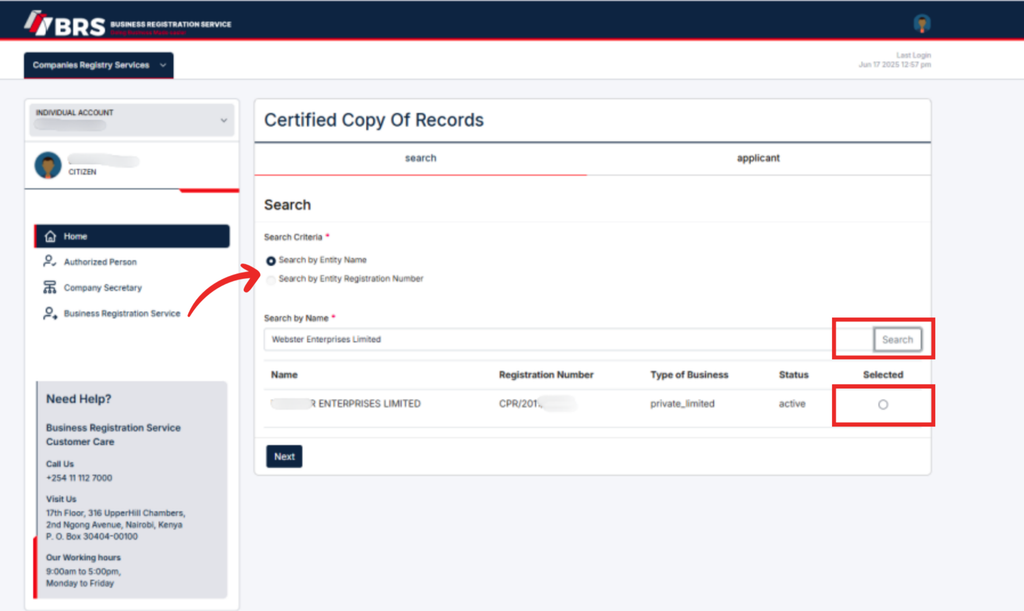
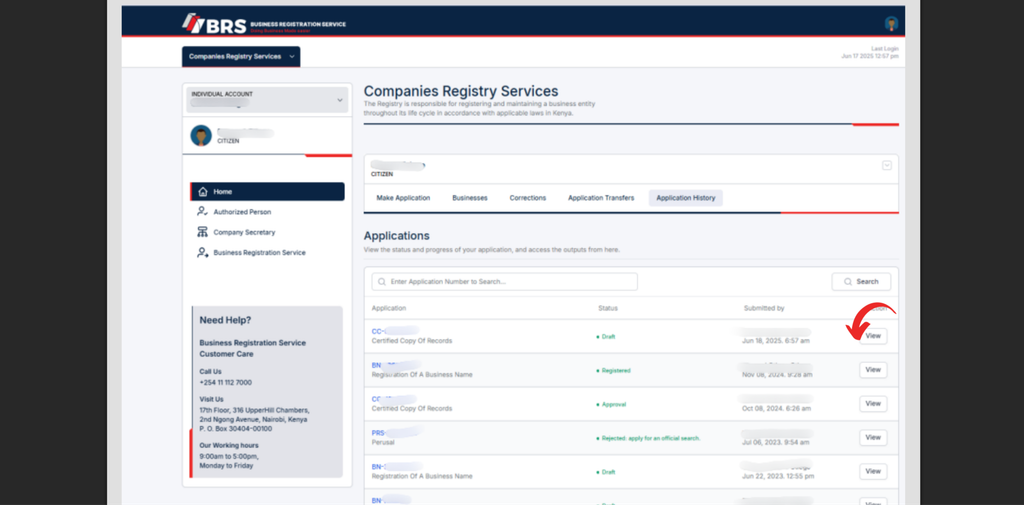
How to Download Company Documents on BRS eCitizen V2 in Kenya
Learn how to download company documents on BRS eCitizen V2, including business registration certificates, company incorporation certificates, and other company records through Application History.
The Business Registration Service (BRS) in Kenya provides an online platform where users can access company registration documents, certificates, and other official records. Through BRS eCitizen V2, individuals and business owners can view the progress of applications, retrieve approved documents, and download or print available records.
If you have completed a business registration or submitted an application through the BRS online portal, you can access the relevant documents through the Application History section. This guide explains how to download company documents on BRS Version 2, including business registration certificates, company incorporation certificates, and other available records. For more information about business registration procedures and related services, explore our business registration guides and articles.
What Is BRS eCitizen V2?
BRS eCitizen V2 is the online platform used to access services provided by Kenya’s Business Registration Service. It allows users to manage applications and access records associated with services offered through the Companies Registry.
The platform helps applicants retrieve available documents without having to search through their original application submissions. Depending on the service and application status, the available records may include a business name registration certificate, company incorporation certificate, and other company registration documents.
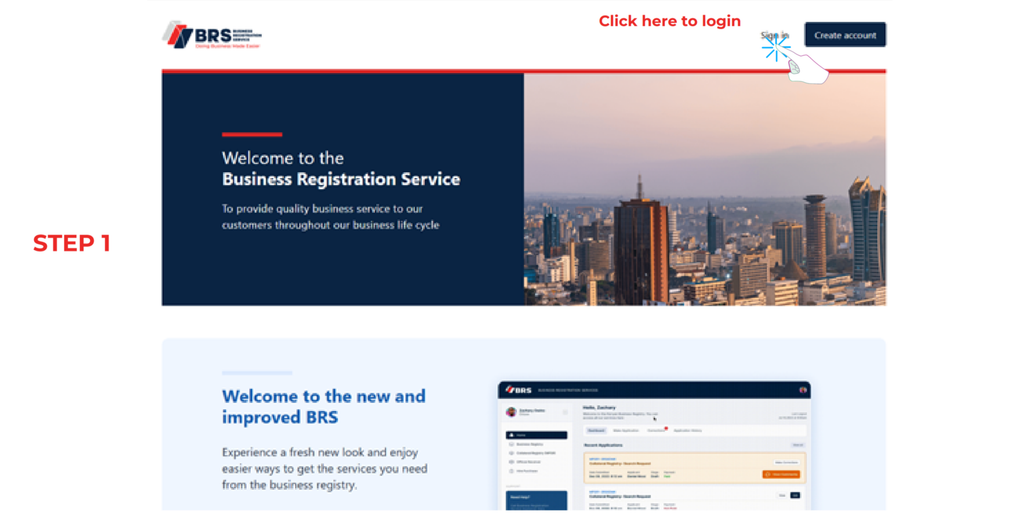
To get started, visit the official BRS Version 2 portal:
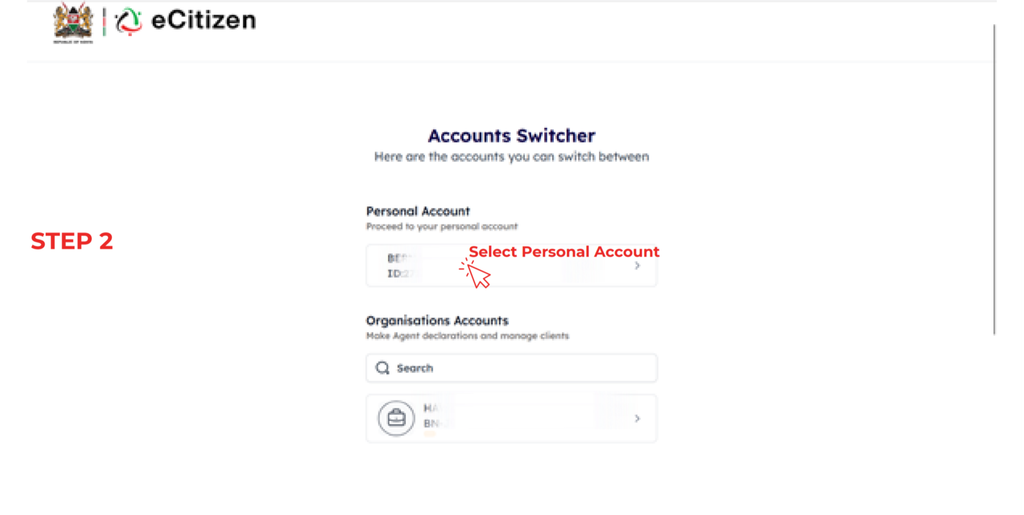
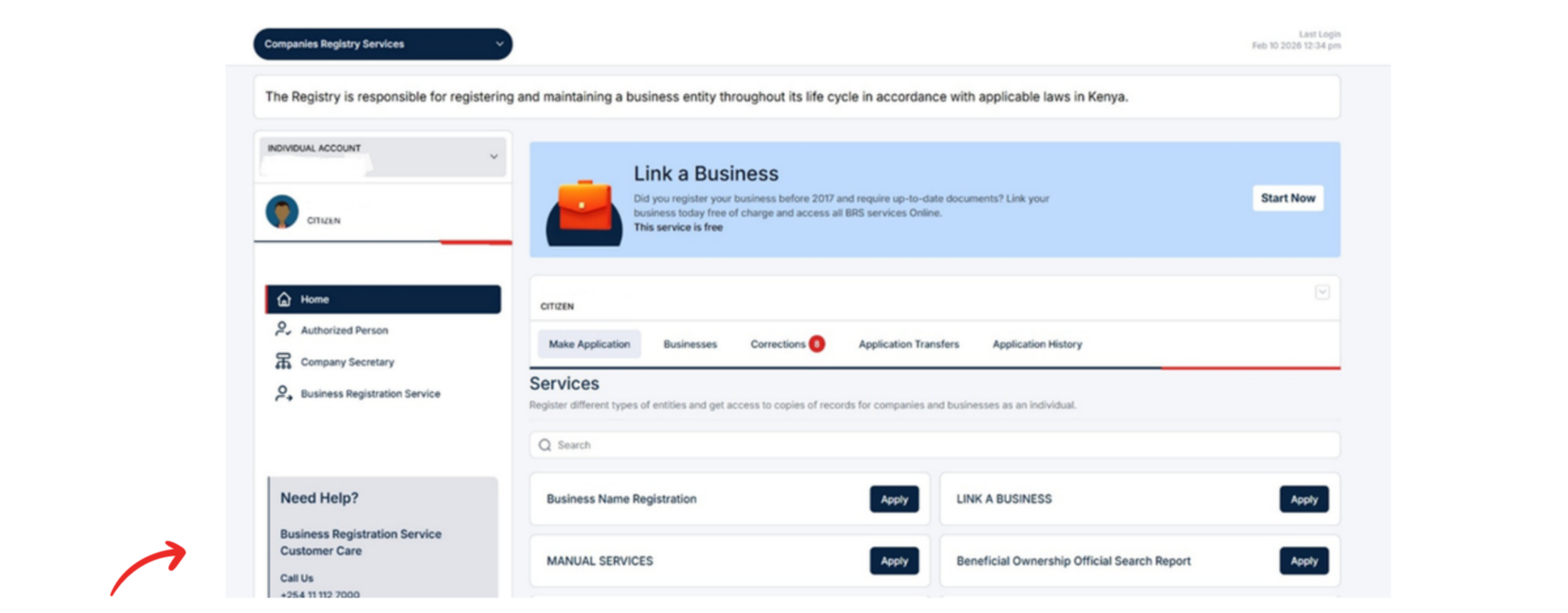
After logging in, locate the Accounts Switcher. This feature allows you to select the account through which you want to access the available services.
Choose the appropriate account associated with your application before proceeding.
Step 1 of How to Download Company Documents on BRS eCitizen V2 in Kenya: Log In to Your eCitizen Account
Step 2: Select Personal Account
In the Accounts Switcher, select Personal Account.
This is the account selection specified in the official BRS guide for accessing application records. Once selected, proceed to the available services.
Make sure you use the eCitizen account associated with the application you want to retrieve. Using a different account may prevent you from finding the relevant application history.
Step 2 of How to Download Company Documents on BRS eCitizen V2 in Kenya: Select Personal Account
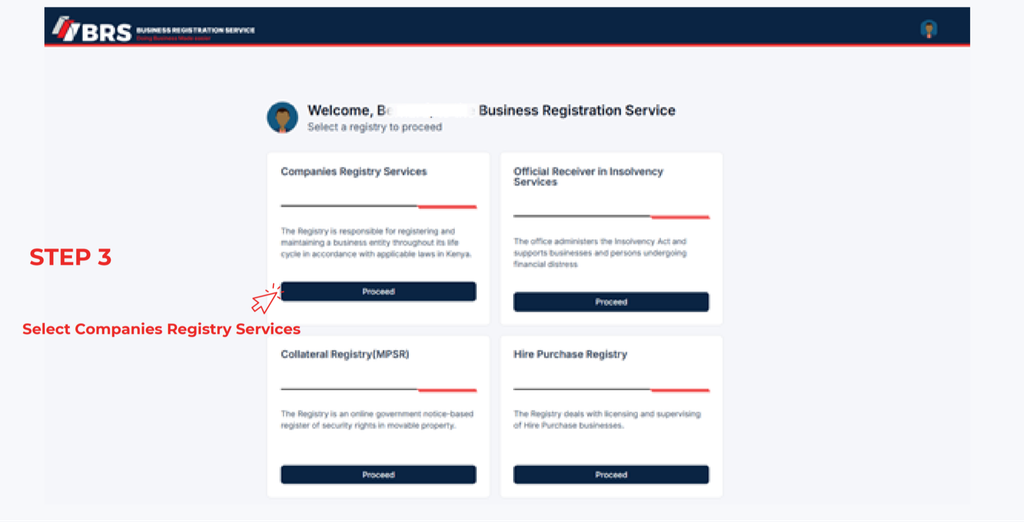
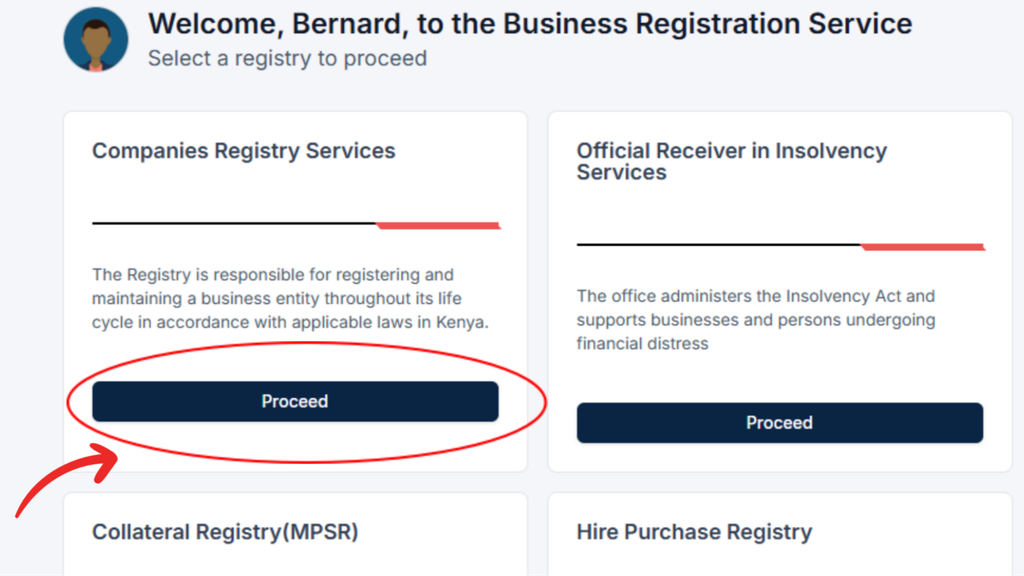
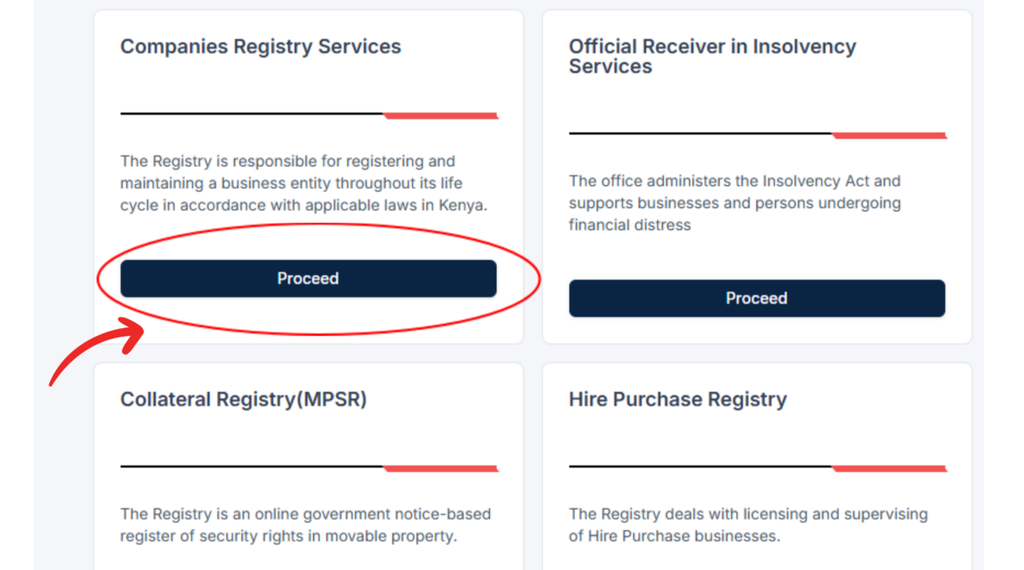
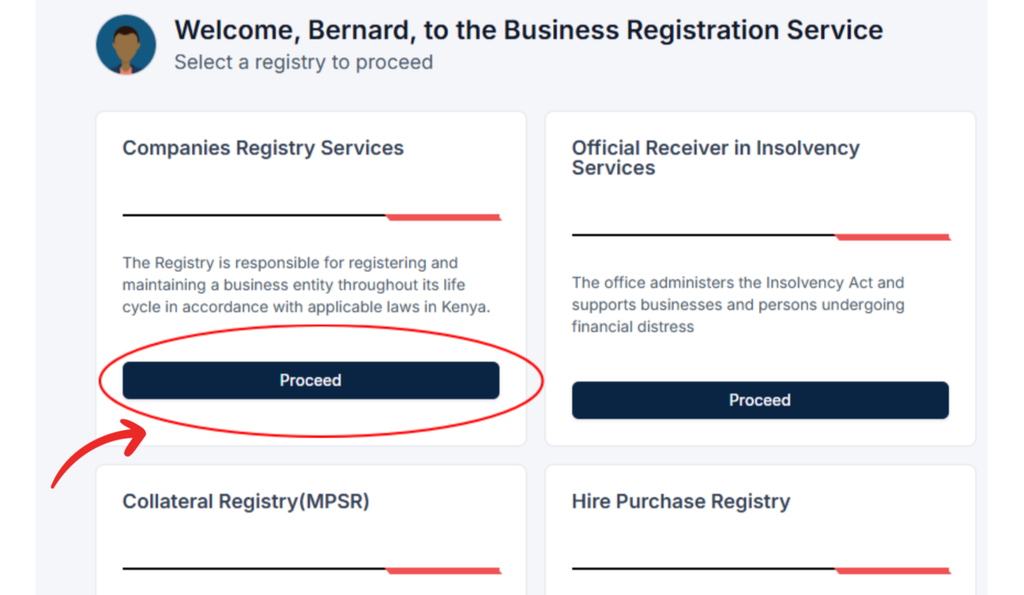
Step 3: Open Companies Registry Services
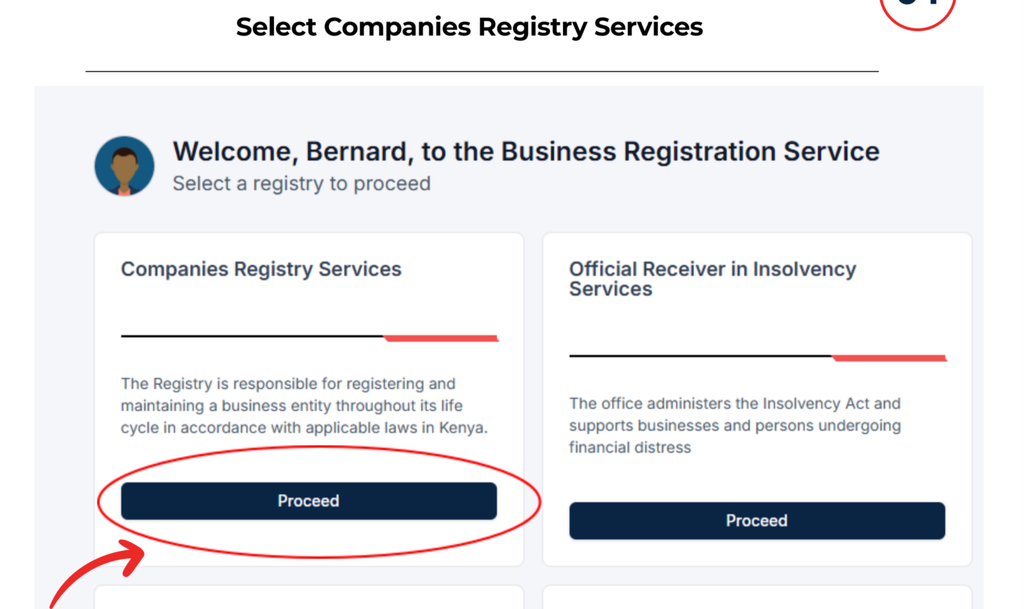
From the available services, select Companies Registry Services and click Proceed.
This section provides access to company registry services and the applications associated with your account.
After proceeding, locate the application management options to continue retrieving your company registration documents.
Step 3 of How to Download Company Documents on BRS eCitizen V2 in Kenya: Open Companies Registry Services
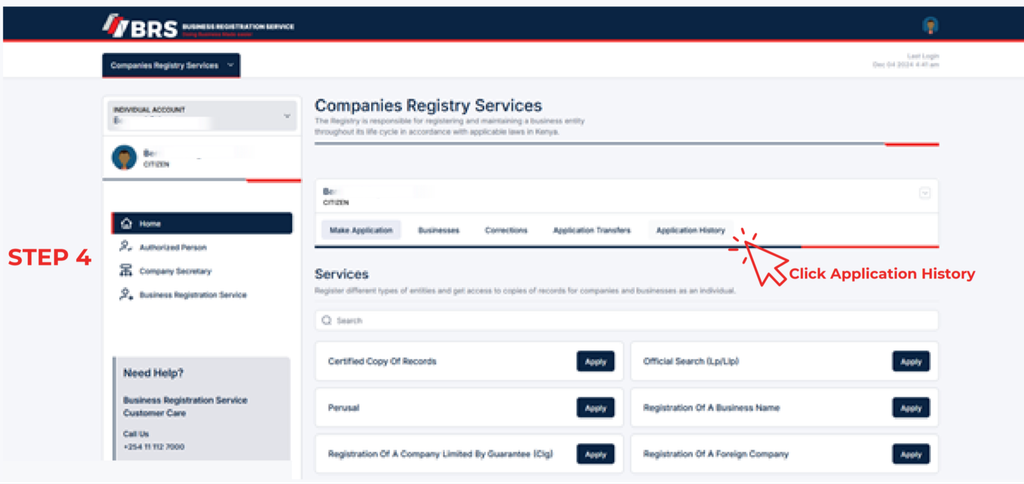
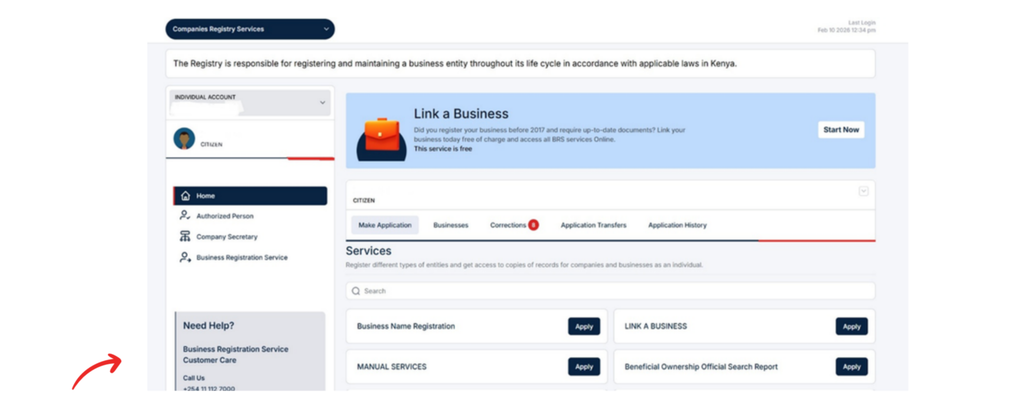
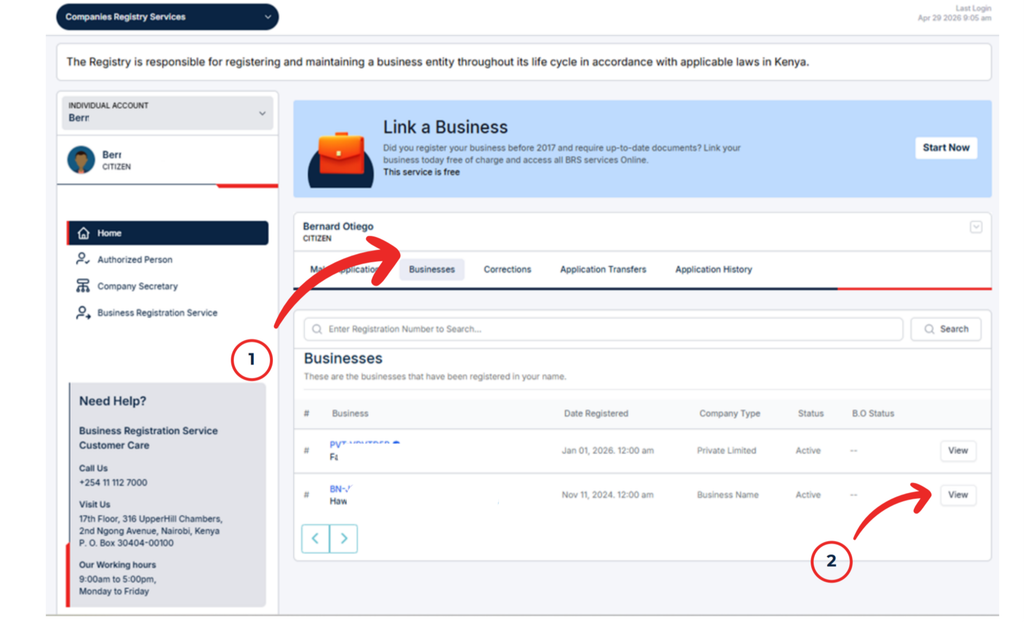
Step 4: Click Application History
On the Companies Registry Services interface, locate Application History, which the official guide identifies as being on the far right of the screen.
Click Application History to view the applications you have lodged through the BRS Version 2 portal.
This section allows you to review the status and progress of your applications and access available outputs.
If you have submitted multiple applications, identify the one associated with the business name, company registration, or other service for which you need documents.
Step 4 of How to Download Company Documents on BRS eCitizen V2 in Kenya: Click Application History
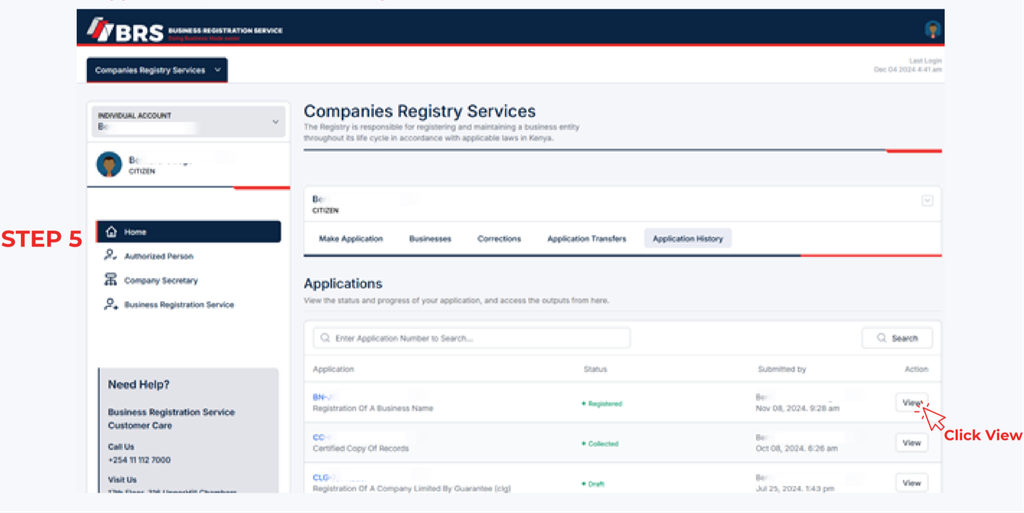
Step 5: Click View Beside the Relevant Application
Once Application History opens, review the listed applications and locate the relevant entry.
Click View beside the application you want to access.
A window will open displaying the records associated with that application. The available documents depend on the application and the outputs provided through the portal.
This step is important because you need to open the correct application before downloading its records.
Step 5 of How to Download Company Documents on BRS eCitizen V2 in Kenya: Click View Beside the Relevant Application
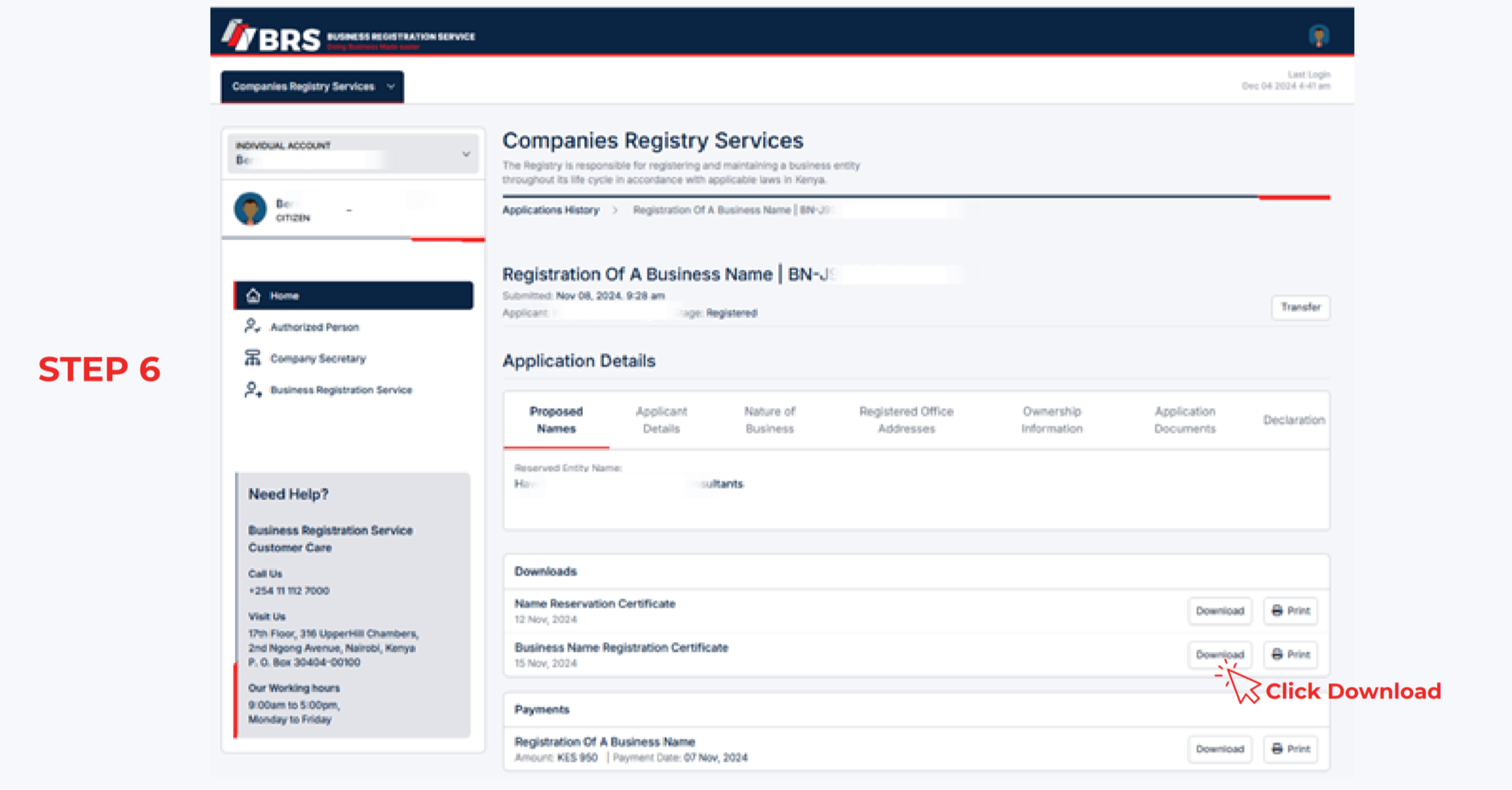
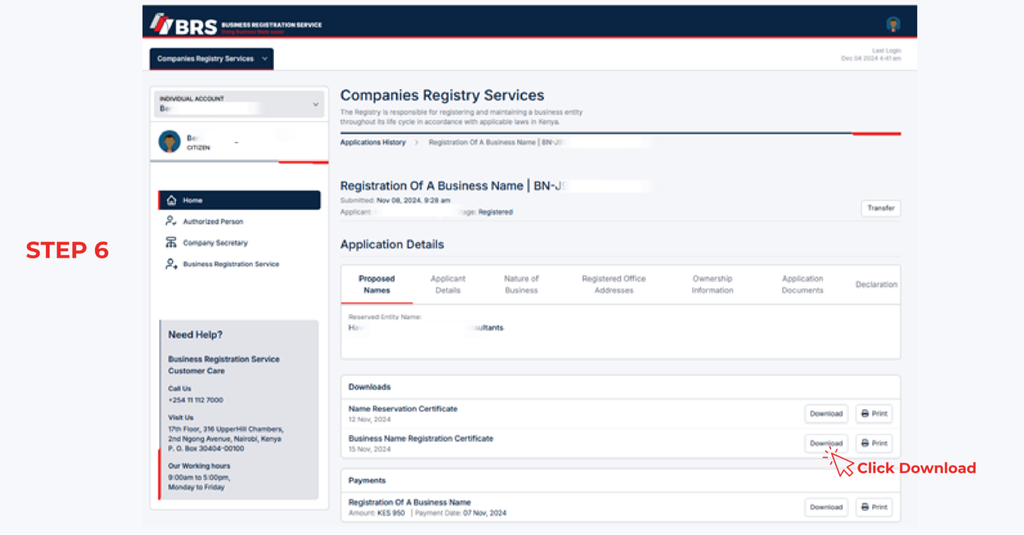
Step 6: Download and Print Your Documents
After clicking View, review the available records and locate the document you need.
Click Download to save the relevant file to your device. If you require a physical copy, open the downloaded document and use your device’s printing function.
Before closing the page, check that you have downloaded the correct document and that the file opens properly.
If several records are available, repeat the process for each document you need.
Step 6 of How to Download Company Documents on BRS eCitizen V2 in Kenya: Download and Print Your Documents
Which Documents Can You Download Through BRS eCitizen V2?
The records available through the portal depend on the service used, the application submitted, and the outputs issued by the Business Registration Service. The official list of entities registered by BRS can help you understand the types of business entities covered by the registry.
Documents you may be able to access include the following:
Business Registration Certificate
A business registration certificate serves as evidence of registration for a business name where such a certificate has been issued. Applicants can look for the relevant record under the application associated with their business name registration.
Company Incorporation Certificate
A company incorporation certificate is an important record confirming that a company has been incorporated. If the certificate is available in your application outputs, you can access it through Application History.
Business Name Registration Certificate
Business owners who registered a business name can check their application records for the corresponding business name registration certificate.
Other Company Registration Documents
The BRS portal may also provide other records or outputs associated with an application. These can include documents generated during the registration process or records made available through the relevant Companies Registry service.
Not every document will necessarily appear under every application. Check the records displayed when you select View.
How to Check Your BRS Application Status
The Application History section is useful not only for downloading documents but also for checking application progress.
After logging in and selecting Companies Registry Services, open Application History. The portal displays applications lodged through the relevant account, allowing you to review their status and progress.
If your business registration application is still being processed, the required certificate or other output may not yet be available for download.
In that situation, check the application status and return to the relevant record when the necessary output becomes available. If you need clarification about a pending application, contact the Business Registration Service through its official communication channels.
Troubleshooting BRS Certificate Downloads
Sometimes users may have difficulty finding or downloading company registration documents. The following checks can help resolve common problems.
Application Not Appearing in Application History
Confirm that you are logged in to the correct eCitizen account and have selected Personal Account, as specified in the official BRS guide.
If the application still does not appear, check whether it was submitted through another account or whether you have selected the appropriate registry service.
Certificate Not Available for Download
Review the application’s status and check whether the relevant output has been issued. An application that is still being processed may not yet have a downloadable certificate.
If the application appears complete but the document remains unavailable, contact BRS for assistance.
Downloaded Document Will Not Open
Try downloading the document again and opening it with a compatible PDF reader or browser. If you are using a mobile device, check that the file was saved successfully and that you can locate it in your downloads folder.
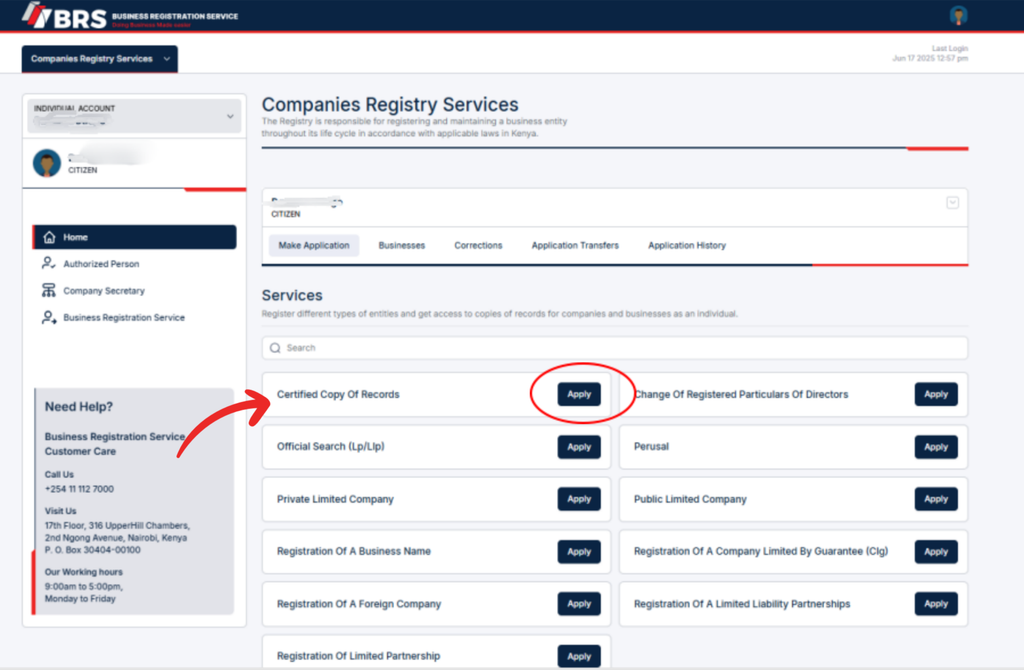
Need a Certified Copy of Company Records
Downloading an existing document is different from applying for a certified copy of records. If you need a certified copy for official, legal, banking, or compliance purposes, check the applicable Companies Registry service and its requirements.
Other BRS Services and Company Registration Guides
The Business Registration Service provides several services beyond downloading certificates. Depending on your needs, the following resources may help you complete related company registry procedures.
Before submitting a new application or requesting an additional service, review the applicable requirements and charges. The official BRS Companies Registry fee schedule provides information about relevant registry fees.
Contact the Business Registration Service
If you cannot access your application, locate the required document, or complete the BRS certificate download process, contact the Business Registration Service using the contact details provided in its official guide.
When requesting assistance, explain the problem clearly and provide the relevant application details requested by BRS. Avoid sharing your password or other sensitive login credentials.
Frequently Asked Questions
1. How do I download my company incorporation certificate from eCitizen?
Log in to the BRS eCitizen V2 portal, select Personal Account, open Companies Registry Services, and click Application History. Find the relevant application, click View, and download the available company incorporation certificate.
2. Why can’t I find my business registration certificate on BRS eCitizen V2?
The certificate may not be available because you are using the wrong eCitizen account, have selected the wrong registry service, or the application has not yet produced a downloadable output. Check your application history and status before contacting BRS for assistance.
3. Can I print company documents after downloading them from BRS?
Yes. According to the official BRS guide, users can download and print available records. After downloading the required document, open the file on your device and select the print option.
How to Use the MPSR Collateral Registry in Kenya: A Step-by-Step Guide
Learn how to use the MPSR collateral registry in Kenya, register security interests in movable property, complete online applications, search notices, and understand the Movable Property Security Rights Act.
The Movable Property Security Rights (MPSR) Registry is an electronic government register in Kenya that allows users to register and search notices of security rights in movable property. Administered by the Business Registration Service (BRS), the registry supports secured transactions by making information about registered security interests publicly accessible.
The collateral registry in Kenya provides a way for creditors to record security interests in movable assets, while businesses and individuals can use eligible movable property as collateral when seeking financing. Understanding the registration process, the information required, and how to access the online system can help users complete their applications accurately.
This guide explains how to access the MPSR registry, submit an initial notice, enter the required information, and review application records. For more practical business registration information, users can explore the business registration and compliance guides.
What Is the MPSR Collateral Registry in Kenya?
The MPSR Registry is an online, notice-based public register of security rights in movable property. It operates under Kenya’s Movable Property Security Rights Act, 2017, which provides a legal framework for using movable assets to secure obligations.
Unlike a system that focuses exclusively on land or buildings, the movable property security rights framework enables eligible movable assets to be used in secured transactions, subject to applicable legal requirements.
Role of the Business Registration Service
The Business Registration Service is a Kenyan State Corporation established under the Business Registration Service Act, 2015. Its responsibilities include administering laws and policies relating to the registration of companies, partnerships, business names, and other relevant matters, including security rights.
Through the MPSR system, the BRS provides electronic services that allow users to submit notices and search the registry without relying entirely on paper-based processes.
Businesses that need to verify the types of entities covered by the registration system can consult the official BRS list of registered entities.
Purpose of the Electronic Collateral Registry
The electronic collateral registry supports several important functions:
Recording notices of security interests in movable property.
Providing public access to registered notices.
Supporting lenders and borrowers involved in secured transactions.
Enabling searches for previously registered notices.
Maintaining application histories for users.
Improving transparency in movable asset financing.
It is important to understand that registering a notice does not, by itself, guarantee that a debt will be repaid or establish every aspect of a creditor’s legal rights. The underlying security agreement, applicable law, and relevant registration requirements remain important.
What Is Movable Property Collateral?
Movable property collateral refers to eligible assets that can be used to secure an obligation without being permanently attached to land.
Depending on the applicable law and the terms of the transaction, movable assets may include equipment, machinery, inventory, vehicles, agricultural assets, receivables, and certain other forms of personal property.
Examples of Assets Used as Collateral
Businesses may use different categories of movable property to support financing arrangements.
Machinery and equipment: Assets used in manufacturing, construction, agriculture, and other commercial activities.
Inventory: Goods held for sale or used in business operations.
Vehicles: Eligible vehicles used for commercial or personal purposes.
Receivables: Money owed to a business by its customers.
Agricultural assets: Certain livestock, crops, and related assets, where legally eligible.
The precise assets that may be offered as security depend on the transaction and applicable legislation. Borrowers should confirm that the asset can legally be used as collateral and that the security agreement adequately identifies it.
Why Is the MPSR Registry Important?
The collateral registry plays an important role in secured transactions in Kenya by providing a central electronic location for recording and searching notices.
Benefits for Borrowers
Businesses and individuals who own eligible movable assets may have additional options when seeking credit. They may not need to rely exclusively on land or buildings to support a financing arrangement.
For small businesses, this framework can be particularly relevant when machinery, inventory, vehicles, or receivables form a substantial part of their assets.
However, the availability of financing depends on the lender’s assessment, the value and eligibility of the collateral, the borrower’s financial position, and the terms of the loan.
Benefits for Creditors
Creditors can use the registry to record notices associated with security interests and search for existing notices.
These searches can help creditors assess potential competing claims involving particular grantors or collateral. The registry’s public notice function can therefore support better-informed lending decisions.
Transparency in Secured Transactions
The public notice registry improves access to information about registered security interests. Nevertheless, a search result should be interpreted carefully. A registry search is not necessarily a complete determination of ownership, enforceability, priority, or the current balance of a secured obligation.
Requirements for MPSR Online Registration
Before starting an MPSR online registration application, prepare the information required for the relevant transaction.
The official MPSR User Guide identifies several categories of information that applicants must provide when submitting an initial notice. Applicants who need the original procedural instructions can consult the MPSR User Manual and Collateral Registry Guide in Kenya.
Information About the Grantor
The grantor is the person or organisation that grants a security right in movable property.
Depending on the applicant’s circumstances, the system may require the grantor’s category and identifying particulars. The official guide illustrates selecting an appropriate type, such as Kenyan Citizen, before entering the remaining details.
Applicants should ensure that the information accurately identifies the grantor and corresponds with the relevant transaction documents.
Information About the Creditor
The application also requires the particulars of the creditor, who holds or is intended to hold the security interest under the relevant arrangement.
Enter the requested creditor information carefully. Errors in names or identifying particulars may create difficulties when searching for or interpreting a registered notice.
Description of the Collateral
The collateral description identifies the movable property covered by the notice.
Provide a description that corresponds with the security agreement and the assets involved in the transaction. The information should be sufficiently accurate to help identify the collateral, in accordance with the applicable legal and system requirements.
Secured Amount and Effectiveness Period
The application process includes fields for the maximum amount secured and the period of effectiveness.
These details should be completed using the information applicable to the transaction. Applicants should not assume that entering an amount or an effectiveness period independently determines the full scope or duration of their contractual rights.
Review the governing legislation and relevant transaction documents whenever the correct entry is uncertain.
How to Register an Initial Notice in the MPSR Registry
The following steps are based on the official Collateral Registry User Manual published by the Business Registration Service.
Step 1: Access the BRS Online Services
Visit the official Business Registration Service website at brs.go.ke and navigate to the relevant collateral registry services.
The registry is accessed through the online government service environment. Ensure that you are using the official platform before entering personal or business information.
Step 2: Sign In Through eCitizen
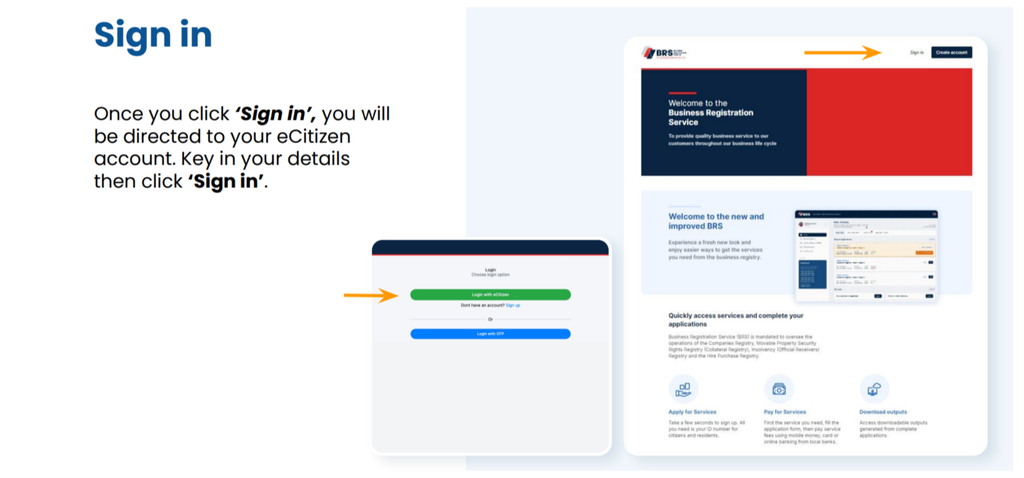
Select the Sign in option. You will be directed to your eCitizen account, where you must enter your login credentials.
Follow the instructions displayed on the screen to authenticate your account.
If you cannot access your account, resolve the login issue through the appropriate official support channel before proceeding with the application.
Step 2 of How to Use the MPSR Collateral Registry in Kenya: A Step-by-Step Guide: Sign In Through eCitizen
Step 3: Complete the One-Time Password Verification
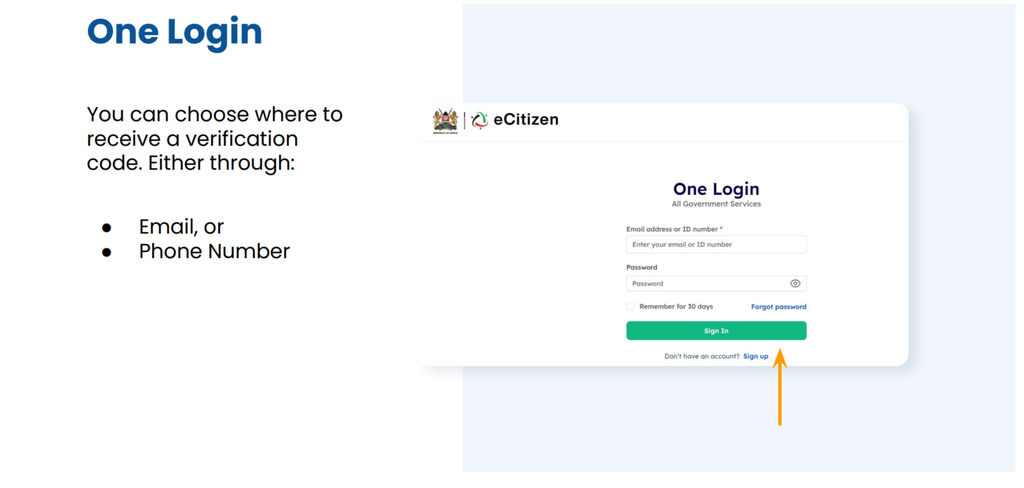
The sign-in process may require a one-time password (OTP).
According to the user guide, you can choose to receive the verification code through either your registered email address or your phone number.
If you choose email verification, enter the OTP sent to your email and select Next. If you choose phone verification, enter the code sent to your phone and select Next.
After successful verification, select Continue to proceed to the dashboard.
Never share your OTP or account password with an unauthorised person.
Step 3 of How to Use the MPSR Collateral Registry in Kenya: A Step-by-Step Guide: Complete the One-Time Password Verification
Step 4: Open the Collateral Registry
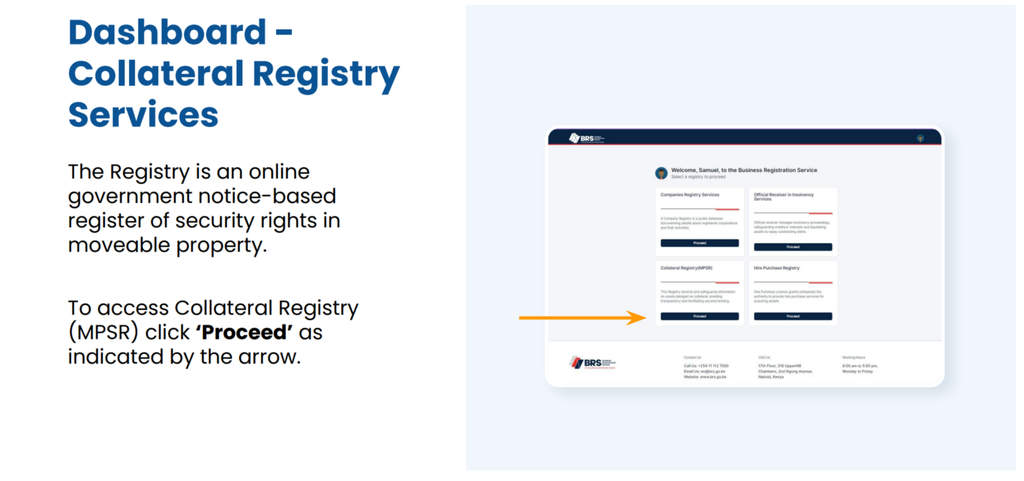
From the dashboard, locate the Collateral Registry Services section.
Select Proceed to access the MPSR registry system.
The registry provides access to services for submitting notices and searching existing records. The precise appearance of the dashboard may change as the government updates its online services.
Step 4 of How to Use the MPSR Collateral Registry in Kenya: A Step-by-Step Guide: Open the Collateral Registry
Step 5: Select the Initial Notice Application
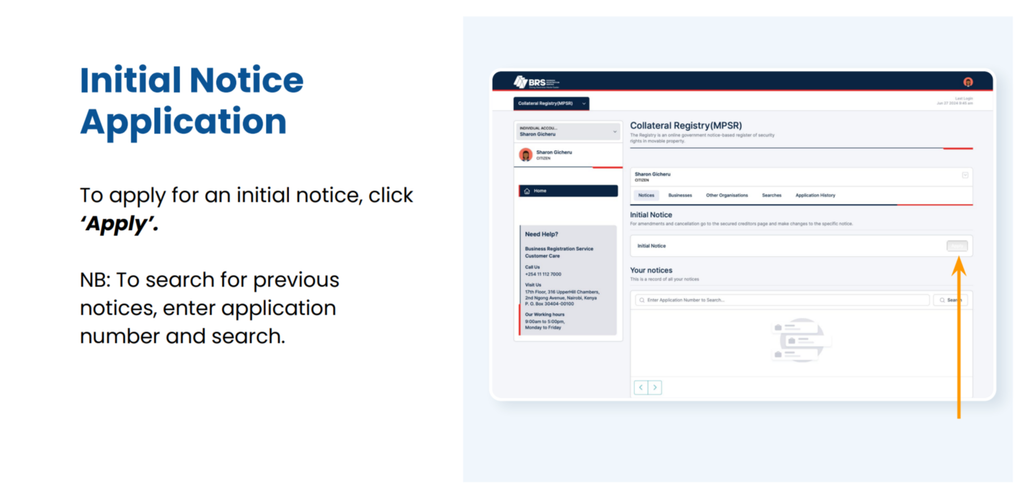
To register a new notice, select Apply under the initial notice application section.
If you need to locate an existing application or notice, the system also provides a search function where you can enter an application number, as applicable.
Before creating a new application, check whether the transaction has already been submitted to avoid unnecessary duplicate filings.
Step 5 of How to Use the MPSR Collateral Registry in Kenya: A Step-by-Step Guide: Select the Initial Notice Application
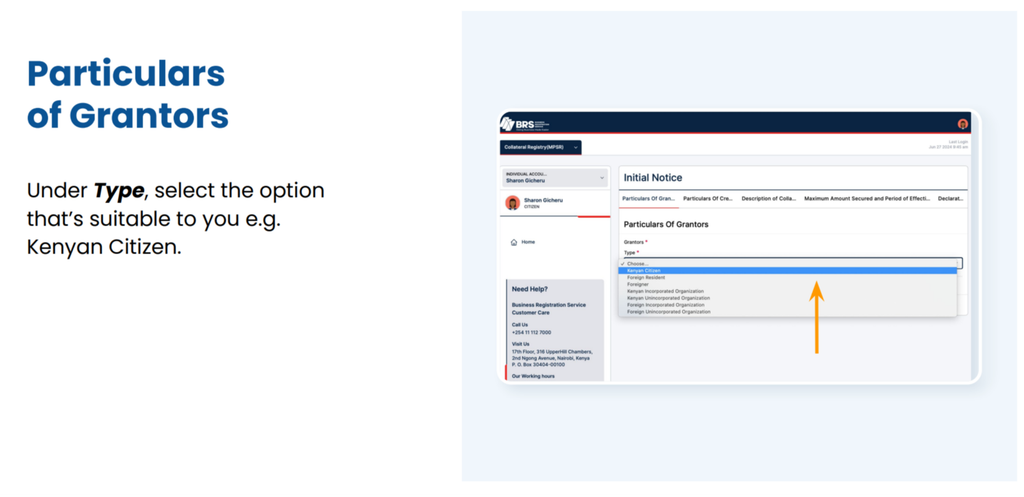
Step 6: Enter the Grantor’s Particulars
Select the appropriate grantor type from the available options.
For example, the user guide illustrates choosing Kenyan Citizen where that category applies. Other applicants should select the option that accurately reflects their circumstances.
Enter the remaining required details and select Next.
Check that the information matches the relevant identification or business records. Incorrect grantor particulars can make a notice more difficult to identify and may have legal consequences.
Step 6 of How to Use the MPSR Collateral Registry in Kenya: A Step-by-Step Guide: Enter the Grantor’s Particulars
Step 7: Enter the Creditor’s Particulars
Provide the creditor’s details in the fields presented by the system.
Confirm that the creditor is correctly identified and that the particulars are consistent with the transaction documentation.
Oncethe required fields are complete, select Next to continue.
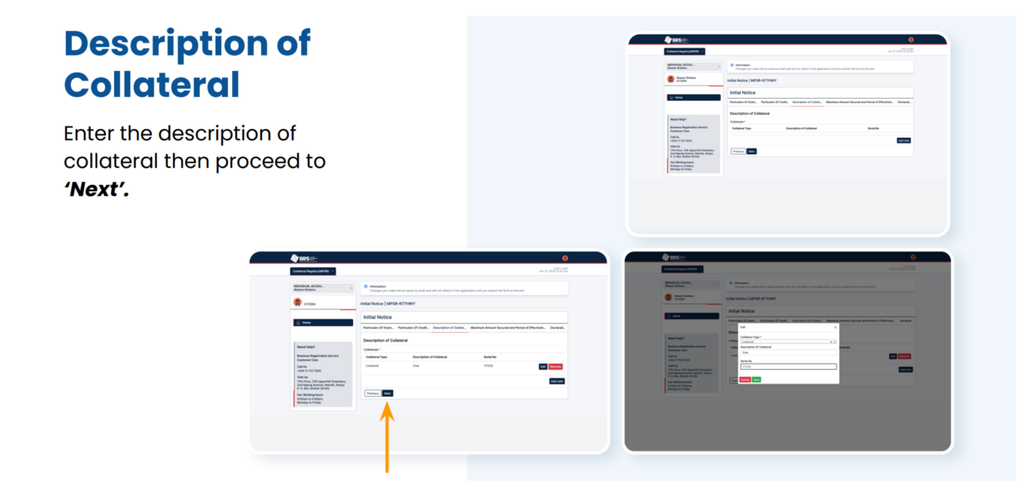
Step 8: Describe the Collateral
Enter the description of the movable property covered by the security arrangement.
The description should correspond with the underlying agreement and identify the relevant assets as accurately as the applicable requirements demand.
If several assets are involved, follow the system’s instructions for describing them. Avoid using vague descriptions that could create uncertainty about the property covered by the notice.
Proceed to the next section after reviewing the collateral information.
Step 8 of How to Use the MPSR Collateral Registry in Kenya: A Step-by-Step Guide: Describe the Collateral
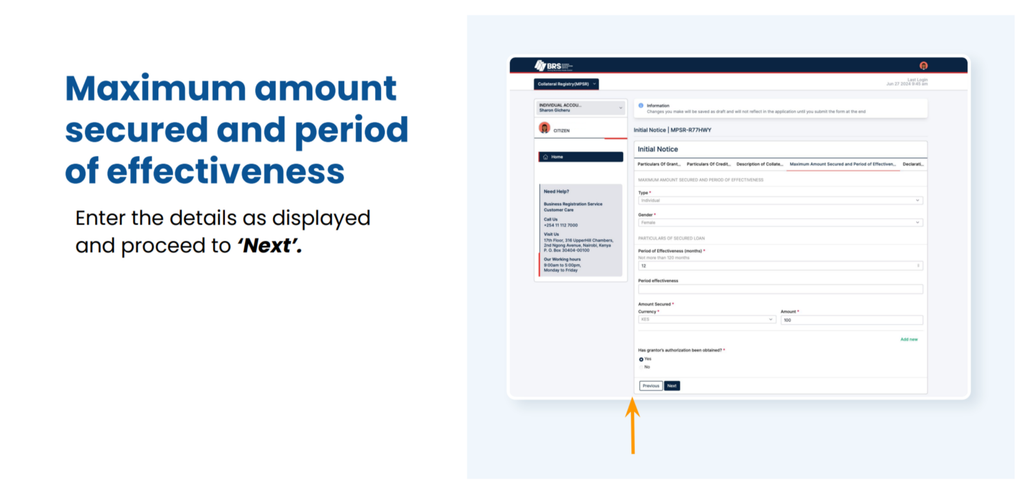
Step 9: Enter the Maximum Secured Amount and Effectiveness Period
Complete the fields for the maximum amount secured and the period of effectiveness.
Use the correct figures and dates or duration information required by the system and supported by the transaction documents.
Where the security arrangement contains complicated financial terms, multiple obligations, or changing collateral, obtain appropriate legal advice before submitting the notice.
Step 9 of How to Use the MPSR Collateral Registry in Kenya: A Step-by-Step Guide: Enter the Maximum Secured Amount and Effectiveness Period
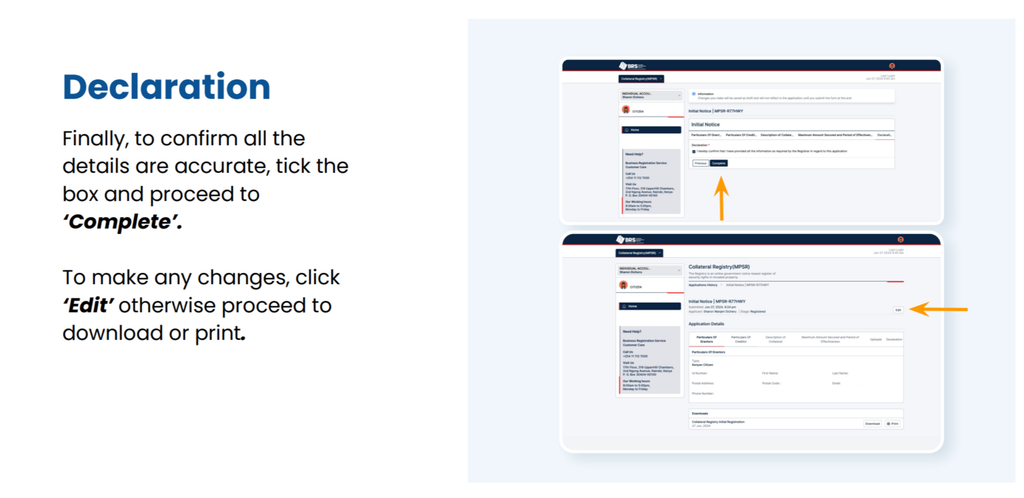
Step 10: Review the Declaration
Before completing the application, carefully review the information entered in each section.
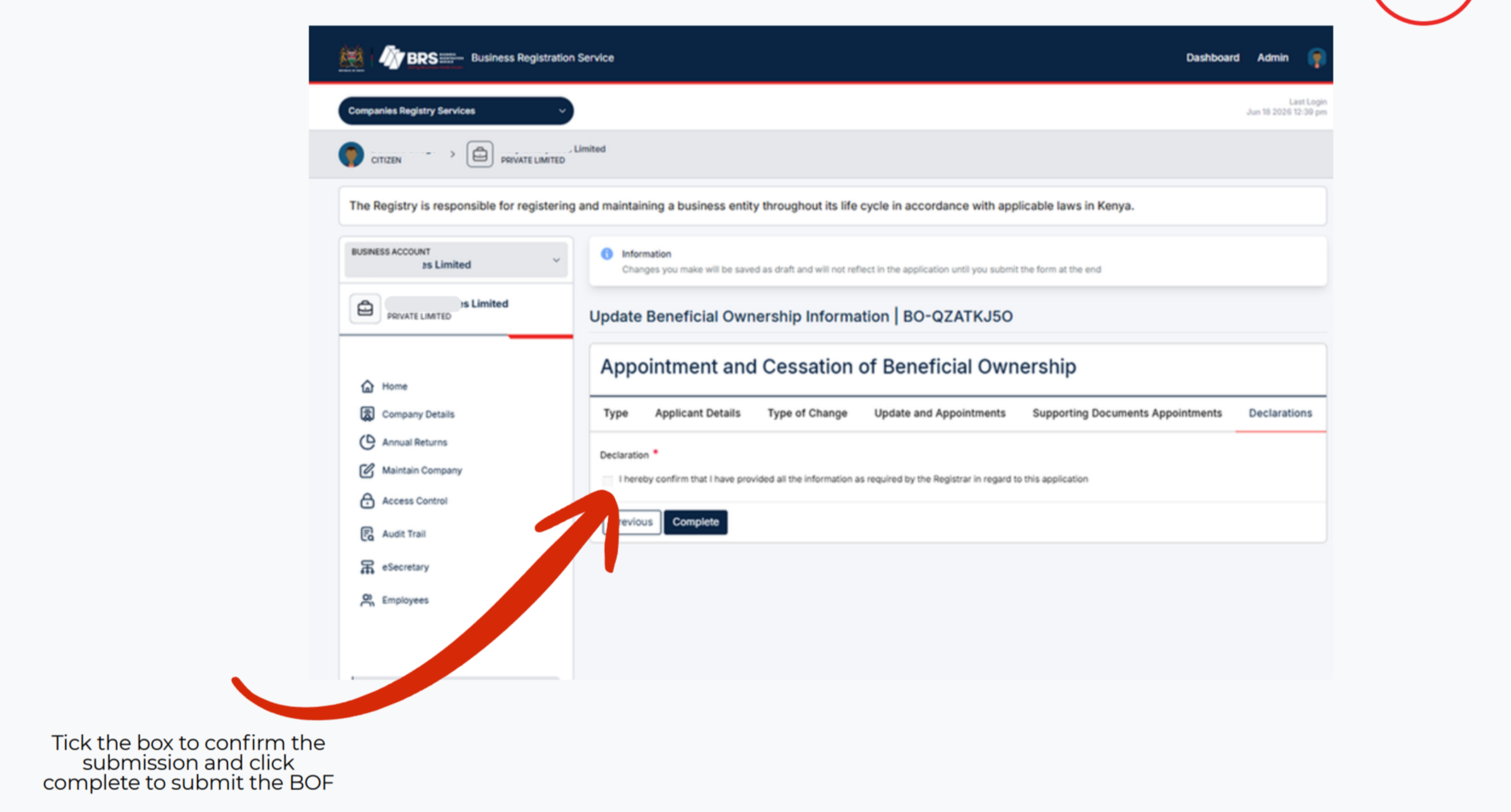
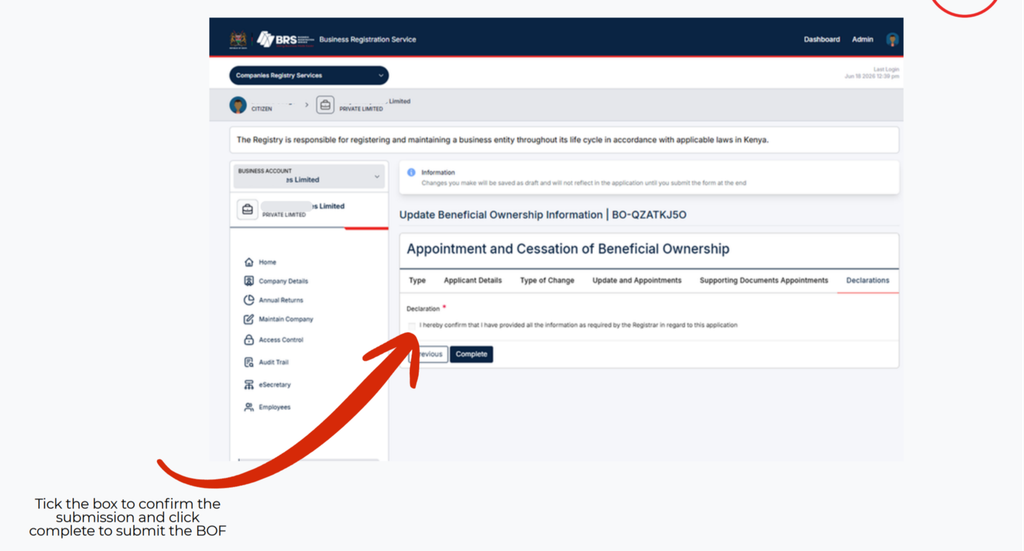
The system provides an opportunity to confirm that the particulars are accurate. Tick the declaration box as instructed and select Complete when you are satisfied with the details.
If you identify an error, select Edit and correct it before finalising the application.
Step 10 of How to Use the MPSR Collateral Registry in Kenya: A Step-by-Step Guide: Review the Declaration
Step 11: Download or Print the Application Record
After completing the application, use the available options to download or print the relevant record.
Keep copies of the confirmation and associated transaction documents for your records. Where the system provides a reference or application number, retain it for future searches and correspondence.
A completed electronic submission should not automatically be interpreted as a guarantee that every legal requirement has been satisfied. Check the system’s confirmation and any further instructions provided.
Step 11 of How to Use the MPSR Collateral Registry in Kenya: A Step-by-Step Guide: Download or Print the Application Record
How to Search the Kenya Collateral Registry
The MPSR Registry also supports searches for previously registered notices.
A registry search can help a lender, borrower, adviser, or other authorised user investigate notices associated with a particular transaction.
Search Using an Application Number
Where you already have an application number, enter it in the relevant search field and submit the search.
This can help you locate a particular application or notice without having to start a new registration process.
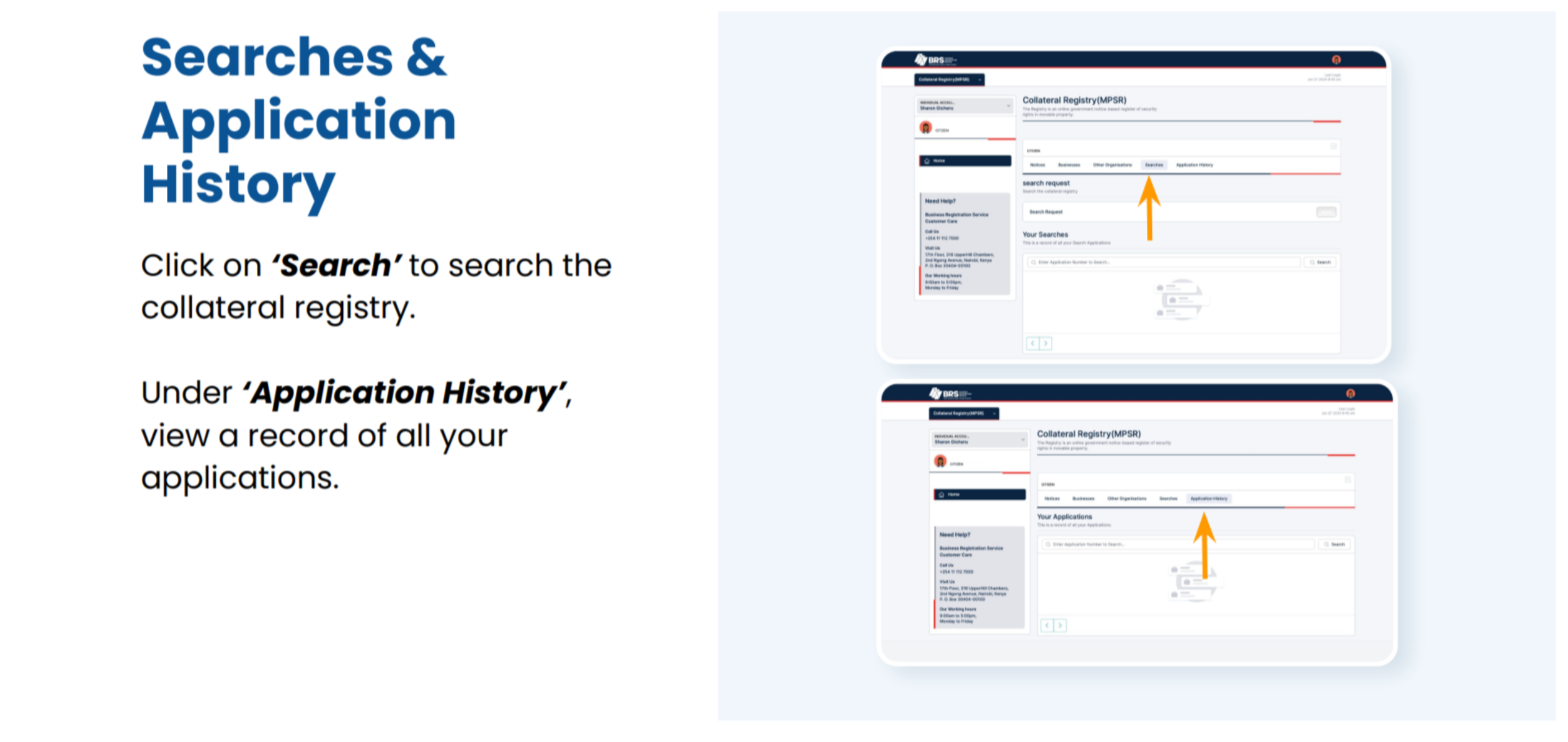
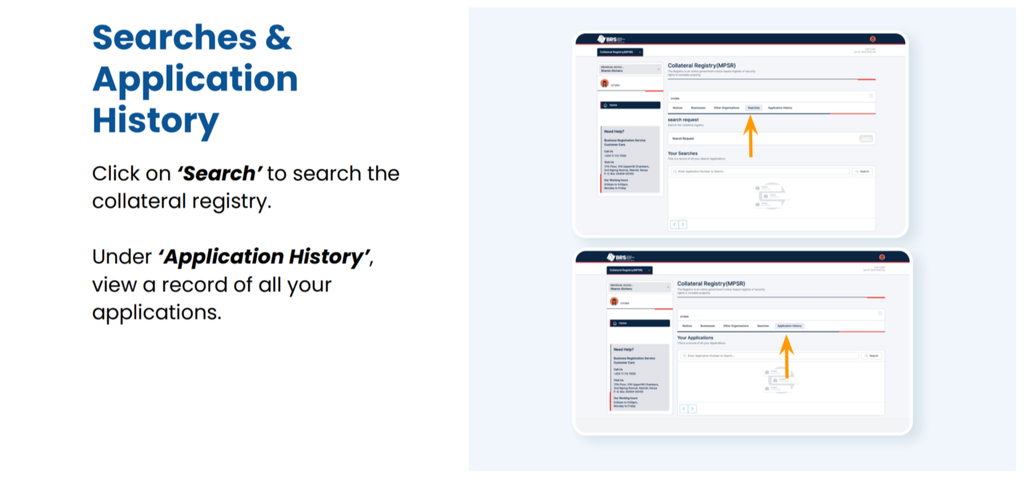
Review the Application History
The user guide identifies an Application History section where users can view a record of their applications.
This function can be useful for tracking previously submitted applications and retrieving relevant information when following up on a transaction.
Search Before Extending Credit
Creditors may wish to search the registry as part of their due diligence before accepting movable property as security.
A search may reveal existing notices that warrant further investigation. However, users should not assume that a search alone conclusively establishes whether an asset is unencumbered or determines the legal priority of competing claims.
Where necessary, seek legal advice and review the underlying agreements and relevant statutory provisions.
Businesses and Other Organisations in the MPSR System
The official user guide also describes sections for Businesses and Other Organisations.
The Businesses section allows users to view details of listed businesses registered in their name, as available through the platform.
The Other Organisations section provides an option to add other organisations for MPSR-specific purposes.
Users should follow the instructions displayed within their accounts and ensure that the correct organisation is associated with the intended transaction. These functions should not be confused with the separate procedures for incorporating a company or registering a business name.
Understanding Security Interest Registration in Kenya
Security interest registration is an important part of the framework governing secured transactions, but the registration process should be understood in its proper legal context.
The Movable Property Security Rights Act, 2017, provides the principal statutory framework for security rights in movable property. The applicable legal rules determine how security rights are created, made effective against third parties, prioritised, and enforced.
Registration Is Not the Same as Creating a Security Agreement
The underlying security agreement and the registry notice serve different functions.
A security agreement documents the arrangement between the relevant parties. A registry notice provides public notice of a claimed security interest.
The requirements for creating an enforceable security right and making it effective against third parties must be assessed under the applicable legislation. Filing a notice should not be treated as a substitute for preparing the necessary agreement.
Priority and Competing Security Interests
When more than one creditor claims rights over the same collateral, questions of priority may arise.
The outcome can depend on statutory priority rules, the circumstances of each transaction, the type of collateral, and other legally relevant factors. Registration timing may be important, but it should not be treated as the only factor in every case.
Creditors should conduct appropriate due diligence and obtain legal advice where competing claims or complex security arrangements exist.
Keep Registry Information Accurate
Applicants should take care when entering grantor details, creditor particulars, collateral descriptions, secured amounts, and effectiveness periods.
If information needs to be changed, users should consult the available registry procedures and applicable law to determine the correct method. Do not assume that editing an already submitted notice is always possible or that every correction has the same legal effect.
The BRS website lists the contact number +254 011 112 7000 in the referenced user guide. Confirm the current contact details through the official website before relying on them.
The manual provides procedural guidance for signing in, accessing the collateral registry, submitting an initial notice, entering the relevant particulars, completing the declaration, and reviewing application history.
Because online systems and administrative procedures can change, follow the instructions currently displayed on the official platform if they differ from older screenshots or documentation.
For questions about fees for other company registration services, the official BRS companies registry fee schedule provides a relevant reference. Do not assume that company registration fees also apply to MPSR notices.
Frequently Asked Questions About the MPSR Registry
1. What is the MPSR Registry in Kenya?
The MPSR Registry is an electronic, notice-based government register of security rights in movable property. It is administered by the Business Registration Service and supports the registration and searching of notices relating to secured transactions.
2. How do I register a security interest in the MPSR Registry?
Access the official BRS online services, sign in through eCitizen, complete any required OTP verification, and open Collateral Registry Services. Select Apply for an initial notice, enter the grantor and creditor particulars, describe the collateral, provide the secured amount and effectiveness period, review the declaration, and complete the application.
3. Can I search the collateral registry before accepting an asset as security?
Yes. The MPSR Registry provides search functionality for existing notices. A search can support due diligence before accepting movable property as collateral. However, search results should be assessed alongside the underlying agreements and applicable legal requirements, particularly where ownership, competing claims, or priority is uncertain.
LLP Registration in Kenya: Requirements, Procedure, Cost and Duration
Learn about LLP registration in Kenya, including requirements, online registration procedure, Form LLP-1, partner details, registration fees, costs, duration, and post-registration compliance.
Registering a Limited Liability Partnership (LLP) in Kenya provides professionals and business partners with a formal business structure that combines elements of a traditional partnership and a company. A limited liability partnership is a separate legal entity, offering partners a degree of protection from personal liability for the obligations of the business, subject to applicable law.
The Business Registration Service (BRS) administers LLP registration in Kenya through the government’s online registration system. Applicants must provide the proposed business name, partner and manager details, business address, nature of business, and other required documentation.
This guide explains the LLP registration procedure in Kenya, the documents and information required, registration fees, online application steps, and ongoing compliance obligations. For more guidance on business formation and regulatory procedures, explore the business registration and compliance articles.
What Is a Limited Liability Partnership in Kenya?
A limited liability partnership is a business structure that combines features of a partnership with the separate legal identity of a company. Under this arrangement, the LLP exists as a legal entity distinct from its individual partners.
The structure may be particularly suitable for professional firms and businesses operated by two or more partners who want a formal legal framework for their operations.
Benefits of a Limited Liability Partnership
Registering a limited liability partnership in Kenya offers several potential benefits:
Separate legal identity: The LLP exists independently of its partners.
Limited liability protection: Partners generally receive protection against certain liabilities of the LLP, subject to applicable legal exceptions.
Professional business structure: The arrangement may suit professional practices, including eligible legal and consultancy firms.
Continuity: The LLP can continue operating as a legal entity independently of changes involving individual partners, subject to the law.
Formal business operations: Registration establishes the partnership as a recognised legal entity.
An LLP is not automatically the best structure for every business. Applicants should consider the nature of their activities, professional regulations, tax obligations, and the legal responsibilities associated with the partnership. The Business Registration Service’s list of registered entities provides additional context on the types of business structures recognised in Kenya.
LLP Registration Requirements in Kenya
Understanding the LLP registration requirements before starting an application can help reduce errors and delays. Applicants should prepare the relevant information for the partners, manager, proposed business name, and business premises.
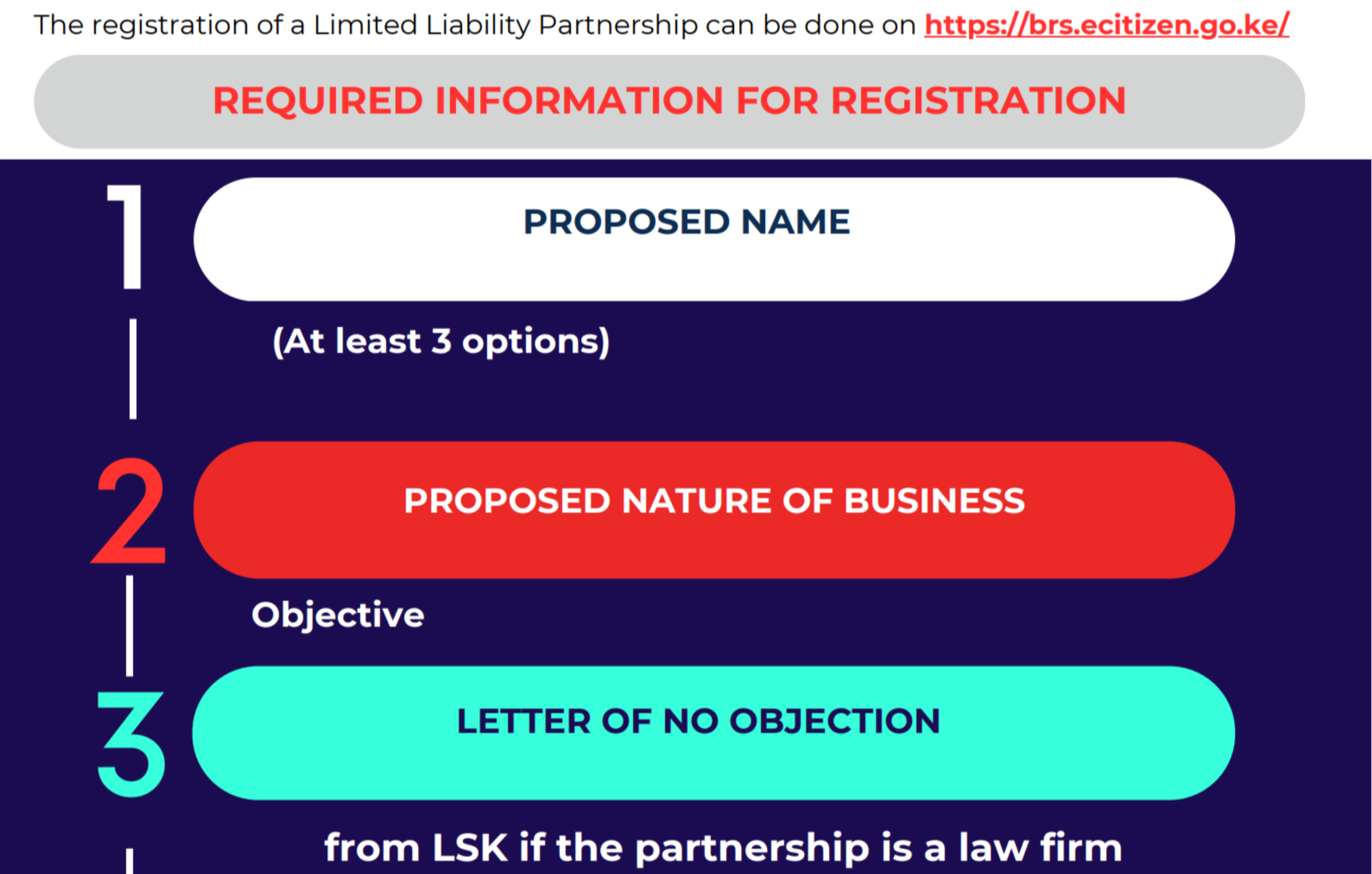
1. Proposed LLP Business Name
Applicants should prepare at least three proposed names for the limited liability partnership. Providing alternatives can help if the preferred name is unavailable or does not satisfy the applicable naming rules.
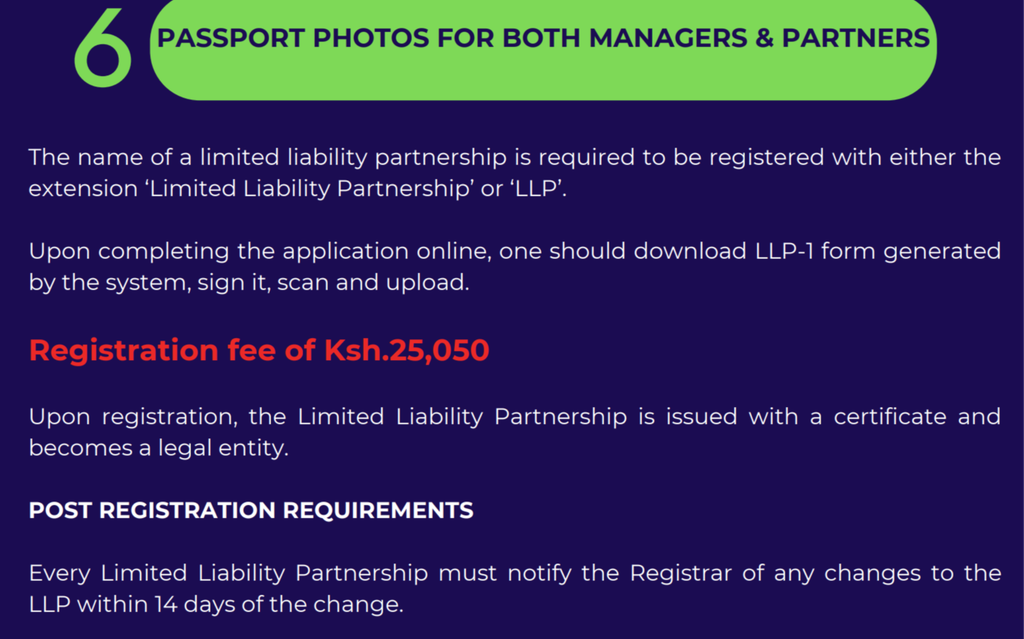
The registered name must include either the words Limited Liability Partnership or the abbreviation LLP, in accordance with the applicable requirements.
The proposed name should be distinctive and should not conflict with existing registered names or applicable naming restrictions.
2. LLP Partner Details
The application requires the full names and identification details of the proposed partners. Applicants should prepare the following information for each partner:
Full legal name.
National identification number or applicable passport details.
Email address.
Telephone number.
Physical or residential address.
Occupation.
Passport photograph, where required by the application.
The information submitted should be accurate and consistent with the relevant identification documents.
3. LLP Manager Details
A limited liability partnership must have at least one manager and at least two partners under the requirements described by the Business Registration Service.
The manager may also be one of the partners. Applicants should prepare the manager’s full name, identification details, occupation, contact information, physical address, and passport photograph where required.
The manager’s role is important because the LLP must have an individual responsible for the relevant management and statutory responsibilities.
4. Proposed Nature of Business
Applicants must describe the intended activities of the partnership. The proposed nature of business should clearly explain what the LLP will do.
For example, the description might cover legal services, accounting, consultancy, technology services, or another legitimate commercial activity.
Where the business operates in a regulated profession, applicants should establish whether additional licences, professional approvals, or supporting documents are required.
5. Registered Office Address
The application requires a proposed business address. Applicants should prepare the physical address of the LLP’s proposed office or principal place of business.
The address should accurately identify the location from which the business will operate or maintain its registered office, as applicable.
Applicants should also ensure that the proposed premises are suitable for the intended activities and satisfy any relevant licensing or regulatory requirements.
6. Letter of No Objection
A letter of no objection may be required for certain LLP registrations, depending on the nature of the business and the applicable regulatory requirements.
For example, the BRS guidance identifies a letter from the Law Society of Kenya (LSK) in connection with the registration of a law firm.
Applicants establishing a professional practice should confirm the applicable requirements with the relevant professional body and the BRS before submitting their applications.
LLP Registration Procedure in Kenya
The LLP registration process is conducted online through the Business Registration Service’s official registration platform.
Before starting the application, collect the proposed names, partner details, manager details, business address, nature of business, and any supporting documents that may be required.
Check that the identification information, contact details, and addresses are correct.
Preparing the information in advance makes it easier to complete the online form accurately.
Step 2: Apply for LLP Name Reservation
Submit the proposed LLP business name through the applicable online process.
The name reservation stage allows the registration authority to assess whether the proposed name is available and complies with the relevant naming requirements.
Providing alternative names can help prevent unnecessary delays if the first choice is rejected or unavailable.
Applicants should use the name approved through the official system when completing the subsequent registration steps.
Step 3: Complete the Online LLP Application
Log in to the eCitizen registration portal and access the relevant Business Registration Service application for a limited liability partnership.
Enter the required information, including:
The approved LLP name.
Details of the partners and manager.
The proposed nature of business.
The principal place of business or proposed registered address.
Contact information and other requested particulars.
Review the information carefully before proceeding to payment and submission.
Step 4: Download and Complete Form LLP-1
According to the BRS guidance, completing the online application generates Form LLP-1, which must be downloaded.
The form should be signed as required, scanned, and uploaded through the registration system.
Applicants should ensure that the signed document is legible and that the information matches the details entered in the online application. If you need help accessing registration documents after approval, consult this guide on downloading certificates and other records from BRS in Kenya.
Step 5: Upload Supporting Documents
Upload the documents requested by the registration portal. These may include identification information, passport photographs for the relevant managers and partners, and any applicable supporting letters or professional approvals.
The exact documents required should be confirmed through the current application instructions, particularly where the LLP will operate in a regulated profession. The official BRS forms directory can also help applicants locate relevant registration forms.
Step 6: Pay the LLP Registration Fees
Pay the registration fee displayed or prescribed for the application through the official payment process.
The BRS guidance supplied for this procedure states a registration fee of KSh 25,050. Applicants should verify the current amount on the official portal before making payment because government fees and administrative requirements can change.
Retain the payment confirmation for your records.
Step 7: Await Review and Registration
After submitting the application, signed form, supporting documents, and payment, monitor the application through the official system.
The registration authority may review the submission and request corrections or additional information if necessary.
Once the application is approved, the LLP is issued a certificate of registration and becomes a legal entity.
The LLP registration cost depends on the prescribed government charges and any additional expenses associated with preparing the application.
According to the BRS guidance provided for this registration procedure, the stated registration fee is KSh 25,050.
Applicants should distinguish between the official registration fee and the total cost of establishing the business.
Potential additional expenses may include:
Professional advice or assistance with the application.
Preparation of partnership documents.
Professional-body approvals, where applicable.
Business premises and related administrative expenses.
Licences or permits required for the intended business activities.
Not every LLP will incur all these additional expenses. The total cost depends on the circumstances of the partnership and the requirements applicable to its operations.
The LLP registration duration depends on the completeness of the application, the availability of the proposed name, the accuracy of the supporting documents, and the time required for official review.
An application that contains accurate information and all required documents may proceed more smoothly than one requiring corrections or additional approvals.
Factors that may affect the registration timeline include:
Delays in name reservation or approval.
Incorrect partner or manager identification details.
Missing signatures on Form LLP-1.
Incomplete supporting documentation.
Additional requirements imposed by a relevant professional body.
Requests for clarification from the registration authority.
The BRS guidance provided does not specify a guaranteed processing period. Applicants should therefore check the current status through the official portal rather than relying on an assumed completion date.
What Happens After LLP Registration?
Receiving the certificate of registration establishes the LLP as a legal entity, but registration is only the beginning of its compliance responsibilities.
Partners should understand the ongoing obligations that apply to their business.
Maintain at Least Two Partners
The LLP must maintain at least two partners during its existence, in accordance with the requirements described in the BRS guidance.
The partners should monitor changes in membership and take appropriate steps if the number of partners changes.
Notify the Registrar of Changes
The supplied BRS guidance states that an LLP must notify the Registrar of changes within 14 days of the change.
Changes may involve partner or manager details, business particulars, or other information recorded in the official register.
Because the precise notification requirements depend on the nature of the change, applicants should consult the applicable rules and current BRS procedures before submitting an amendment. For related guidance, read this step-by-step guide to changing particulars on BRS in Kenya.
File the Annual Declaration of Solvency
The guidance also identifies an annual declaration of solvency as an ongoing LLP compliance requirement.
Partners and managers should establish a compliance calendar to track the applicable filing dates and ensure that required declarations are submitted on time.
They should confirm the current filing procedure and any applicable deadlines through the BRS.
Maintain Appropriate Business Records
An LLP should maintain accurate financial, operational, and statutory records. Depending on its activities, it may also need to meet tax filing, accounting, employment, licensing, and other regulatory obligations.
Registration does not automatically satisfy every obligation imposed on a business operating in Kenya.
Although the LLP registration application records essential information about the partnership, the partners should also consider documenting their internal working arrangements.
An LLP partnership agreement can help establish clear expectations and reduce the risk of disputes.
Depending on the partners’ needs and the applicable law, the agreement may address:
Each partner’s responsibilities and authority.
Capital contributions and ownership-related arrangements.
Allocation of profits and losses.
Decision-making procedures.
Admission or departure of partners.
Procedures for resolving disputes.
Management responsibilities.
Dissolution or winding-up arrangements.
The partners should obtain appropriate professional advice to ensure that the agreement is consistent with Kenyan law and the LLP’s intended structure.
Common LLP Registration Mistakes to Avoid
Applicants can reduce the likelihood of delays by checking the application carefully before submission.
Submitting an unavailable name: Prepare alternative names and verify that the selected name meets the applicable requirements.
Providing inconsistent personal details: Ensure that partner and manager information matches the relevant identification documents.
Using an unclear business description: Describe the intended activities accurately and identify any regulated activities that may require additional approval.
Forgetting to sign Form LLP-1: Download the generated form, complete the required signatures, scan it clearly, and upload it as instructed.
Ignoring professional approvals: Where the LLP operates in a regulated profession, establish whether a letter of no objection or another approval is necessary.
Overlooking post-registration obligations: Keep track of changes that must be reported, annual declarations, and other statutory filings.
Relying on outdated fees: Verify the registration charge and current requirements directly through the official BRS platform before submitting payment.
Businesses that use secured financing may also wish to understand the applicable collateral registration framework. The Collateral Registry MPSR user guide for Kenya provides related information on that separate process.
Frequently Asked Questions
1. How much does it cost to register an LLP in Kenya?
The BRS guidance referenced in this article lists an LLP registration fee of KSh 25,050. Applicants should verify the current government fee through the official registration portal before paying.
2. How many partners are required to register an LLP in Kenya?
The supplied BRS guidance specifies at least two partners and at least one manager. A manager may also be a partner in the LLP.
3. Where can I register a limited liability partnership in Kenya?
You can access the official Business Registration Service website and its online registration platform at https://brs.ecitizen.go.ke/. The process involves submitting the required particulars, completing Form LLP-1, uploading supporting documents, paying the applicable fee, and awaiting approval.
Debtor Bankruptcy Proceedings in Kenya: A Step-by-Step Legal Guide
Learn about debtor bankruptcy proceedings in Kenya, bankruptcy law, bankruptcy order applications, Insolvency Act requirements, creditor rights, trustee appointments, and discharge after three years.
Debtor bankruptcy proceedings in Kenya provide a legal framework for individuals who cannot meet their financial obligations when they fall due. Governed by the Insolvency Act, 2015, and the applicable regulations, the process allows an eligible debtor to petition the High Court for a bankruptcy order and, subject to the law, obtain relief from qualifying debts after discharge.
Understanding the bankruptcy legal process is essential for debtors, creditors, and legal representatives. From preparing the required documents to appointing a bankruptcy trustee, administering the debtor’s estate, and obtaining discharge, each stage has specific legal requirements.
This guide explains the bankruptcy process in Kenya, the role of the Official Receiver, creditors’ rights, the consequences of a bankruptcy order, and the conditions for discharge. For additional information on business registration and related legal procedures, readers can explore the business registration and compliance guides.
What Is Bankruptcy Under Kenyan Insolvency Law?
Bankruptcy is a legal proceeding through which an individual who is unable to pay debts may seek a court order declaring them bankrupt. It provides a structured process for addressing outstanding debts, protecting the interests of creditors, and potentially allowing the debtor to make a financial fresh start.
In Kenya, bankruptcy law is primarily governed by the Insolvency Act, 2015, and the Insolvency Regulations. The High Court has jurisdiction over bankruptcy matters, including applications for bankruptcy orders and related proceedings.
Bankruptcy is not simply a private agreement between a debtor and creditors. It is a formal legal process involving court supervision, the Official Receiver, and, where applicable, a bankruptcy trustee. The general overview of debtor bankruptcy proceedings in Kenya provides further guidance on the relevant procedures and requirements.
Who Can Apply for Bankruptcy?
A debtor who meets the applicable statutory requirements may apply to the court for a bankruptcy order. Under Section 32 of the Insolvency Act, a debtor may make an application to be adjudged bankrupt.
The application must comply with the relevant legal and procedural requirements. The debtor may file the bankruptcy petition personally or through an advocate representing them.
Creditors may also initiate bankruptcy proceedings where the applicable statutory conditions are satisfied. The procedure and supporting evidence depend on whether the application is made by the debtor or a creditor.
Purpose of Debtor Bankruptcy Proceedings
Debtor insolvency proceedings serve several purposes:
Establishing a lawful process for dealing with debts that cannot be paid.
Providing an orderly mechanism for administering the debtor’s estate.
Ensuring eligible creditors can submit and prove their claims.
Distributing available assets according to the applicable legal priorities.
Providing a framework for the debtor’s eventual discharge from qualifying debts.
Bankruptcy does not necessarily eliminate every financial obligation immediately. The legal consequences depend on the bankruptcy order, the debts involved, applicable statutory exceptions, and the outcome of the proceedings.
Step-by-Step Bankruptcy Legal Process in Kenya
The bankruptcy legal process involves preparing the petition, obtaining confirmation of compliance, filing the necessary documents in court, notifying creditors, and attending the hearing.
Step 1: Prepare the Bankruptcy Petition
The process begins when the debtor prepares a bankruptcy petition seeking a court order declaring them bankrupt.
According to the Business Registration Service guidance on debtor bankruptcy proceedings, the principal documents include:
Bankruptcy Petition — Form No. 10: The formal application requesting a bankruptcy order.
Supporting Affidavit — Form No. 8: The supporting sworn statement setting out the relevant facts and information.
Application for Bankruptcy Trustee — Form No. 9: The prescribed application relating to the appointment of a bankruptcy trustee.
Statement of Affairs — Form No. 11: A statement setting out the debtor’s financial position, including relevant assets, liabilities, and creditor information.
The applicable forms should be completed accurately and accompanied by any supporting information required under the Insolvency Act and Regulations. The official Business Registration Service forms portal can help applicants locate relevant forms and verify current documentation requirements.
A statement of financial affairs is particularly important because it helps establish the debtor’s financial position and identifies the creditors whose claims may be addressed through the proceedings.
Step 2: Submit the Documents to the Official Receiver
The debtor submits the required documents to the Official Receiver for review and confirmation that the applicable statutory requirements have been met.
The Official Receiver performs an important administrative role in bankruptcy proceedings, including reviewing the documents submitted and undertaking the functions assigned under the insolvency legislation.
If any information or documentation is incomplete, the debtor may need to address the deficiencies before proceeding.
Step 3: Obtain the Certificate of Compliance
Once the Official Receiver confirms compliance with the applicable requirements, the debtor follows the prescribed payment procedure.
The Business Registration Service guidance specifies a statutory payment of KSh 30,000 to the Official Receiver, followed by the issuance of a Certificate of Compliance in relation to the petition.
Applicants should confirm the current prescribed amount, payment instructions, and administrative requirements directly with the relevant office before making payment, as procedures and fees may change.
The Certificate of Compliance confirms that the relevant compliance checks have been completed for the next stage of the application.
Step 4: File the Bankruptcy Petition in the High Court
After obtaining the required confirmation, the debtor proceeds to file the bankruptcy petition and supporting documents in the High Court with jurisdiction over the matter.
Court filing fees may apply in addition to the prescribed payment made during the compliance process. Applicants can consult the official companies registry fee schedule for relevant registry charges, while confirming whether separate bankruptcy-related fees apply to their particular filing.
The matter is then placed before the Deputy Registrar for the necessary procedural checks. The Deputy Registrar confirms whether the application satisfies the relevant requirements and is ready to be placed before a judge for hearing.
A properly prepared bankruptcy court application helps reduce avoidable delays arising from incomplete documents or procedural deficiencies.
Step 5: Publish Notice of the Bankruptcy Petition
Before the hearing, the debtor is required, under the applicable procedure described in the Business Registration Service guidance, to publish notice of the bankruptcy petition in one or more newspapers with wide circulation.
The notice informs creditors and gives them an opportunity to respond to the petition where appropriate.
This stage promotes transparency and helps ensure that affected creditors have an opportunity to participate in the proceedings.
Step 6: Attend the Bankruptcy Hearing
Under Section 34 of the Insolvency Act, the court considers the petition and determines whether the debtor should be adjudged bankrupt.
The court evaluates the evidence and the applicable legal requirements before making its decision. Filing a petition does not automatically mean that a bankruptcy order will be granted.
If the court is satisfied that the relevant conditions have been met, it may issue a bankruptcy order declaring the debtor bankrupt.
The Business Registration Service guidance describes the bankruptcy period as three years, subject to the statutory provisions governing discharge, objections, and other relevant circumstances.
Bankruptcy Order Requirements and Legal Effects
A bankruptcy order has significant legal consequences for the debtor, creditors, and the administration of the debtor’s property.
Once the court makes the order, the applicable provisions of the Insolvency Act govern how the debtor’s estate is managed and how creditors may pursue their claims.
Suspension of Debt Recovery Proceedings
Section 48 of the Insolvency Act provides for a stay of proceedings to recover the bankrupt’s debts following a bankruptcy order.
This helps prevent individual creditors from pursuing recovery independently in circumstances where the law requires claims to be dealt with through the bankruptcy process.
The precise effect of the stay depends on the relevant statutory provisions and the type of proceeding involved.
Vesting and Administration of the Debtor’s Property
Under Section 48, the bankrupt’s property and the powers the bankrupt would otherwise exercise over that property for their own benefit vest in the bankruptcy trustee, subject to the applicable law.
The trustee administers the estate in accordance with the statutory framework and the interests of creditors.
This does not mean that every item of property is necessarily available for distribution. The treatment of particular assets depends on the applicable legal rules, including any relevant exclusions or restrictions.
Publication of the Bankruptcy Order
Section 48(3) of the Insolvency Act provides for publication of notice of the bankruptcy order.
According to the Business Registration Service guidance, the Official Receiver should publish the notice once in the Kenya Gazette and once in a newspaper of wide circulation within 30 days after the order is made.
Publication provides formal notice of the order and supports the administration of the bankruptcy estate.
Bankruptcy Trustee Appointment and Responsibilities
The bankruptcy trustee plays a central role in administering the bankrupt’s estate, handling creditor claims, and overseeing the distribution of available assets.
The Official Receiver or a licensed insolvency practitioner may be appointed as bankruptcy trustee, subject to the applicable statutory requirements.
Powers of the Bankruptcy Trustee
Section 63 of the Insolvency Act sets out powers associated with the administration of a bankrupt’s estate.
These may include:
Managing the bankrupt’s estate or any part of it.
Carrying on the bankrupt’s business where appropriate and permitted by law for the benefit of creditors.
Administering estate assets according to the applicable legal requirements.
Taking steps necessary to identify, realize, and distribute available property.
Performing other functions authorized by the Act.
The trustee must administer the estate in accordance with the law rather than simply follow the preferences of an individual creditor.
Official Receiver Appointment and Role
The Official Receiver has responsibilities throughout the bankruptcy process, from reviewing the initial documents to undertaking statutory functions after a bankruptcy order is made.
The Official Receiver also convenes the first meeting of creditors in accordance with Section 52 of the Insolvency Act.
The guidance explains that the Official Receiver may decide not to convene the first meeting if no creditor requests one within 14 days after the notice is sent, subject to the applicable statutory requirements.
The Official Receiver’s role is therefore important both before the bankruptcy order and during the administration of the estate.
Creditors’ Rights in Bankruptcy Proceedings
Creditors retain important procedural rights during bankruptcy proceedings. These rights allow them to submit claims, participate in relevant meetings, and receive distributions where funds are available.
However, creditors must follow the applicable bankruptcy procedure rather than assume that ordinary debt recovery methods remain available without restriction.
Filing and Proving Debts
A creditor seeking payment from the bankrupt’s estate must submit a proof of debt in the prescribed manner.
The debt must be provable under the applicable law. The trustee considers the claim and administers it according to the statutory framework.
The debtor’s statement of affairs helps identify creditors and outstanding liabilities, but creditors may still need to provide supporting evidence to establish their individual claims.
Attending Creditors’ Meetings
Creditors’ meetings allow creditors to participate in relevant decisions concerning the bankruptcy administration.
Their principal roles may include:
Attending meetings convened under the Act.
Submitting proof of the debts owed to them.
Examining the bankrupt at meetings where permitted.
Considering reports on the administration of the estate.
Participating in decisions on proposals and other matters placed before them.
The purpose of these meetings is to support an orderly process for dealing with the estate and the claims against it.
Composition and Settlement Proposals
During a creditors’ meeting, the bankrupt may propose a composition to satisfy debts owed to creditors.
A composition is an arrangement under which creditors may agree to accept specified terms for resolving the relevant liabilities.
Creditors may consider or amend the proposed terms in accordance with the applicable procedure. The arrangement is not binding until the required court approval has been obtained.
Once approved, the bankrupt and the bankruptcy trustee execute the deed of composition, and the proposal takes effect according to its terms and the law.
This mechanism may provide an alternative to distributing the estate solely through the ordinary bankruptcy process.
Conduct and Completion of Bankruptcy Proceedings
After the bankruptcy order is made, the trustee administers the estate, considers creditors’ claims, and distributes available assets according to the applicable law.
The process may involve meetings, examinations, asset realization, and the preparation of reports.
Public Examination of the Bankrupt
The bankruptcy trustee may summon the bankrupt or other persons covered by Section 168(2) of the Insolvency Act to appear before the trustee or the court, as permitted by law.
A public examination may take place before an absolute order for discharge is made.
These procedures can assist in examining the debtor’s financial affairs and obtaining information relevant to the administration of the estate.
Distribution of the Bankruptcy Estate
The trustee distributes the bankrupt’s estate according to the applicable statutory priorities, including the relevant provisions of the Insolvency Act and its schedules.
After realizing available assets, the trustee determines whether dividends can be paid to creditors.
The trustee may issue a notice declaring final dividends, confirming that no dividends will be paid, or indicating that further dividends may be declared.
If a surplus remains after the relevant liabilities and expenses have been dealt with, it is handled in accordance with the applicable legal requirements.
Final Creditors’ Meeting
Under Section 253(1) of the Insolvency Act, a final creditors’ meeting is held where the trustee considers the administration of the estate complete, subject to the applicable requirements.
Creditors receive and consider the trustee’s report on the administration of the estate and determine whether the trustee should be discharged in accordance with the statutory procedure.
The completion of the estate administration is distinct from the bankrupt’s personal discharge. Each is governed by its own applicable legal requirements.
Consequences of Bankruptcy for the Debtor
A bankruptcy order can affect a debtor’s financial affairs, property, professional activities, and eligibility for certain public or corporate roles.
Understanding these consequences is essential before commencing debtor insolvency proceedings.
Restrictions on Company Management
The Business Registration Service guidance explains that a bankrupt person cannot act as a director of a company or participate in its management except with the leave of the court.
The applicable restrictions should be reviewed before the debtor accepts a directorship or takes part in company management. Further information about the types of entities registered in Kenya is available through the official registered entities directory.
Restrictions on Parliamentary Membership
The guidance also refers to Section 99(2)(f) of the Constitution of Kenya, 2010, concerning the disqualification of a bankrupt person from membership of Parliament.
The precise application of this constitutional provision depends on the relevant legal requirements and circumstances.
Restrictions on Legal Practice
The guidance identifies Section 32 of the Advocates Act as relevant to restrictions on a bankrupt person acting as an advocate.
Individuals in regulated professions should obtain advice on the consequences of bankruptcy for their professional status and any applicable licensing requirements.
Impact on Financial Obligations
Bankruptcy affects the treatment of the debts covered by the proceedings. During the process, claims are generally dealt with under the statutory framework rather than through unrestricted individual recovery.
However, a bankruptcy order should not be interpreted as an immediate, unconditional cancellation of every debt. The effect of bankruptcy and subsequent discharge depends on the applicable legislation and any relevant exceptions.
Discharge from Bankruptcy in Kenya
Discharge marks an important stage in the bankruptcy process because it determines when the bankrupt is relieved from the applicable bankruptcy-related debt obligations.
Automatic Discharge After Three Years
Section 254 of the Insolvency Act provides for automatic discharge after three years, subject to the statutory conditions and exceptions.
The Business Registration Service guidance states that a bankrupt may also apply for discharge earlier.
The timing and effect of discharge should be assessed against the relevant statutory provisions and the circumstances of the individual case.
Objections to Discharge
A discharge may not occur automatically at the end of the three-year period if a creditor or the bankruptcy trustee has lodged an objection under Section 256 and the objection remains unresolved.
An objection must comply with the prescribed form and procedure. If an objection remains outstanding, the bankrupt may be summoned for public examination before the court.
Where the grounds of objection are established, the court may quash the discharge in accordance with the law.
Consequently, debtors should not assume that the passage of three years alone guarantees discharge in every case.
Legal Effect of Discharge
Following a valid discharge, the bankrupt is generally relieved of the qualifying debts covered by the discharge, subject to applicable statutory exceptions.
The law may prevent creditors whose debts are covered by the discharge from continuing recovery action in respect of those debts.
Before relying on a discharge, the debtor should confirm its scope and whether any particular liability remains enforceable under the applicable legislation.
Common Bankruptcy Filing Mistakes to Avoid
A carefully prepared application can help reduce procedural delays and misunderstandings.
Common issues to avoid include:
Incomplete documentation: Ensure that the bankruptcy petition, supporting affidavit, statement of affairs, and other required forms are properly prepared.
Inaccurate financial disclosures: Provide accurate information about relevant assets, liabilities, and creditors.
Failure to confirm compliance: Obtain the required confirmation from the Official Receiver before proceeding to court.
Ignoring publication requirements: Follow the applicable rules for notifying creditors and publishing the bankruptcy notice.
Overlooking creditor claims: Ensure that known liabilities are disclosed and that creditors are given the opportunities required by law.
Assuming immediate debt cancellation: Understand that a bankruptcy order and a discharge have different legal effects.
Failing to obtain professional advice: Seek assistance where the application involves disputed debts, complex assets, business interests, or potential objections to discharge.
Applicants should also verify current forms, fees, filing procedures, and statutory requirements with the Business Registration Service, the Official Receiver, or a qualified Kenyan insolvency practitioner. The official Business Registration Service website is a useful starting point for locating government information and services.
Frequently Asked Questions About Bankruptcy in Kenya
Frequently Asked Questions About Bankruptcy in Kenya
1. How long do debtor bankruptcy proceedings take in Kenya?
The process depends on document preparation, compliance checks, court scheduling, creditor participation, and the administration of the estate. The Business Registration Service guidance describes a three-year bankruptcy period, subject to the statutory rules governing discharge and objections. This should not be confused with a guarantee that every stage of the proceedings will take exactly three years.
2. Can creditors recover their debts after a bankruptcy order?
A bankruptcy order generally places the relevant debt recovery proceedings under the applicable insolvency framework. Section 48 provides for a stay of proceedings to recover the bankrupt’s debts. Creditors may submit proof of debt and participate in the administration of the estate, subject to the law. The treatment of particular claims depends on the applicable statutory provisions.
3. Does bankruptcy automatically clear all debts after three years?
Not necessarily. Section 254 provides for discharge after three years, subject to statutory conditions, including the rules governing objections. The effect of discharge depends on which debts are covered and whether any legal exceptions apply. Debtors should obtain advice before assuming that a particular obligation has been extinguished.
Company Liquidation in Kenya: A Step-by-Step Guide
Learn the company liquidation process in Kenya, including appointment of liquidator, voluntary and court-ordered liquidation, creditor claims, asset distribution, legal requirements, and company dissolution under the Insolvency Act, 2015.
Company liquidation in Kenya is the legal process of winding up a company’s affairs, realising its assets, settling outstanding liabilities, and distributing any remaining funds according to applicable insolvency laws. The process is governed primarily by the Insolvency Act, 2015, and relevant company legislation and regulations.
Understanding the company liquidation process helps directors, shareholders, creditors, and other stakeholders comply with legal requirements and protect their interests. Whether liquidation begins voluntarily or through a court order, the procedure involves appointing a liquidator, notifying relevant authorities, collecting creditor claims, distributing assets, and formally dissolving the company.
This guide explains the main types of liquidation, the appointment of a liquidator, the responsibilities of stakeholders, and the steps involved in completing liquidation and removing a company from the Companies Register. For additional guidance on Kenyan business registration and compliance, explore these business registration resources.
What Is Company Liquidation in Kenya?
Company liquidation is the formal procedure through which a company brings its business affairs to an end. During liquidation, the company’s assets are identified, collected, and sold where necessary to settle debts and other liabilities.
The process is particularly important when a company becomes insolvent and cannot meet its financial obligations. However, certain companies may also undergo voluntary liquidation under the applicable legal framework.
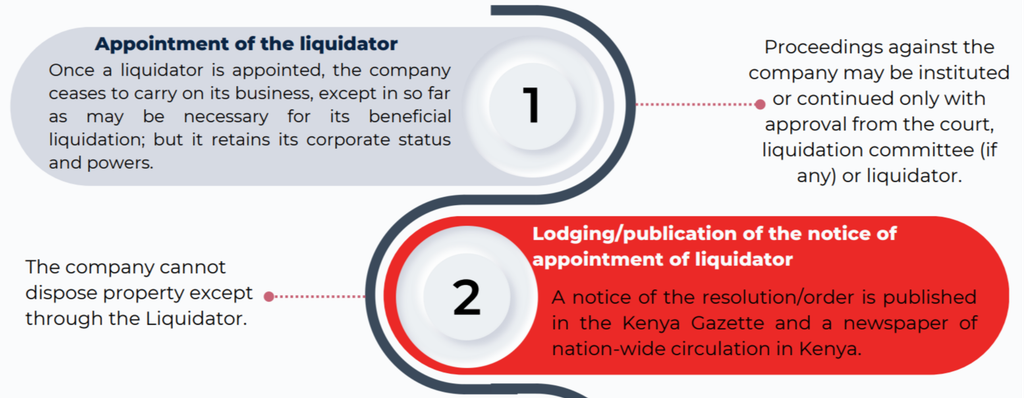
Once a liquidator is appointed, the company’s directors generally cease to exercise their management powers, which are transferred to the liquidator to the extent provided by law. The company retains its corporate status during the liquidation process until it is formally dissolved.
The purpose of liquidation is to ensure that the company’s affairs are handled transparently and that creditors receive distributions in accordance with the applicable legal priorities.
Types of Company Liquidation Under Kenyan Law
The Insolvency Act, 2015, provides for different forms of liquidation depending on the company’s financial position and the circumstances leading to the winding-up process.
1. Members’ Voluntary Liquidation
Members’ voluntary liquidation is generally available to a solvent company whose shareholders decide to bring its operations to an end.
The process typically begins when the shareholders pass a special resolution to liquidate the company and appoint a qualified liquidator. A declaration of solvency may be required under the applicable legal provisions to establish that the company can pay its debts in full within the prescribed period.
The liquidator then realises the company’s assets, settles its liabilities, and distributes any surplus to shareholders in accordance with the law.
2. Creditors’ Voluntary Liquidation
Creditors’ voluntary liquidation is generally used when a company cannot pay its debts as they fall due and liquidation is initiated without a court directly ordering the winding up.
The process involves the relevant company resolutions and creditor procedures required by law. Creditors participate in the process, including decisions concerning the appointment of the liquidator where applicable.
The liquidator takes control of the company’s affairs, identifies its assets and liabilities, receives creditor claims, and distributes available funds according to the statutory order of priority.
3. Court-Ordered Liquidation
Court-ordered liquidation occurs when proceedings are brought before the High Court and the court issues a liquidation order.
The process may be initiated through a liquidation petition by a person or entity legally entitled to present one. Depending on the circumstances, the petition may involve a creditor seeking recovery of an unpaid debt or another party with the necessary legal standing.
Following the order, the appointed liquidator administers the company’s affairs in accordance with the court’s directions and the applicable insolvency framework.
This form of liquidation is subject to the relevant court procedures, statutory requirements, and restrictions on proceedings against the company.
The appointment of a liquidator is a central step in the company winding-up procedure. A liquidator is responsible for taking control of the company’s affairs, realising assets, examining liabilities, and distributing available funds to creditors and other entitled parties.
The appointment may arise through a members’ resolution, a creditors’ process, or a court order, depending on the type of liquidation.
Responsibilities of the Liquidator
The liquidator’s responsibilities generally include:
Taking control of the company’s assets and relevant records.
Investigating the company’s financial position and identifying its liabilities.
Collecting and realising company assets.
Receiving and examining claims submitted by creditors.
Convening meetings of creditors where required.
Distributing available funds according to statutory priorities.
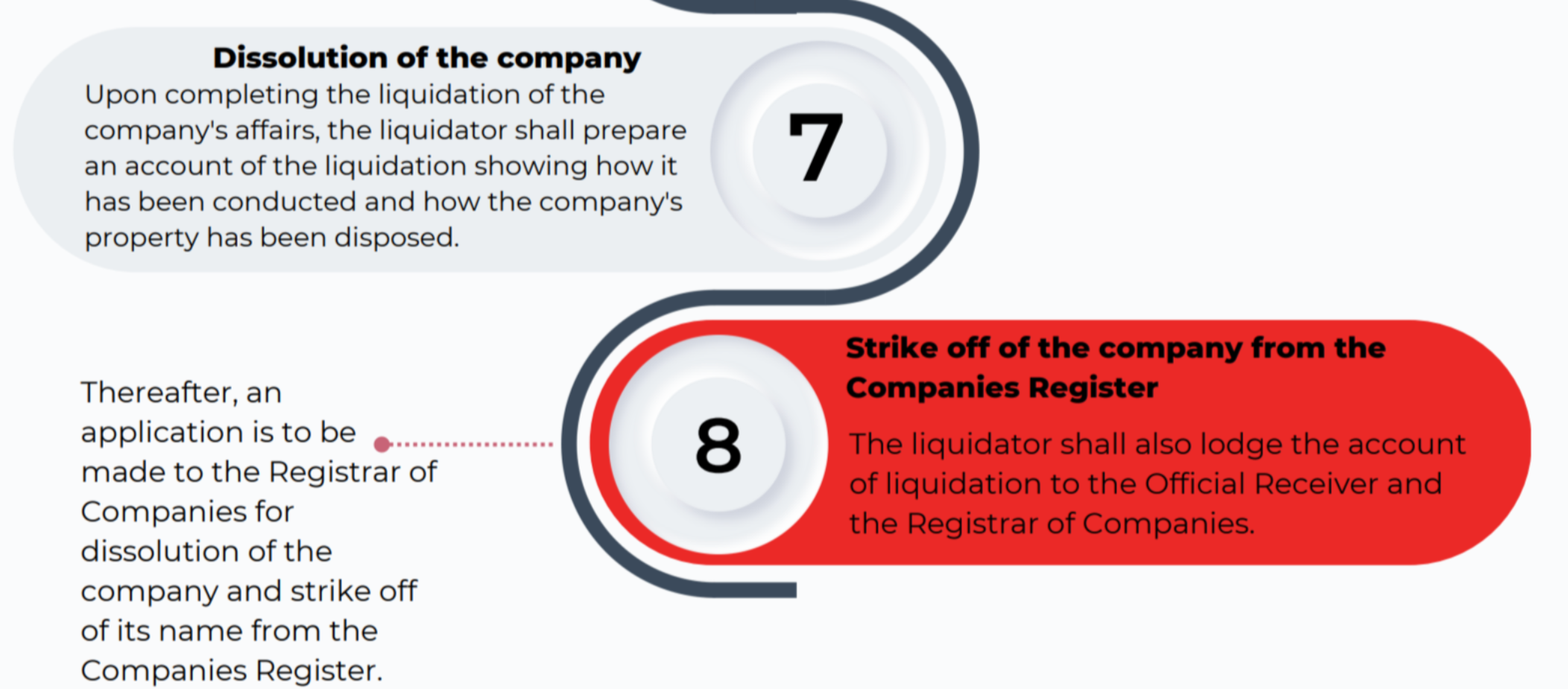
Preparing an account of the liquidation.
Filing the required notices, accounts, and reports with the relevant authorities.
Applying for the company’s formal dissolution when the process is complete.
Once the liquidator is appointed, the company generally cannot dispose of its property independently of the liquidation process. Any continuation of business must be consistent with the purpose of beneficial liquidation and the applicable legal requirements.
Company Liquidation Process: Step-by-Step Guide
The company liquidation process involves a series of legal and administrative steps. The exact procedure depends on whether the liquidation is voluntary or court-ordered and on the company’s particular circumstances.
Liquidation begins when the legally required liquidation resolution is passed or a court issues a liquidation order.
For voluntary liquidation, the relevant company decision-making procedures must be followed. For court-ordered liquidation, the process generally involves presenting a liquidation petition and obtaining the appropriate court order.
The commencement date is important because it determines when various statutory obligations and procedural requirements take effect.
Step 2: Lodging and Publication of the Liquidator’s Appointment
Following commencement, the required notice of appointment of the liquidator must be lodged with the relevant authorities.
The Business Registration Service’s step-by-step guide identifies the Official Receiver and the Registrar of Companies as recipients of the appointment notice. It also describes publication of the relevant resolution or order in the Kenya Gazette and a newspaper of nationwide circulation, as applicable.
The guide states that the appointment notice should be lodged within seven days of commencement of the proceedings. The applicable filing deadlines and publication requirements should be confirmed for the particular liquidation.
These notices help inform creditors, stakeholders, and members of the public that the company is undergoing liquidation.
Step 2: Lodging and Publication of the Liquidator’s Appointment (Company Liquidation in Kenya: A Step-by-Step Guide)
Step 3: Preparation and Filing of the Statement of Affairs
The company’s members and other relevant persons may be required to prepare a Statement of Affairs containing information about the company’s financial position.
The document generally identifies the company’s assets, liabilities, creditors, and other relevant financial information. It assists the liquidator in understanding the company’s affairs and determining what resources are available to meet outstanding obligations.
Directors and other persons with relevant knowledge should cooperate by providing accurate records, financial statements, contracts, and supporting documents.
Incomplete or inaccurate information can delay the process and complicate the assessment of creditor claims.
Step 4: Filing of Claims by Creditors
Creditors must submit their claims in accordance with the applicable insolvency rules and any instructions issued during the liquidation.
The claims process allows the liquidator to examine the amounts owed, assess supporting evidence, and determine which claims can be admitted for distribution purposes.
Creditors may need to provide invoices, loan agreements, contracts, account statements, judgments, or other evidence supporting their claims.
Under the Insolvency Act and the relevant regulations, proof-of-debt procedures help establish the liabilities to be addressed during liquidation. Creditors should comply with any applicable deadlines and evidentiary requirements.
Step 4: Filing of Claims by Creditors (Company Liquidation in Kenya: A Step-by-Step Guide)
Step 5: Convening Meetings of Creditors
The liquidator may convene the first and subsequent meetings of creditors where required by the applicable procedure.
These meetings provide an opportunity to consider the company’s financial position, review relevant proposals, and make decisions on matters reserved for creditors.
The Business Registration Service guide explains that proposals are decided through voting by creditors who have filed proof-of-debt forms. Voting rights and outcomes depend on the applicable statutory rules, including any relevant creditor classification requirements.
Creditors should review the information provided before participating in decisions that affect the liquidation.
Step 6: Realisation of Company Assets
Company assets must be identified, secured, collected, and realised as necessary to meet the company’s liabilities.
The process may involve selling property, recovering outstanding debts, collecting money held in bank accounts, and dealing with other assets belonging to the company.
The liquidator is responsible for administering these assets in accordance with the law. Directors and other relevant persons should not independently transfer or dispose of company property outside the authorised process.
Proper documentation of asset valuations, sales, recoveries, and expenses helps maintain transparency and accountability.
Step 7: Declaration of Dividends and Distribution to Creditors
After assessing creditor claims and determining the funds available for distribution, the liquidator distributes the proceeds in accordance with the applicable statutory priorities.
The Insolvency Act provides rules governing the treatment of different categories of claims. Depending on the circumstances, these may include secured claims, preferential debts, and unsecured claims.
The Business Registration Service guide refers to the Second Schedule of the Insolvency Act in explaining distributions.
Creditors should not assume that all claims will be paid in full. The amount received depends on the assets realised, the costs of the liquidation, the nature and priority of each claim, and the funds available.
Step 7: Declaration of Dividends and Distribution to Creditors (Company Liquidation in Kenya: A Step-by-Step Guide)
Step 8: Preparation and Filing of the Liquidation Account
Once the company’s affairs have been dealt with, the liquidator prepares an account showing how the liquidation was conducted and how the company’s property was disposed of.
The account provides a record of the assets realised, liabilities addressed, expenses incurred, and distributions made.
The liquidator must lodge the required liquidation account and other documents with the relevant authorities, including the Official Receiver and the Registrar of Companies, as required by the applicable procedure.
This stage establishes an account of the liquidator’s work and supports the formal conclusion of the process.
Step 9: Company Dissolution and Strike-Off (Company Liquidation in Kenya: A Step-by-Step Guide)
Step 9: Company Dissolution and Strike-Off
After completing the liquidation and satisfying the applicable requirements, an application is made for the company’s dissolution and removal of its name from the Companies Register.
The precise filing procedure depends on the applicable legislation and the circumstances of the liquidation. Relevant records and filing requirements can be checked through the Business Registration Service website.
Dissolution marks the formal legal conclusion of the company’s existence. It should not be confused with merely ceasing business operations or submitting an ordinary company deregistration application.
The company’s records and liquidation documents should be retained in accordance with the relevant legal and regulatory requirements.
Liquidation Legal Requirements in Kenya
Compliance with liquidation legal requirements is essential to ensure that the process is conducted properly and that the interests of creditors, shareholders, and other stakeholders are addressed.
The principal legal framework includes the Insolvency Act, 2015, together with applicable regulations and relevant provisions of Kenyan company law.
Corporate Resolutions and Court Orders
Depending on the type of liquidation, the process may require a shareholder special resolution, a creditors’ decision, or a court order.
For members’ voluntary liquidation, the company must follow the prescribed procedures for approving liquidation and appointing a liquidator.
For court-ordered liquidation, the relevant petition, court proceedings, and resulting orders must be complied with.
Financial Records and Disclosure
The company must provide the information required for the liquidation, including relevant financial records and details of its assets and liabilities.
Company financial statements, accounting records, creditor information, and supporting documents may be needed to establish the company’s financial position and facilitate the liquidator’s work.
Directors and other relevant persons should avoid withholding records or providing misleading information.
Liquidation proceedings operate for the benefit of creditors collectively, subject to the applicable legal framework.
Creditors must submit claims through the prescribed process, while the liquidator assesses those claims and administers distributions according to statutory priorities.
Legal restrictions may also apply to proceedings against the company once liquidation has commenced. Depending on the circumstances, court, liquidator, or liquidation committee approval may be necessary before certain proceedings can be instituted or continued.
Tax and Regulatory Obligations
Liquidation does not automatically eliminate outstanding tax obligations or other regulatory responsibilities.
The company and liquidator should identify outstanding taxes, filing obligations, and any required clearances. A tax clearance certificate may be relevant in certain administrative or tax-related circumstances, but it should not be assumed to be a universal prerequisite for every form of liquidation.
The applicable requirements should be confirmed with the relevant tax and company registration authorities.
Company Liquidation vs. Company Deregistration in Kenya
Company liquidation and company deregistration are related but distinct procedures.
Liquidation involves administering the company’s assets and liabilities, dealing with creditor claims, and distributing available funds under the applicable legal framework.
Deregistration or strike-off generally concerns removing a company’s name from the Companies Register through the appropriate statutory procedure. It may be available in circumstances where a company qualifies for administrative removal without requiring a full liquidation.
A company with unresolved debts, disputed liabilities, or other circumstances requiring formal insolvency proceedings may need a liquidation procedure rather than an ordinary strike-off.
When Is Liquidation Appropriate?
Liquidation may be appropriate when the company’s affairs require a formal process for collecting assets, resolving creditor claims, and distributing available funds.
It may also be necessary where insolvency proceedings have been initiated or a court has issued the relevant order.
When Is Company Strike-Off Appropriate?
Company strike-off may be suitable for a company that qualifies under the applicable legal requirements and can use the relevant administrative process.
However, strike-off should not be treated as a substitute for addressing outstanding debts or complying with legal obligations. Directors should confirm that the company is eligible before pursuing this route.
Common Challenges During the Liquidation Process
Liquidation can become complicated when a company has incomplete records, disputed debts, insufficient assets, or competing creditor claims.
Common challenges include:
Missing or inaccurate accounting records.
Disputes concerning ownership or valuation of assets.
Failure by creditors to provide adequate proof of debt.
Delays in selling assets or recovering outstanding receivables.
Disagreements about creditor priorities and distributions.
Outstanding tax or regulatory obligations.
Failure to submit notices, reports, or other required documents on time.
These issues can increase costs and extend the time required to complete the liquidation.
Companies can reduce avoidable delays by maintaining proper records, cooperating with the liquidator, identifying creditors early, and obtaining appropriate professional advice. Businesses considering restructuring rather than immediate liquidation may also wish to review the company administration process in Kenya.
How Long Does Company Liquidation Take in Kenya?
There is no single timeline that applies to every company liquidation in Kenya.
The duration depends on factors such as the company’s financial complexity, the number of creditors, the value and liquidity of its assets, the existence of disputes, and whether court proceedings are involved.
A company with straightforward affairs and readily realisable assets may be easier to wind up than one with complex financial arrangements, ongoing litigation, or disputed ownership of property.
Timely submission of creditor claims, accurate financial disclosure, and compliance with filing requirements can help reduce unnecessary delays. However, the liquidation should not be considered complete until the applicable statutory procedures have been satisfied.
Frequently Asked Questions
1. What are the main steps in company liquidation in Kenya?
The main steps generally include commencing liquidation proceedings, appointing a liquidator, lodging and publishing the required notices, preparing a Statement of Affairs, receiving creditor claims, convening meetings where required, realising assets, distributing funds, filing the liquidation account, and applying for dissolution and removal from the Companies Register.
2. Who can appoint a liquidator in Kenya?
The appointment depends on the type of liquidation. Shareholders may appoint a liquidator through the appropriate voluntary liquidation procedure, creditors may participate in the appointment process for creditors’ voluntary liquidation, and the High Court may appoint or remove a liquidator in accordance with the law.
3. Can a company be deregistered without liquidation in Kenya?
Yes, a company may qualify for a strike-off or other dissolution procedure without undergoing a full liquidation. However, eligibility depends on the applicable legal requirements and the company’s circumstances. Companies with unresolved liabilities or insolvency issues should obtain appropriate advice before pursuing deregistration.
Company Administration Process in Kenya: A Complete Step-by-Step Guide
Learn the company administration process in Kenya under the Insolvency Act 2015, including administrator appointment, creditor rights, administration steps, timelines, and alternatives to liquidation.
The company administration process in Kenya is a legal procedure designed to help financially distressed companies restructure their operations, protect their assets, and explore alternatives to liquidation. Governed by the Insolvency Act, 2015, company administration provides a framework for rescuing struggling businesses, improving outcomes for creditors, and preserving business value where possible.
Understanding the company administration procedure is essential for directors, creditors, shareholders, and business owners facing financial challenges. This guide explains the objectives of administration, the appointment and responsibilities of an administrator, the key administration process steps, applicable legal protections, time limits, and possible outcomes under Kenyan insolvency law. For additional business compliance information, explore our business registration and compliance guides.
What Is the Company Administration Process?
Company administration is a formal insolvency procedure in which a qualified insolvency practitioner or the Official Receiver takes responsibility for managing a company’s affairs, business, and property.
The primary aim is to determine whether the company can continue operating as a going concern, be restructured into a viable business, or be sold in a way that preserves its value. Where business rescue is not achievable, administration may help secure a better financial outcome for creditors than immediate liquidation.
In Kenya, the process is governed by the Insolvency Act, 2015, particularly Part VIII, which establishes the legal framework for company administration. The official Business Registration Service website provides access to government information and business registration resources.
Objectives of Company Administration
The company administration process has three principal objectives:
Maintaining business continuity: Keeping the company operational where possible and giving it an opportunity to recover from financial difficulties.
Achieving better outcomes for creditors: Securing a more favourable return for creditors as a whole than would likely be available through immediate liquidation.
Realising company assets: Selling or otherwise realising company property to facilitate distributions to secured and preferential creditors in accordance with applicable law.
The administrator considers these objectives within the statutory framework and the circumstances of the company. Administration does not guarantee that the business will survive, but it provides a structured opportunity to pursue the most appropriate outcome.
Who Can Appoint an Administrator in Kenya?
The appointment of an administrator is a central stage in the company insolvency process. Under the applicable legal framework, an administrator may be appointed through the following routes.
1. Court Appointment
A court may appoint an administrator where the relevant statutory requirements are satisfied. This route is known as court order administration and may be used when judicial intervention is necessary to address a company’s financial position or protect the interests of relevant stakeholders.
The court considers the applicable legal requirements and the circumstances of the application before making an order.
2. Appointment by a Qualifying Floating Charge Holder
A holder of a qualifying floating charge may be entitled to appoint an administrator if the relevant conditions under the Insolvency Act are met.
A floating charge generally covers a changing pool of company assets. The appointment mechanism can enable a qualifying secured creditor to protect its security interests and support an orderly administration process. Businesses and creditors dealing with secured interests may also consult the Kenyan collateral registry user manual for relevant information about movable property security registration.
3. Appointment by the Company or Its Directors
A company or its directors may initiate administration when the business faces financial difficulties and the statutory requirements for appointment are satisfied.
Early consideration of administration can help directors assess whether restructuring is possible before the company’s financial position deteriorates further. Directors should obtain appropriate legal and insolvency advice to determine the correct procedure and comply with their obligations.
Who Is Qualified to Act as an Administrator?
An administrator must be a licensed insolvency practitioner or the Official Receiver of the Republic of Kenya, as provided for under the applicable legal framework.
The administrator must exercise the powers and perform the duties prescribed by law, taking account of the company’s circumstances and the interests of creditors.
Step-by-Step Company Administration Procedure
The company administration procedure involves several stages, from the appointment of the administrator to the preparation of proposals, creditor consideration, implementation, and eventual termination.
The process begins with a valid appointment through the appropriate legal route.
Once appointed, the administrator assumes responsibility for managing the company’s affairs, business, and property within the scope of the Insolvency Act.
The administrator must also issue the required appointment notices to the company, known creditors, and the Registrar. Publication of the appointment notice must be undertaken in the applicable local newspaper or the Kenya Gazette, as required by law.
Step 2: Obtain the Company’s Statement of Affairs
The administrator may request a statement of affairs from the relevant person, setting out the company’s financial position.
The statement helps establish the company’s assets, liabilities, creditors, and other information needed to assess its prospects.
Under the procedure outlined by the Business Registration Service, the relevant statement of affairs is provided within 12 days of the request. The applicable statutory requirements and circumstances should be checked when determining the precise deadline.
This information helps the administrator understand the extent of the company’s financial difficulties and evaluate the available restructuring options. Where company records are required for verification, the relevant procedure for obtaining certified copies of records from the BRS may also be useful.
Step 3: Develop a Company Continuity Proposal
After assessing the company’s position, the administrator prepares a statement of proposals explaining how the objectives of administration may be achieved.
A company continuity proposal may include measures intended to preserve the business as a going concern, restructure its liabilities, improve operational efficiency, or arrange a sale of the business or its assets.
Depending on the circumstances, the proposals may include:
A voluntary arrangement with creditors.
A compromise or arrangement under the Companies Act.
Operational restructuring to improve business viability.
Measures to realise assets and distribute proceeds where appropriate.
If the administrator concludes that the purpose of administration cannot be achieved, the proposals should explain the reasons for that conclusion and identify the appropriate next steps.
Step 4: Circulate the Proposals to Relevant Parties
The administrator sends the statement of proposals to known creditors, company members, and the Registrar for registration, as required by the applicable procedure.
Circulating the proposals gives relevant stakeholders an opportunity to understand the intended approach and consider its implications.
The proposals must respect applicable legal protections. In particular, the administrator’s statement of proposals should not include actions that improperly affect the rights of secured creditors or the rights attached to preferential debts.
Step 5: Follow the Creditors Meeting Procedure
The proposals are presented to creditors for consideration where a meeting is required.
During the creditors meeting procedure, creditors may approve the proposals without changes or approve them with modifications to which the administrator consents.
The administrator must consider the applicable statutory rules when convening and conducting the meeting and recording the outcome.
A creditors’ meeting may not be necessary in certain circumstances, including where the company has sufficient property to pay every creditor or where the objectives of administration cannot be achieved, subject to the applicable legal requirements.
Step 6: Report the Creditors’ Decision
Following the consideration of the proposals, the administrator reports the relevant decision to the court and lodges a copy with the Registrar as required.
Where modifications have been approved and accepted by the administrator, the revised proposals must be handled in accordance with the applicable procedure.
If the administrator believes a proposed revision is substantial, the statement of proposals may be revised and submitted for consideration under the relevant statutory requirements.
Step 7: Implement the Approved Proposals
Once the relevant proposals have been approved, the administrator proceeds with the measures necessary to achieve the purpose of administration.
These measures may include restructuring operations, negotiating arrangements with creditors, selling assets, or facilitating the sale of the business.
The precise actions depend on the company’s financial position, the approved proposals, applicable legal protections, and the administrator’s statutory powers.
If the proposals are not approved, whether in their original form or with acceptable modifications, the court may make an order terminating the administrator’s appointment in accordance with the applicable legal framework.
Effects of an Administration Order on a Company
An administration order has significant legal consequences for the company, its directors, and its creditors.
Protection Against Certain Legal Proceedings
The administration framework provides a moratorium during the administration period. Under the applicable statutory conditions, this restricts certain legal actions and enforcement measures against the company or its property unless the required consent or court permission is obtained.
The purpose is to give the administrator an opportunity to assess the business, preserve its value, and pursue an appropriate restructuring or realisation strategy without the process being undermined by individual enforcement actions.
Suspension of Liquidation Applications
Under the administration framework described by the Business Registration Service, an application for liquidation generally cannot be made while the administration order is in effect, and a pending liquidation application is suspended, subject to applicable law.
This protection supports the administration process by providing time to evaluate alternatives to immediate liquidation.
Protection of Company Assets
The administrator assumes control of the company’s property and affairs in accordance with the law. This helps preserve and manage assets while the administrator determines the most appropriate course of action.
The moratorium and asset-control arrangements are not unlimited. Secured creditor rights, court powers, statutory exceptions, and other applicable legal provisions must still be considered.
Functions and Powers of the Administrator
The Insolvency Act, 2015, sets out the administrator’s functions and powers, including those described in the Act’s Fourth Schedule.
These powers allow the administrator to manage the company effectively while pursuing the objectives of administration.
Taking Control of Company Affairs and Property
The administrator assumes control of the company’s affairs and property and takes the steps necessary to manage its business within the legal framework.
This may involve reviewing financial records, evaluating business operations, identifying liabilities, and protecting assets from unnecessary loss.
Convening Meetings
The administrator may convene meetings of company members and creditors where appropriate.
These meetings provide a formal mechanism for communicating proposals, obtaining decisions, and addressing matters arising during administration.
Appointing or Removing Directors
The administrator may have the power to remove a director from office or appoint a director, subject to the applicable legal requirements.
This power may be relevant when changes in management are necessary to support effective restructuring or protect the company’s interests.
Managing and Disposing of Assets
The administrator may take action to manage company property, dispose of assets subject to a floating charge, and deal with goods held by the company under credit-purchase arrangements where legally permitted.
Asset realisation must be conducted in accordance with the administrator’s powers, relevant security rights, and statutory requirements.
Distributing Proceeds to Creditors
Where appropriate, the administrator may distribute company assets or their proceeds to creditors according to the applicable statutory priorities and legal requirements.
The distribution process must take account of secured interests, preferential debts, and other relevant creditor entitlements.
Company Directors’ Responsibilities During Administration
Company directors’ responsibilities remain an important consideration when a business enters administration.
Although the administrator assumes control of the company’s affairs within the scope of the appointment, directors should ensure that they cooperate with the process and comply with their continuing legal obligations.
Providing Accurate Financial Information
Directors and other relevant officers may need to provide the administrator with financial records, details of company assets, information about liabilities, and other documents necessary to establish the company’s position.
Accurate and complete information helps the administrator assess restructuring options and develop realistic proposals.
Cooperating With the Administrator
Directors should respond appropriately to lawful requests, provide access to relevant company information, and avoid obstructing the administration process.
They should also seek professional advice about their continuing duties and any restrictions applicable to their role.
Avoiding Unauthorised Transactions
Transactions involving company assets or business operations should be handled in accordance with the administrator’s authority and the applicable legal framework.
Directors should not assume they retain unrestricted control over the company once an administrator has been appointed.
How Long Does the Company Administration Process Take?
Under the procedure described by the Business Registration Service, an administrator’s appointment ordinarily ends at the end of 12 months, including the date on which the appointment took effect, subject to the applicable statutory rules.
An extension may be soughtthrough a court application for a period not exceeding six months under the framework described in the guidance.
The actual duration may depend on the complexity of the company’s financial affairs, the number of creditors, the nature of its assets, the feasibility of restructuring, and the progress made towards achieving the objectives of administration.
Companies with complicated liabilities or difficult asset-sale arrangements may require more time to resolve outstanding issues.
Because statutory time limits and extension requirements can depend on the circumstances and applicable law, parties should confirm the current requirements before relying on a specific deadline.
Company Administration Exit Routes
The company administration exit routes depend on whether the administrator achieves the objectives of administration and what outcome is legally appropriate.
Successful Business Rescue
If the purpose of administration is achieved, the administrator takes the required steps to conclude the process and return the company to its directors where appropriate.
The company may then continue operating under its normal management, subject to any applicable arrangements or continuing legal obligations.
Restructuring or Compromise With Creditors
A company may emerge from administration following the implementation of a voluntary arrangement, compromise, or other restructuring arrangement permitted by law.
Such arrangements may help the company address its liabilities and continue trading, provided the relevant requirements are met.
Sale of the Business or Its Assets
Where continued operation under the existing ownership or structure is not viable, a sale may preserve some or all of the business’s economic value.
The proceeds may then be applied in accordance with applicable legal requirements and creditor entitlements.
Conversion to Liquidation
If the objectives of administration cannot be achieved, liquidation may become the appropriate next step.
Although administration is one of the principal liquidation alternatives in Kenya, it does not eliminate the possibility of liquidation. Instead, it provides an opportunity to evaluate rescue, restructuring, and asset-realisation options before proceeding to the relevant alternative.
The court may terminate an administrator’s appointment in circumstances permitted by law. For example, a creditor may apply for termination where there are allegations of improper motives, subject to the court’s assessment and applicable legal requirements.
Administration may also be terminated where the statutory purpose has been sufficiently achieved or where another legally recognised circumstance justifies termination.
When Does an Administrator’s Appointment End?
The termination of administration and the termination of an individual administrator’s appointment are related but distinct matters.
The administration process may end when its objectives have been achieved, when a court orders termination, or when another applicable statutory ground arises.
An individual administrator’s appointment may also end because of resignation, death, loss of the required professional status, or a court decision that the administrator should no longer remain in office.
The applicable procedures must be followed to ensure that the relevant parties and authorities receive the required notices and documents.
Once the appointment ends, the administrator’s discharge from liability for acts done or omitted in the role is governed by the applicable law and should not be interpreted as automatic immunity from every possible claim.
Dissolution of a Company Under Administration
Dissolution may arise where the administrator concludes that the company has no property that could support a distribution to creditors.
Under the procedure outlined in the Business Registration Service guidance, the administrator lodges a notice of this position with the court, the Registrar, and each known creditor.
The company is then dissolved at the end of three months, subject to the applicable statutory conditions and any relevant legal requirements.
This procedure differs from a successful company rescue. It addresses circumstances in which the available assets are insufficient to support a distribution and continued administration is not considered appropriate.
Company Administration vs Company Liquidation Process
Company administration and the company liquidation process are both insolvency-related procedures, but they serve different purposes.
Feature
Company Administration
Company Liquidation
Primary purpose
To pursue business rescue, a better outcome for creditors, or appropriate asset realisation
To wind up the company and realise its assets for distribution
Management
An administrator assumes control within the statutory framework
A liquidator manages the winding-up process
Business continuity
May allow the company to continue trading or be sold as a going concern
Generally focuses on winding up the company’s affairs
Creditor interests
Seeks the statutory objectives of administration, including a potentially better outcome for creditors
Distributes available assets according to applicable priorities and legal requirements
Potential outcome
Restructuring, business sale, return to directors, or another lawful exit
Completion of winding up and eventual dissolution where applicable
The appropriate procedure depends on the company’s financial position, the prospects for rescue, creditor interests, and the relevant statutory requirements. Administration should not be assumed to be preferable in every case, particularly where the business has no realistic prospect of achieving its objectives.
Insolvency Law Kenya: Legal Framework and Compliance
The Insolvency Act, 2015, provides the principal statutory framework for company administration in Kenya. Part VIII addresses administration, while the Act’s relevant schedules set out additional provisions concerning the administrator’s functions and powers.
The Companies Act may also be relevant where an administration proposal involves a compromise or arrangement requiring action under that legislation.
The Business Registration Service provides official guidance on the administration process and related company procedures. Businesses, directors, and creditors should consult the current legislation and official guidance when making decisions because statutory requirements, procedural rules, and legal interpretations may change.
For complex cases, professional advice from a qualified Kenyan insolvency practitioner or an advocate familiar with insolvency law can help clarify appointment requirements, creditor rights, deadlines, and potential outcomes.
Company Administration Process in Kenya: A Complete Step-by-Step Guide
Frequently Asked Questions
1. What is the main purpose of company administration in Kenya?
The main purpose is to keep a company operating as a going concern where possible, achieve a better outcome for creditors than immediate liquidation would likely provide, or realise company assets for distribution to eligible creditors. The appropriate objective depends on the company’s circumstances and the statutory framework.
2. How long does company administration take in Kenya?
An administrator’s appointment ordinarily ends after 12 months under the procedure described in the Business Registration Service guidance. A court extension of up to six months may be available under the applicable framework. The exact duration and extension requirements should be verified against current legislation.
3. Can a company return to normal operations after administration?
Yes. If the objectives of administration are achieved, the administrator may conclude the process and return the company to its directors where appropriate. Other outcomes may include a restructuring arrangement, a business sale, or liquidation if rescue is not feasible.
Additional relevant resources
For related business registration and insolvency procedures, see these guides:
How to Submit, Download and Access a Certified Copy of Records on BRS eCitizen in Kenya: Step by Step Guide
Learn how to apply for, submit, download and access a certified copy of records through the BRS eCitizen portal, including application tracking, payment, corrections and password-protected company documents.
Obtaining a certified copy of company records in Kenya is an important process for businesses, directors, shareholders, and other applicants who need official company documents for legal, financial, or administrative purposes. The Business Registration Service (BRS) provides an online process through the eCitizen platform that allows applicants to request, pay for, and download certified company records.
This guide explains how to apply for a certified copy of records, track an application, complete payment, download certified documents, and access password-protected files using the BRS eCitizen portal.
What Is a Certified Copy of Records?
A certified copy of records is an official copy of company information or documents issued through the relevant company registry process. These records may be required when dealing with government agencies, financial institutions, legal representatives, or other organisations that request verified company documentation.
The Business Registration Service Kenya provides access to company registry services through its online platform, allowing applicants to request available records without necessarily visiting a physical office. For additional business registration information and guidance, applicants can consult the Business Registration Service website.
Depending on the company’s registry file and the documents available, applicants can request relevant company registration documents and other records maintained by the Registrar of Companies. You can also review the official list of entities registered by BRS to understand the types of entities covered by its registration services.
Why Do You Need Certified Company Documents?
Certified company documents may be required for several purposes, including:
Opening or maintaining a business bank account.
Completing due diligence checks.
Supporting legal or regulatory procedures.
Verifying company registration information.
Submitting documents to government institutions.
Confirming company details for commercial transactions.
Applicants should identify the specific documents required before starting the application to reduce the likelihood of corrections or delays. For more business-related guidance, explore the Start a Business in Africa blog.
Requirements for Applying Through the BRS eCitizen Portal
Before beginning the application, ensure you have access to the BRS Version 2 platform and the information needed to identify the company.
The main requirements include:
Access to an eCitizen account.
The company’s registered name or registration number.
Details of the specific records being requested.
The applicant’s personal information.
A valid phone number for application notifications.
A payment method accepted by the portal.
You should also have a clear understanding of the purpose of your request so that you can provide an appropriate explanation in the application comment box. Where necessary, consult the official BRS forms page for relevant registry forms and documentation.
Step-by-Step Guide to Apply for a Certified Copy of Records
Log in using your eCitizen account credentials. Ensure that you are accessing the official portal before entering personal information or making payments.
Step 2: Select Companies Registry Services
After logging in, locate and select Companies Registry Services.
This section provides access to services relating to company registration, registry records, and other company-related applications.
Step 2: Select Companies Registry Services (How to Submit, Download and Access a Certified Copy of Records on BRS eCitizen in Kenya: Step by Step Guide)
Step 3: Choose Certified Copy of Records
Under the available services, select Certified Copy of Records.
Click Apply to proceed to the application form.
Check that you have selected the correct service before continuing, particularly if you need a certified copy of a specific company document rather than another registry service.
Under the available services, select Certified Copy of Records. (How to Submit, Download and Access a Certified Copy of Records on BRS eCitizen in Kenya: Step by Step Guide)
Step 4: Search for the Company
Choose the appropriate search criterion. You can search using either:
The registered company name.
The company’s registration number.
Enter the relevant information and perform the search.
When the correct company appears in the search results, select it to continue.
Using the correct registration number can help you identify the intended company, especially when multiple businesses have similar names.
Step 4: Search for the Company (How to Submit, Download and Access a Certified Copy of Records on BRS eCitizen in Kenya: Step by Step Guide)
Step 5: Select the Required Documents
After selecting the company, choose the documents you want to obtain.
Review the available options carefully and select only the records required for your purpose. Availability may depend on the company’s registry file.
Provide a brief explanation in the comment box describing the purpose or nature of your request.
Next, enter the applicant’s information and click Preview to review the application.
Check that the company details, selected documents, comments, and applicant information are accurate before proceeding.
Step 6: Submit the Application and Pay the Assessed Fee
After completing the application, submit it for assessment.
You will receive an SMS notification requesting you to log in and pay the assessed fee when payment is required.
To locate the application:
Log in to the BRS eCitizen portal.
Open Application History.
Find the relevant application.
Click Pay.
Follow the payment instructions displayed on the portal.
The applicable fee should be confirmed through the official Companies Registry fee schedule. Do not assume that all document requests have the same charges.
Keep your payment receipt and application reference number for future tracking.
Step 7: Respond to Corrections if Necessary
The registry may issue a correction if the requested documents are unavailable or if further action is required.
Read the correction carefully and determine what needs to be changed before resubmitting the application.
Important: If the requested records cannot be located, resubmitting the same application without making the required amendments may result in rejection with a message stating that the file cannot be found.
Review the correction instructions and update the application appropriately rather than repeatedly submitting unchanged information.
Step 8: Track the Application Status
After submitting the application and completing the required payment, monitor its progress through the portal.
To check the status:
Log in to your eCitizen account.
Select Companies Registry Services.
Open Application History.
Locate the application using its reference number.
Check the current status and any instructions provided.
Step 8: Track the Application Status (How to Submit, Download and Access a Certified Copy of Records on BRS eCitizen in Kenya: Step by Step Guide)
Processing times may vary depending on the application and the availability of the requested records. Allow time for the registry to assess and process your request.
How to Download a Certified Copy of Records
Once the application has been processed, you can retrieve the certified document through the application history section. For further instructions on downloading certificates and other records, see this guide to downloading company documents on BRS Version 2.
Step 1: Open Application History
Log in to the BRS eCitizen portal and select Companies Registry Services.
Navigate to Application History to view your submitted applications.
Step 2: Find the Application Reference Number
Locate the relevant application and confirm its reference number.
Select the corresponding View option to open the application details and access the processed documents.
Step 3: Download the Certified Document
When the document is available, click the Download button.
Save the file to a secure location on your device. Open it to confirm that the document is accessible and that it corresponds to the company and records you requested.
This process enables company records download directly through the online registry service, subject to the application’s successful processing.
Step 4: Download the Payment Receipt
Your payment receipt should also be available within the relevant application details.
Download and retain the receipt as evidence of payment. It may also contain information needed to access the protected certified document.
Keeping both the receipt and the certified document together makes it easier to retrieve the records when required.
How to Open a Password-Protected Certified Document
Some certified documents downloaded from the BRS platform are password-protected. This is particularly important when submitting documents to government institutions or financial institutions.
The downloaded file may open with a forwarding letter explaining how to access the certified document.
Step 1: Open the Downloaded File
Locate the downloaded document and open it using a compatible document reader.
If a forwarding letter appears, follow the instructions provided to access the certified records.
Step 2: Scan the QR Code
The forwarding letter may contain a password-protected QR code that must be scanned to access the certified document.
Use a compatible QR code scanner and follow the instructions displayed.
Step 3: Locate the Password on the Receipt
According to the BRS guide, the password required to access the certified document can be found by checking the ID No. field on the payment receipt.
Open the receipt associated with the application and locate the relevant information.
Step 3: Locate the Password on the Receipt (How to Submit, Download and Access a Certified Copy of Records on BRS eCitizen in Kenya: Step by Step Guide)
Step 4: Enter the Password Exactly as Displayed
Enter the password in the required field, matching the characters shown on the receipt.
Check for typing errors, including incorrect characters or accidental spaces. If access fails, verify the information against the receipt and follow the instructions provided by the portal.
Step 5: Share the Document Securely
If you are submitting the certified records to a bank, government agency, or another institution, ensure that the recipient receives the information necessary to access the protected document.
Because the password may be derived from information displayed on the receipt, share it securely and only with the intended recipient.
Do not assume that forwarding the protected document alone will allow the receiving institution to open it.
Common Problems When Accessing Certified Company Records
Applicants may encounter issues when searching for company records, completing payments, or opening downloaded documents.
The Company Does Not Appear in Search Results
Confirm that the company name or registration number has been entered correctly. Check for spelling errors and verify that you have selected the appropriate search criterion.
If the company still cannot be found, consult the registry’s official support channels.
The Application Is Returned for Corrections
Review the correction notice and make the requested amendments before resubmitting the application.
If the system indicates that the file cannot be found, do not repeatedly submit the same unchanged request. Follow the correction instructions or seek assistance from the registry.
The Payment Option Is Not Available
Check the application’s current status and confirm whether an assessment has been completed. Follow any payment instructions displayed in Application History.
If payment has already been made, retain the receipt and verify the transaction status before attempting another payment.
The Downloaded Document Will Not Open
Confirm that the file has downloaded completely and that you are using a compatible document reader.
If the file is password-protected, consult the forwarding letter and payment receipt for the required access instructions.
The Receiving Institution Cannot Access the Document
Confirm that the institution has received the correct file and the necessary password or access information. Verify that the password has been entered exactly as displayed on the receipt.
If the problem continues, consult the BRS support channels for assistance.
Other Useful BRS and Company Registration Services
The BRS eCitizen portal provides access to more than certified company records. Depending on your business needs, other registry services may help you maintain accurate company information and meet regulatory requirements.
These resources address different business and regulatory procedures. Always confirm the applicable requirements with the relevant authority before submitting an application.
Best Practices for Successful Company Records Access
To make the application process more efficient, follow these practical recommendations:
Verify company details: Use the correct registered name or registration number before selecting the company.
Specify the documents required: Select the relevant records and explain the purpose of the request clearly.
Review the application: Use the preview function to identify errors before submission.
Monitor notifications: Check SMS messages and Application History for assessment, payment, and correction instructions.
Retain the receipt: Keep the payment receipt because it provides proof of payment and may contain the document access password.
Protect confidential information: Store downloaded documents securely and share passwords only with authorised recipients.
Use official channels: Access the BRS portal directly and confirm fees and procedural requirements through official guidance.
These practices can help minimise avoidable errors and make it easier to obtain and submit certified company documents.
Frequently Asked Questions
1. How do I apply for a certified copy of records in Kenya?
Log in to the BRS eCitizen portal, select Companies Registry Services, choose Certified Copy of Records, and click Apply. Search for the company, select the required documents, enter the applicant’s details, review the application, and submit it. Pay the assessed fee when instructed and monitor Application History for updates.
2. Where can I download my certified company documents?
After the application has been processed, log in to the BRS eCitizen portal and open Companies Registry Services. Select Application History, locate the relevant application using its reference number, click View, and select Download when the certified document is available.
3. Where can I find the password for a certified document?
The BRS guide instructs applicants to check the ID No. field on the payment receipt for the password needed to access the certified document. Open the forwarding letter, follow the QR code instructions where applicable, and enter the password exactly as shown on the receipt.
Step-by-Step Guide to Changing Company Particulars on the BRS Version 2 Platform in Kenya
Learn how to change company particulars in Kenya using the BRS Version 2 platform, including director appointments, share transfers, company structure updates, authorization methods, and eCitizen business registration steps.
Updating company information is an important responsibility for businesses registered in Kenya. Whether you need to appoint a director, cease a director’s appointment, transfer shares, or update company records, the Business Registration Service (BRS) provides an online process through the eCitizen platform.
The BRS Version 2 platform enables businesses to initiate company structure updates and submit applications electronically. Understanding the application process, authorization requirements, and available services can help applicants complete a company particulars amendment more efficiently. For additional guidance on business registration and compliance, explore the business registration resources and guides.
This guide explains how to access the BRS eCitizen portal, initiate a company structure update, select the appropriate authorization method, and submit changes involving directors and shareholders.
What Is the BRS Version 2 Platform?
The BRS Version 2 platform is an online system used to access company registry services through Kenya’s eCitizen infrastructure. It allows eligible applicants to initiate company structure updates and other supported changes to registered business information.
The Business Registration Service Kenya oversees business registration and company registry functions. Through its online services, applicants can access available company records and begin applications to update information where the relevant service is supported.
Common company structure changes covered by the process described in the official BRS guide include:
Appointment of a new director.
Cessation of an existing director.
Appointment of an existing shareholder as a director.
Transfer of shares to existing or new shareholders and directors.
Resignation of a beneficial owner, where the relevant option is available.
These services help companies maintain accurate records and document changes to their ownership and management structures.
Requirements for Changing Company Particulars in Kenya
Before starting the company changes application process, prepare the information and documents relevant to the proposed change.
1. An eCitizen Account
Applicants should have an active eCitizen account to access the BRS Version 2 platform. Keep your login credentials available because the system may require authentication before allowing you to proceed.
2. Company Registration Details
Identify the registered company or business you want to update. Ensure that you select the correct entity from the list associated with your account or locate it using the available business search function.
You can also consult the official BRS list of registered entities when checking information about registered business entities.
3. Appropriate Authorization
The application requires an authorization method appropriate to the proposed company change. The official BRS guide identifies three options:
Board Resolution.
General Meeting of the Company.
Gazette Notice.
The appropriate option depends on the nature of the change and the applicable legal and procedural requirements. Applicants should confirm which authorization method applies before submitting an application.
4. Supporting Information and Documents
Depending on the requested change, you may need resolution details, director information, shareholder information, or share transfer details. Prepare accurate information before proceeding to reduce the likelihood of errors or requests for clarification.
The official BRS forms page can help applicants identify relevant forms and supporting documentation where applicable.
How to Log In to the BRS Version 2 Platform
Follow these steps to access the online company registry services.
Check that you are accessing the official government platform before entering your personal information.
Step 1: Open the BRS Version 2 Website (Step-by-Step Guide to Changing Company Particulars on the BRS Version 2 Platform in Kenya)
Step 2: Select Your Login Method
On the login page, choose your preferred authentication method. The platform may offer:
Login with eCitizen.
Login with OTP.
If you select the eCitizen option, enter the requested login credentials, such as your email address or identification number and password.
Step 3: Complete OTP Authentication
If prompted to verify your identity, select the available verification option, such as email or phone, and enter the one-time password (OTP) sent to you.
An OTP is a temporary verification code used to confirm access to your account. Keep it private and do not share it with anyone.
Step 4: Open Your Personal Account
After successfully signing in and completing any required verification, select Personal Account to continue.
This takes you to the account interface where you can access the relevant business and company records associated with your account.
Step 4: Open Your Personal Account (Step-by-Step Guide to Changing Company Particulars on the BRS Version 2 Platform in Kenya)
How to Access Company Registry Services on eCitizen
Once logged in, follow the steps below to access the appropriate registry service.
Step 5: Select Company Registry Services
Choose the Company Registry Services option and click Proceed.
This opens the company registry section, where the available services can be accessed.
Step 6: Select the Company or Business
Locate the company you want to update. Depending on the available account options, you may select an individual account to view registered businesses or use the business option to search for the relevant entity.
Check the company details carefully before proceeding. Selecting the wrong entity may result in an application being initiated against an unintended company.
Step 7: Choose Maintain Company
After selecting the correct business or company, choose Maintain Company.
This option provides access to supported services for maintaining registered company information.
Step 8: Initiate a Company Structure Update
Select Company Structure Update Service and click Apply to initiate the application.
Follow the on-screen instructions and click Next when required to proceed to the applicant details and authorization stages.
How to Access Company Registry Services on eCitizen (Step-by-Step Guide to Changing Company Particulars on the BRS Version 2 Platform in Kenya)
How to Select the Authorization Method
The BRS Version 2 platform provides different authorization routes for company structure changes. Selecting the appropriate route is an important part of the application process.
Option 1: Board Resolution
Choose Board Resolution when the proposed change is supported by the appropriate board resolution under the applicable requirements.
After selecting this option and clicking Next, the system displays the available changes that can be processed through this route.
These may include:
Director appointments and cessations.
Appointment of existing shareholders as directors.
Share transfers involving new or existing directors and shareholders.
Resignation of a beneficial owner, where supported by the selected application route.
How to Select the Authorization Method (Step-by-Step Guide to Changing Company Particulars on the BRS Version 2 Platform in Kenya)
Select the relevant change and follow the instructions displayed by the system.
A board resolution for company changes should be prepared and approved in accordance with the company’s governing documents and applicable legal requirements. Do not assume that every company change can be authorized solely through a board resolution.
Option 2: General Meeting of the Company
Select General Meeting of the Company if the proposed change is being authorized through the relevant company meeting process.
After selecting this option, enter the requested details of the ordinary or special resolution, as applicable. Click Next to continue to the page where you can select the change to be processed.
Ensure that the resolution details match the company’s actual decision and supporting records. The appropriate resolution type and approval requirements depend on the proposed action and applicable law.
Option 3: Gazette Notice
Select Gazette Notice when the applicable procedure requires or permits the relevant change to be processed using this authorization route.
Click Next and follow the instructions to select the proposed change.
Before proceeding, verify that the Gazette Notice option applies to your circumstances and that you have the required supporting information. The availability of an option on the platform does not, by itself, establish that it is legally appropriate for every application.
How to Change Company Directors on BRS Version 2
The BRS Version 2 platform supports certain director appointment and cessation applications through the company structure update service.
Appoint a New Director
To appoint a new director:
Log in to the BRS Version 2 platform.
Select the company you want to update.
Open Maintain Company.
Select Company Structure Update Service and click Apply.
Choose the applicable authorization method.
Select the director appointment option.
Enter the requested details and proceed through the application.
Review the information and follow the submission instructions.
Ensure that the proposed director’s details are accurate and that the necessary company approvals and supporting documents are available.
Cease an Existing Director
If a director is leaving the company, select the relevant director cessation option when it is available under the chosen authorization route.
Enter the requested information and follow the on-screen instructions to complete the application.
Before submitting, confirm the director’s details and ensure that the cessation is supported by the appropriate company records and complies with applicable legal requirements.
Appoint an Existing Shareholder as a Director
Where an existing shareholder is being appointed as a director, select the corresponding option if it is available for the chosen authorization method.
Follow the instructions to identify the relevant shareholder and provide the required details.
An appointment should be recorded accurately so that the company’s management information reflects the approved change.
How to Transfer Company Shares on BRS Version 2
Share transfers may involve an existing shareholder, a new shareholder, an existing director, or another eligible recipient identified by the platform.
How to Transfer Company Shares on BRS Version 2 (Step-by-Step Guide to Changing Company Particulars on the BRS Version 2 Platform in Kenya)
Step 1: Select the Share Transfer Option
On the page displaying the available changes, select Share Transfer to New and Existing Directors and Shareholders.
This option is intended for supported share transfers involving the categories of recipients identified in the BRS guide.
Step 2: Enter the Required Share Transfer Details
Follow the instructions provided by the system and enter the requested information about the transfer.
Depending on the transaction, this may involve details relating to the transferor, recipient, and shares being transferred. Ensure that the information agrees with the relevant company records and transfer documentation.
Step 3: Review the Application
Check all the information before proceeding. Confirm that the intended parties and transaction details are correct.
Share transfers may also involve additional legal, tax, company approval, or documentation requirements. The online application should not be treated as a substitute for satisfying those requirements.
Step 4: Proceed With the Submission
Click Next and follow the remaining instructions displayed by the platform.
Retain any application reference, acknowledgement, or confirmation generated by the system. Check the application status through the available official channels and respond to any requests for additional information.
Selecting Multiple Company Changes
The BRS guide explains that applicants may select one or more changes on the relevant selection page, subject to the options supported by the system.
The platform may allow applicants to select up to three changes at once, depending on the available workflow.
Before proceeding, consider the following:
Select only the changes that are relevant to your application.
Confirm that the selected changes are compatible with the authorization method.
Ensure that the required supporting information is available for each change.
Review the selections before clicking Next.
If a particular combination is unavailable, follow the options presented by the system rather than attempting to bypass the application’s restrictions.
How to Update Company Information and Maintain Accurate Records
Keeping company information accurate is important for regulatory compliance, corporate governance, and business administration.
The phrase change of company particulars can refer to different types of updates. Not all changes follow the same procedure, and not every company detail is necessarily managed through the Company Structure Update Service.
Company Structure Changes
These include supported changes to directors, shareholders, and share ownership. Applicants should select the specific service that corresponds to the proposed transaction.
A change of registered office address is distinct from a director appointment or share transfer. To change a registered business address, identify the relevant address-change service and confirm its current requirements on the official BRS platform.
Change of Company Name
A company name change may require a separate application and the appropriate approvals. Applicants seeking a company name change in Kenya should use the applicable official service rather than assuming that the director and shareholder structure update process will change the registered name.
Change of Nature of Business
A change in the nature of business may also require a separate procedure, depending on the company’s registration details and the nature of the proposed change. Confirm which service is available and whether supporting documentation or additional approvals are necessary.
Company Officials and Other Particulars
Other changes, including updates to company officials or particular business registration details, should be initiated through the appropriate service within the official portal.
To update company information successfully, identify the exact record that needs changing, select the correct service, and follow the requirements applicable to that transaction.
Common Mistakes to Avoid When Changing Company Details in Kenya
Applicants can reduce delays by reviewing their applications carefully before submission.
Selecting the Wrong Company
If several companies are associated with your account, verify the company name and registration details before initiating the application.
Choosing the Wrong Authorization Method
Board resolutions, general meeting resolutions, and Gazette Notices are not interchangeable in every situation. Confirm the appropriate method before selecting an option.
Entering Incorrect Director or Shareholder Details
Errors in names, identification information, or transaction details may create inconsistencies with existing records. Review all information before proceeding.
Using an Incorrect Service
The Company Structure Update Service is intended for supported structural changes. A name change, registered office address change, or other amendment may require a different service.
Failing to Keep Application Records
Retain relevant resolutions, supporting documents, application references, and submission confirmations. These records can help when tracking an application or responding to a request for clarification.
For current instructions, service requirements, and guidance on the company changes application process, consult the official Business Registration Service website.
The BRS guide lists 011 112 7000 as a contact number for further information. Confirm the current contact details on the official website if you need assistance.
Because online services and administrative requirements can change, always follow the latest instructions displayed by the official platform and consult a qualified legal professional when a proposed change raises questions about company law or shareholder rights.
Frequently Asked Questions
1. How do I change company particulars on the BRS Version 2 platform?
Log in through the BRS Version 2 eCitizen portal, select Company Registry Services, choose the relevant company, open Maintain Company, and select Company Structure Update Service. Click Apply, choose the appropriate authorization method, and follow the instructions for the proposed change.
2. Which authorization methods are available for company structure updates?
The BRS guide identifies three options: Board Resolution, General Meeting of the Company, and Gazette Notice. The appropriate method depends on the nature of the proposed change and the applicable legal and procedural requirements.
3. Can I change directors and transfer shares through BRS Version 2?
The platform supports specified director appointments, director cessations, appointments of existing shareholders as directors, and share transfers involving eligible new or existing shareholders and directors. Available options depend on the authorization route and the current application workflow.
BRS Consent Process in Kenya: A Step-by-Step Guide to Giving Consent Using OTP
Learn how to complete the BRS consent process in Kenya using OTP verification, approve director appointments, confirm share transfers, resolve eCitizen consent issues, and manage company changes through the Business Registration Service portal.
The Business Registration Service (BRS) in Kenya uses an online consent process to verify and approve certain company-related transactions, including director appointments, director resignations, and share transfers. This process helps confirm that the individuals involved are aware of and agree to the proposed changes before an application proceeds.
The BRS consent process is completed through the eCitizen platform and requires a valid account, access to the phone number or email address registered with the Registrar of Companies, and a One-Time Passcode (OTP). Applicants must review the transaction details and submit their decision accurately to ensure the application is processed correctly.
In this guide, we explain how to complete eCitizen consent approval, how to respond to an OTP request, and what to do if you approve or decline a transaction. For more practical information on business registration and company compliance, explore our business registration and company services blog.
What Is the BRS Consent Process?
The BRS consent process is an online verification procedure administered by the Business Registration Service Kenya. It allows individuals to confirm whether they agree to specific company transactions submitted through the Companies Registry.
When an application involves appointing or resigning a director or transferring shares, the relevant person may receive a consent request. The request includes details of the proposed transaction and instructions for submitting a decision.
The process uses a One-Time Passcode to help verify the authenticity of the transaction. Consent must be submitted through the designated online process, and the application may remain pending until all required parties have responded.
Transactions That Require Consent
The BRS consent process may apply to several company-related transactions, including:
Director appointment approval: Confirming agreement to a proposed appointment as a company director.
Director resignation: Verifying a resignation application involving a director.
Share transfer consent: Confirming agreement to a proposed transfer of company shares.
Company officials changes: Verifying relevant changes to the individuals holding official positions within a company.
Shareholder changes: Confirming consent where a proposed transaction affects shareholding arrangements.
The precise consent requirements depend on the transaction and the parties involved. Applicants should review the information displayed on the consent page before making a decision.
Requirements for eCitizen Consent Approval
Before starting the consent procedure, ensure that you have the necessary account access and contact details.
1. An Active eCitizen Account
You must have an eCitizen account to access the online Companies Registry services. If you do not have an account, complete the applicable account registration process before attempting to submit consent.
2. Access to Your Registered Phone Number or Email Address
The OTP and consent notification are sent using the contact details registered with the Registrar of Companies, including details provided during registration or updated subsequently.
Ensure that you can access the registered email account or phone number. If your contact details have changed, you may need to update them through the appropriate official procedure. For further information about updating company records, consult this step-by-step guide to changing particulars on BRS.
3. Ability to Receive OTP Messages
Your phone must be able to receive the required SMS messages. The official BRS guide also advises users to ensure that their phone numbers are enabled to receive promotional messages to facilitate OTP delivery.
For email notifications, check your inbox and spam or junk folders if the message does not appear immediately.
4. Company Information
You should know the company name or registration number associated with the proposed transaction. This information helps you identify the relevant company within the online BRS portal.
You can also consult the official list of entities registered by BRS to understand the types of entities handled through the registration service.
How to Give Consent Using OTP: Step-by-Step Guide
Follow these steps to complete the consent approval procedure through the BRS online system.
Log in using your eCitizen account credentials. Select whether you want the login OTP to be sent to your registered email address or phone number, then complete the login verification process.
Keep your login credentials and verification codes confidential.
Step 1: Log In to the eCitizen Platform – BRS Consent Process in Kenya: A Step-by-Step Guide to Giving Consent Using OTP
Step 2: Select Your Personal Account
After logging in, proceed to the account switcher page and select your personal account.
This allows you to access the relevant services and respond to consent requests associated with your identity.
Step 3: Open Companies Registry Services
From your dashboard, select Companies Registry Services.
The system will direct you to the Companies Registry landing page, where you can access the relevant company services.
Step 3: Open Companies Registry Services – BRS Consent Process in Kenya: A Step-by-Step Guide to Giving Consent Using OTP
Step 4: Search for the Relevant Company
Choose your search criteria. Depending on the available options, you can search using the company name or registration number.
Enter the required information carefully and identify the correct company before proceeding. Verifying the company details helps reduce the risk of responding to a request involving the wrong entity.
Step 4: Search for the Relevant Company – BRS Consent Process in Kenya: A Step-by-Step Guide to Giving Consent Using OTP
Step 5: Retrieve the Consent Notification
Retrieve the message sent to your registered phone number or email address. Open the notification and click the link provided to access the consent page.
If you cannot find the email, check your spam or junk folder. If the notification was sent by SMS, review your messages and confirm that you are checking the correct registered number.
Use the official portal and verify that the request relates to the expected company transaction before continuing.
Step 5: Retrieve the Consent Notification – BRS Consent Process in Kenya: A Step-by-Step Guide to Giving Consent Using OTP
Step 6: Review the Transaction Details
The consent page displays the company details and a summary of the proposed transaction.
Read the information carefully before deciding whether to approve or decline the request.
Check the following details where applicable:
The company name and registration information.
The nature of the proposed transaction.
Whether the request relates to a director appointment, director resignation, or share transfer.
Whether you recognise and agree with the proposed change.
If you did not initiate the transaction or do not recognise the request, do not approve it without further verification.
Step 7: Enter Your Consent Decision
The BRS consent page requires you to enter one of two responses:
Approved: Select this response if you agree to the transaction.
Declined: Select this response if you do not agree to the transaction.
The response must be entered exactly as specified. According to the official guide, the system will not accept variations of these terms.
If you decline the request, you may provide additional information explaining your decision. For example, you can explain that you were unaware of the transaction or do not agree with the proposed change.
Step 7: Enter Your Consent Decision – BRS Consent Process in Kenya: A Step-by-Step Guide to Giving Consent Using OTP
Step 8: Complete One-Time Password Verification
Enter the OTP sent to your registered phone number or email address in the appropriate field on the consent page.
Check the code carefully before submitting your response. An incorrect or expired code may prevent successful verification, in which case you should follow the instructions provided by the portal.
An OTP is intended for verification and should not be shared with another person.
Step 9: Submit Your Response
Review your decision and the transaction details once more before submitting the consent.
If you select Approved, the application will be automatically approved once your consent has been recorded, provided there are no outstanding consents required from other parties.
If you select Declined, the application will not proceed and will be marked as declined.
Follow any on-screen instructions to confirm that your response has been submitted.
The next step depends on the decision you submit and whether other parties must also provide consent.
If You Approve the Transaction
When you approve the request and complete OTP verification, the system records your consent. If all required parties have also provided their consent, no further action is required from you or with BRS in relation to the pending consent requests described in the guide.
However, approval of your consent should not be confused with confirmation that every aspect of a company transaction has been completed. Where applicable, check the application status through the official portal.
If You Decline the Transaction
A declined application will not proceed. You may also provide an explanation indicating why you do not consent.
If the request is unfamiliar or appears unauthorised, retain any relevant notifications and seek clarification through official BRS support channels before taking further action.
If Other Parties Have Not Responded
Some applications require consent from more than one person. In such cases, approving your own request may not be sufficient to complete the transaction.
The application can remain pending until all outstanding consent requirements have been addressed.
Common BRS Consent Problems and How to Resolve Them
Although the online process is designed to be straightforward, users may experience difficulties with account access, OTP delivery, or transaction verification.
OTP Not Received
If you do not receive your OTP:
Confirm that you selected the correct registered phone number or email address.
Check your email inbox and spam or junk folders.
Ensure your phone can receive SMS messages and is enabled to receive promotional messages, as advised in the BRS guide.
Verify that your registered contact details are current.
Follow the official portal’s instructions if you need another code.
If the problem continues, contact BRS support for assistance.
Unable to Access the Consent Link
If the consent link does not open the expected page, confirm that the notification relates to a legitimate BRS transaction and try accessing the official portal again.
Avoid entering your personal information or OTP on unfamiliar websites. If the link remains inaccessible, seek assistance through the official BRS website.
Incorrect Consent Response
The consent system requires the exact responses Approved or Declined. Alternative wording may not be accepted.
Enter the required response precisely as displayed in the instructions, and review your selection before submitting it.
Company Details Do Not Match
If the company name, registration number, or transaction details do not match your expectations, do not approve the request until you have verified the information.
You can use the available company search information to check the relevant entity and contact BRS support if you cannot establish whether the request is correct.
Application Remains Pending
An application may remain pending if other required parties have not yet submitted their consent.
Check the application status and determine whether additional consent is outstanding. If all required parties have responded but the status does not change, seek clarification from BRS.
How the BRS Consent Process Relates to Company Registration in Kenya – BRS Consent Process in Kenya: A Step-by-Step Guide to Giving Consent Using OTP
How the BRS Consent Process Relates to Company Registration in Kenya
The BRS consent procedure is one part of Kenya’s wider business registration process. Company formation and subsequent changes to company records are managed through the applicable Companies Registry procedures.
People researching company registration Kenya should distinguish between incorporating a company and approving a later transaction involving an existing company.
Private Limited Company Registration
Private limited company registration generally involves selecting an appropriate business structure, conducting a business name search, reserving a suitable name where applicable, preparing company incorporation documents, and submitting the application through the prescribed registration channel.
The specific company formation requirements depend on the entity type and applicable regulations.
Business Name Search and Name Reservation
A business name search helps applicants determine whether a proposed name is available for use under the relevant registration rules.
Name reservation eCitizen procedures may form part of the applicable registration workflow. Applicants should confirm the current requirements and fees through official BRS resources before submitting an application.
Business Name Conversion
A business name conversion involves changing the registered business structure to a company structure where the applicable procedure permits it.
This process is distinct from giving consent to a director appointment, resignation, or share transfer. Applicants should follow the relevant conversion instructions and provide the required documentation. Our guide to cessation and conversion of a business name in Kenya provides additional information about this process.
Company Incorporation Documents
Company incorporation documents support the formal registration of a company and may include information about its proposed structure, directors, shareholders, and other required particulars.
The documents required depend on the registration type and applicable rules. Consent requests for subsequent company changes should be handled separately through the appropriate BRS procedure. Applicants can consult the official BRS forms directory for relevant registration and company administration forms.
Business Registration Checklist
Before submitting a company registration application or responding to a consent request, use a checklist to confirm that you have:
Access to the appropriate eCitizen account.
Accurate company identification details.
Current registered contact information.
The relevant incorporation or transaction documents, where applicable.
Access to the registered phone number or email address for OTP verification.
Reviewed the transaction details and understood the consequences of approving or declining.
A checklist helps reduce avoidable errors, but it does not replace the official instructions for the specific transaction.
Downloading Company Certificates and Records
After completing company registration or making changes to company records, you may need copies of official documents for compliance, banking, contractual, or administrative purposes.
Companies may also have separate obligations to maintain accurate beneficial ownership information. These requirements are distinct from consent for director appointments, resignations, and share transfers.
Kenya’s business registration framework covers different legal structures and company-related services. For example, people establishing a limited liability partnership can consult the guide to registering a limited liability partnership in Kenya.
Businesses using movable property as collateral may also need information about the applicable collateral registry procedures. The MPSR collateral registry user guide provides related guidance.
These services address different legal and administrative requirements, so it is important to follow the instructions applicable to the particular entity or transaction.
The official step-by-step guide explains how to access the consent page, review company transaction details, enter the required decision, and complete OTP verification.
The guide lists the BRS support telephone number as 0112 700 000. If you experience persistent difficulties, use the official website to confirm the available support channels and any updated contact information.
For current company registration and service costs, consult the official Companies Registry fee schedule. Fees and procedures may vary according to the service requested, so confirm the applicable requirements before submitting an application.
Always rely on official BRS instructions for current procedures, eligibility requirements, fees, and application status.
Frequently Asked Questions
1. How do I give consent on the BRS portal in Kenya?
Log in to your eCitizen account, select your personal account, open Companies Registry Services, search for the relevant company, and access the consent notification sent to your registered phone number or email address. Review the transaction, enter Approved or Declined, provide the OTP, and submit your response.
2. What happens if I decline a BRS consent request?
If you select Declined, the application will not proceed and will be marked as declined. You may provide additional information explaining why you do not consent, particularly if you were unaware of the transaction or disagree with the proposed change.
3. Why is my BRS consent application still pending after approval?
Your consent may have been recorded successfully, but the application can remain pending if other parties are required to approve the transaction. Check the application status and confirm whether all outstanding consent requirements have been completed.
How to Convert a Business Name to a Company in Kenya: Step-by-Step Guide
Learn how to convert a business name to a company in Kenya through BRS eCitizen. Discover Form BN 6 requirements, cessation fees, company registration steps, documents, and timelines.
Converting a business name into a company in Kenya is an important step for entrepreneurs who want to expand their operations, establish a formal corporate structure, and separate their business activities from their personal affairs. The Business Registration Service (BRS) provides an online process through the eCitizen platform that allows eligible business owners to cease an existing business name and proceed with registering a new company or another business entity.
This guide explains how to convert a business name to a company in Kenya, including the business cessation process, Form BN 6 requirements, registration fees, application steps, and what to do after approval. For more business registration resources, explore the Start a Business in Africa blog.
Understanding Business Name Conversion in Kenya
A business name is commonly used by sole proprietors and partnerships to conduct business. However, as a business grows, its owners may decide to adopt a different legal structure to support expansion, improve governance, or accommodate additional investment.
The business name conversion process involves applying to cease the existing business name and, after the cessation application is approved, initiating an application for the intended entity type through the Business Registration Services portal.
According to the BRS step-by-step guide, a business name can be ceased for closure or converted into one of the following entity types:
Private Limited Company
Limited Liability Partnership (LLP)
Public Limited Company
Choosing the appropriate structure depends on the business’s objectives, ownership arrangements, funding requirements, and legal obligations. The official BRS list of registered entities provides further information about the types of entities registered in Kenya.
Sole Proprietorship to Company Conversion
A sole proprietorship to company transition can help a business owner establish a separate legal entity. A private limited company generally has a legal identity distinct from its shareholders, and shareholder liability is usually limited, subject to applicable law and circumstances.
This structure may be suitable for businesses planning to employ more people, enter larger commercial contracts, bring in investors, or establish more formal management arrangements.
However, converting a business name does not automatically transfer every existing asset, contract, licence, debt, or tax obligation to the new company. Business owners should assess these matters separately and obtain professional advice where necessary.
Step-by-Step Business Name Conversion Procedure
The Business Registration Service manages the process through its online registration platform. Follow the steps below to submit a cessation application and initiate the conversion.
Log in using your individual account rather than the business account. Select whether you want the one-time password (OTP) sent to your registered email address or phone number.
Enter the OTP when prompted to complete the authentication process.
Using the correct account is important because the official procedure directs applicants to access the relevant business through their personal account.
Step 1: Log In to the eCitizen Business Registration Portal (How to Convert a Business Name to a Company in Kenya: Step-by-Step Guide)
Step 2: Open Companies Registry Services
After logging in, navigate to the dashboard and select Companies Registry Services.
Open the Businesses section and locate the business name you intend to cease and convert. Select the relevant business and click View to access its available services.
Confirm that you have selected the correct business name before proceeding with the application.
Step 2: Open Companies Registry Services (How to Convert a Business Name to a Company in Kenya: Step-by-Step Guide)
Step 3: Select Cessation of Business Name
Within the business record, open the maintenance options. Depending on the interface displayed, the relevant option may appear as Maintain or Maintain Company.
Select Cessation of Business Name to begin the business cessation process.
The portal will prompt you to select the reason for cessation. The available choices include closing the business or ceasing the existing business name for conversion into another entity.
Step 3: Select Cessation of Business Name (How to Convert a Business Name to a Company in Kenya: Step-by-Step Guide)
Step 4: Choose Conversion as the Reason for Cessation
Select the conversion option if you intend to establish a company or another eligible business entity rather than permanently close the business.
Step 4: Choose Conversion as the Reason for Cessation (How to Convert a Business Name to a Company in Kenya: Step-by-Step Guide)
You will then be prompted to select the intended entity type. The options identified in the BRS guide include:
Private Limited Company
Limited Liability Partnership
Public Limited Company
Choose the appropriate entity type based on your business requirements.
Choose the appropriate entity type based on your business requirements. (How to Convert a Business Name to a Company in Kenya: Step-by-Step Guide)
Selecting the correct reason is essential because the subsequent steps depend on whether the existing business name is being closed or converted.
Step 5: Download and Complete Form BN 6
The next stage involves downloading Form BN 6, which is used for the business name cessation application.
Review the form carefully, provide the required information, and sign it where indicated. Scan the completed and signed form so that it can be uploaded to the online application.
Ensure that the uploaded document is legible and complete. Incorrect information, missing signatures, or unclear attachments may delay the review process.
The Form BN6 deregistration requirement is an important part of the official cessation procedure. Applicants can consult the official BRS forms page for available registration forms and related documentation.
Step 6: Pay the Business Cessation Fee
The BRS step-by-step guide specifies a business cessation application fee of KES 250.
Complete the payment through the prescribed payment process on the portal. Confirm the amount shown before paying, as applicable fees and payment instructions may change.
This amount relates to the cessation application described in the guide. It should not be treated as the total cost of registering the new company.
Step 6: Pay the Business Cessation Fee (How to Convert a Business Name to a Company in Kenya: Step-by-Step Guide)
Step 7: Submit the Cessation Application for Review
After uploading Form BN 6 and completing the payment, submit the application for review.
The Business Registration Service will review the application and determine whether it can be approved. Monitor your eCitizen account for application updates or requests for additional information.
Do not assume that the conversion can begin immediately after submission. The cessation application must first be approved.
What Happens After Business Cessation Approval?
Approval of the cessation application is the point at which the next stage of the business name conversion procedure becomes available.
According to the BRS guide, applicants who select conversion can access the existing business name record and initiate the application for the new entity type after approval.
Initiating Private Limited Company Registration
Once the cessation application is approved, log back into the BRS eCitizen portal and access the relevant business name record.
Proceed with the available conversion option and complete the application details required for the new company type.
For private limited company registration, ensure that you provide the information requested by the portal, including the relevant company and ownership details. Review the application before submission and complete the applicable payment.
The process may require additional information or documents depending on the company structure and the circumstances of the application.
Obtaining the Certificate of Incorporation
After submitting the company application and completing the required payment, monitor its status through the official portal.
If the application is approved, the company can receive its Certificate of Incorporation in accordance with the applicable registration process.
The Certificate of Incorporation serves as evidence that the company has been incorporated. It is distinct from the cessation approval for the former business name.
Once incorporated, the company should ensure that its banking arrangements, tax records, licences, contracts, and other relevant business records reflect the correct legal entity.
Company Registration Requirements in Kenya
The company registration requirements in Kenya depend on the type of entity being established and the information requested by the Business Registration Service.
For a business name conversion, applicants should prepare for both the cessation stage and the subsequent company registration stage.
Business Registration Documents
The initial cessation application requires the completed and signed Form BN 6 described in the BRS guide.
For the subsequent company application, applicants should be prepared to provide the information and supporting documents requested by the portal. Depending on the company type and circumstances, these may include:
Proposed company name details.
Information about the company’s shareholders or members.
Details of the directors and other relevant officeholders.
Registered office and contact information.
Identification and other supporting information required for the relevant individuals.
Any additional declarations or documents requested by the registration system.
This is a general preparation checklist, not an exhaustive official document list. Applicants should rely on the requirements displayed in the live application rather than assume that every item applies to every company.
Before proceeding, consider whether a private limited company, limited liability partnership, or public limited company best suits your business.
A private limited company may be appropriate for an owner-managed business seeking a separate legal identity. An LLP may be more suitable for certain professional or partnership-based activities, while a public limited company is subject to a different set of requirements and governance considerations.
Understanding the cost and timeline helps business owners plan the transition without unnecessary interruptions.
Company Registration Fees Kenya
The official BRS guide specifies a KES 250 fee for the business name cessation application.
The total cost of the full conversion process may be higher because the subsequent company registration stage has its own applicable fees. The final amount depends on the entity type, the services required, and the current official fee schedule.
Before paying, review the official BRS Companies Registry fee schedule and confirm the amounts displayed by the portal. Avoid relying on outdated fee estimates from unofficial sources.
Business Registration Timeline
The business registration timeline depends on the completeness of the application, the accuracy of the submitted documents, the review process, and any additional information requested by the registry.
The BRS guide describes the sequence of steps but does not specify a guaranteed processing period.
To reduce avoidable delays:
Check the accuracy of all application details.
Ensure Form BN 6 is signed where required.
Upload clear and complete documents.
Complete the prescribed payment.
Monitor the portal for application updates.
Respond promptly to requests for clarification or additional documentation.
Applicants should wait for the cessation approval before attempting the next stage of the conversion process.
Business Cessation Versus Permanent Closure
Business cessation does not always mean that the owner intends to stop trading permanently. The correct application option depends on the intended outcome.
Cessation for Conversion
Choose conversion when you intend to cease the existing business name and proceed with an eligible company or other business entity.
After approval, follow the instructions provided by the portal to initiate the next application.
Cessation for Closure
Choose closure when you no longer intend to operate the business under that business name and do not plan to proceed with the conversion process.
Closing a business name does not necessarily settle outstanding tax obligations, debts, contractual commitments, or regulatory requirements. These matters should be addressed separately where applicable.
Business name deregistration should be completed through the official process. Before submitting a closure application, check whether the business has outstanding obligations that need to be addressed.
If the objective is to establish a company, select the conversion option rather than the closure option. This helps ensure that the application follows the intended process.
Common Mistakes to Avoid During Business Name Conversion
Applicants can reduce delays and confusion by paying attention to the following issues.
Using the Wrong Account
The official guide instructs applicants to log in using their individual eCitizen account rather than the business account. Follow this instruction when starting the cessation application.
Selecting the Wrong Cessation Reason
Choose conversion if you intend to proceed with a new entity. Selecting closure instead may not follow the intended conversion pathway.
Submitting an Incomplete Form BN 6
Check that the form has been completed and signed where required. Upload a clear scan and ensure that the document corresponds to the correct business name.
Confusing Cessation Fees With Company Registration Fees
The KES 250 specified in the guide is the cessation application fee. Do not assume that it covers the subsequent company registration application.
Assuming Existing Obligations Transfer Automatically
The establishment of a new company does not, by itself, establish that all assets, contracts, permits, liabilities, or tax records have transferred. Review each relevant obligation and complete any additional procedures required.
Where the business has secured borrowing against movable assets, review any relevant registration obligations using this MPSR collateral registry user guide.
Frequently Asked Questions
1. How do I convert a business name to a private limited company in Kenya?
Log in to the official BRS eCitizen portal using your individual account, open Companies Registry Services, locate the business name, and select the cessation option. Choose conversion, complete and upload Form BN 6, and pay the prescribed KES 250 cessation fee. After approval, access the business record and initiate the private limited company registration application.
2. How much does it cost to convert a business name into a company in Kenya?
The BRS guide specifies KES 250 for the business cessation application. The subsequent company registration application may attract additional fees. Check the current official fee schedule and the amounts displayed on the portal to establish the total cost.
3. How long does business name conversion take in Kenya?
The BRS guide does not provide a guaranteed processing period. The timeline depends on the completeness of the application, the registry’s review, and whether further information is required. Applicants should monitor their eCitizen accounts and wait for cessation approval before initiating the next stage.
How to Update Beneficial Ownership Information in Kenya: Step-by-Step Guide
Learn how to update beneficial ownership information in Kenya through the BRS online portal, add or remove beneficial owners, update company records, and meet beneficial ownership compliance requirements.
Updating beneficial ownership information is an important compliance requirement for companies registered in Kenya. The Business Registration Service (BRS) provides an online process that enables companies to report changes in their beneficial ownership structure, including the appointment of new beneficial owners, updates to existing owners’ details, and the cessation of beneficial ownership.
The beneficial ownership update process is available through the BRS platform on eCitizen. Companies can access the relevant service, enter the required information, download and sign the Beneficial Ownership Form (BOF), and submit it electronically.
This guide explains how to update beneficial ownership information, navigate the BRS online portal, report beneficial owner changes, and maintain accurate company ownership records. For more company registration and compliance resources, explore our business registration guides and articles.
What Is Beneficial Ownership Information?
Beneficial ownership information identifies the natural persons who ultimately own or control a company, directly or indirectly. These individuals are known as beneficial owners, and they may exercise control through shareholding, voting rights, or other arrangements.
An ultimate beneficial owner is the individual who ultimately benefits from or exercises effective control over a legal entity, even when ownership is held through another company or intermediary.
Beneficial ownership details help establish transparency in corporate structures and support efforts to prevent money laundering, corruption, terrorist financing, tax evasion, and other financial crimes.
Why Is Beneficial Ownership Disclosure Important?
Accurate beneficial ownership records help regulators and other competent authorities understand who owns or controls a company. They also support due diligence by financial institutions, business partners, and other relevant parties.
Kenya’s beneficial ownership disclosure framework follows recommendations developed by the Financial Action Task Force (FATF), which promotes transparency and measures to prevent the misuse of legal persons and legal arrangements.
Companies should therefore ensure that their beneficial ownership information remains accurate and up to date whenever relevant ownership or control arrangements change.
Beneficial Ownership Requirements in Kenya
The beneficial ownership requirements in Kenya are established under Section 93A of the Companies Act, Cap 486, and the Companies (Beneficial Ownership Information) Regulations, 2020, as referenced in the Business Registration Service’s official guidance.
The Business Registration Service Kenya operationalised its Beneficial Ownership Information e-Register on 13 October 2020. Under the framework described by BRS, companies registered under the Companies Act are required to prepare and submit their beneficial ownership information register to the Registrar of Companies.
Companies should maintain complete records of their beneficial owners and report relevant changes through the prescribed process. Businesses can also consult the official list of entities registered by BRS to learn more about the types of legal entities handled by the registry.
When Should a Company Update Its Beneficial Ownership Register?
A company may need to update its beneficial ownership register when there are changes to the individuals who ultimately own or control it, or when previously submitted information needs correction.
Common circumstances include:
Appointment of a new beneficial owner.
Cessation of an existing beneficial owner’s status.
Changes to the particulars of an existing beneficial owner.
Changes in ownership or control arrangements that affect beneficial ownership.
Corrections to previously submitted beneficial ownership information.
Companies should assess the applicable legal requirements and filing timelines whenever such changes occur.
How to Update Beneficial Ownership Information Through BRS
The BRS online portal allows companies to submit changes through the Companies Registry Services section. The following steps are based on the official BRS step-by-step guide for updating beneficial ownership information on BRS Version 2. For additional instructions, see our step-by-step guide to updating beneficial ownership information on BRS in Kenya.
When prompted, select whether you want the login one-time password (OTP) sent to your registered email address or phone number. Complete the authentication process to access your account.
Step 1 of How to Update Beneficial Ownership Information in Kenya: Step-by-Step Guide: Log In to the BRS eCitizen Portal
Step 2: Select Your Personal Account
After logging in, you will be directed to the account switcher page.
Select your personal account to continue to the dashboard. Ensure that you are using the appropriate account to access the company whose beneficial ownership information you intend to update.
Step 3: Open Companies Registry Services
On the dashboard, select Companies Registry Services.
This section provides access to company registration and maintenance services, including the beneficial ownership information update service.
Step 3 of How to Update Beneficial Ownership Information in Kenya: Step-by-Step Guide: Open Companies Registry Services
Step 4: Select the Relevant Business
Click the Businesses tab to view the businesses associated with your account.
Locate the company for which you need to update the beneficial ownership details and click View.
Check the company information carefully before proceeding to ensure that you are making changes to the correct legal entity.
Step 5: Choose Update Beneficial Ownership Information
Once the company record is open, select the Maintain Company tab.
The available company maintenance services will appear. Choose Update Beneficial Ownership Information and click Apply.
A subsequent screen will appear, allowing you to continue with the beneficial ownership update process.
Step 6: Save the Application
After clicking Apply, the platform will display the next application screen.
Click Save to continue. Follow the instructions displayed by the system and enter the information requested for the proposed change.
Ensure that the information you provide corresponds to the company’s actual ownership and control arrangements.
Step 7: Select the Type of Beneficial Owner Change
The system will ask you to select the type of change you intend to make.
Depending on the circumstances, the process may involve appointing a new beneficial owner, recording the cessation of an existing beneficial owner, or updating the details of a current beneficial owner.
Select the appropriate change type and save your selection to proceed.
Choosing the correct category helps ensure that the company’s beneficial ownership records accurately reflect the intended change.
Step 8: Add or Update Beneficial Owner Details
The existing beneficial owners associated with the company will be displayed.
The next action depends on the type of change selected.
How to Add a Beneficial Owner
If you need to add beneficial owner information, enter the required details for the newly appointed beneficial owner in the fields provided.
Ensure that the information is accurate and consistent with the company’s supporting records. After saving, the newly appointed beneficial owner should appear alongside the existing beneficial owners in the application.
If the company has additional beneficial owners to report, use the relevant option to add them as required.
How to Update Existing Beneficial Ownership Details
If the change concerns an existing beneficial owner rather than a new appointment, update the relevant particulars as instructed by the platform.
Review the information carefully before saving to reduce the risk of errors or inconsistencies in the beneficial ownership register. If the change also involves other company particulars, our guide to changing company particulars on BRS in Kenya provides related information.
How to Record the Cessation of a Beneficial Owner
If an individual no longer qualifies as a beneficial owner, select the applicable cessation option and follow the instructions provided by the system.
The information submitted should accurately reflect the change in ownership or control. Do not record cessation simply because an individual’s contact details have changed; the selected action should correspond to the actual circumstances.
Step 9: Download and Sign the Beneficial Ownership Form
After entering the relevant information, use the option provided to download the Beneficial Ownership Form (BOF).
Review the form to confirm that the information reflects the intended changes. Sign the form as required, scan the signed document, and prepare it for upload.
Make sure the scanned document is legible and complete before submitting it through the portal. The official BRS forms page provides access to forms published by the registry.
Step 10: Upload the Signed Form
Return to the application and select the file-upload option.
Choose the scanned and signed Beneficial Ownership Form from your device and upload it to the system.
Click Save to continue. Before moving to the final submission stage, confirm that the correct document has been attached and that the information entered in the application matches the signed form.
Step 11: Confirm and Submit the Application
The final stage requires you to confirm the submission.
Tick the confirmation box displayed on the platform and click Complete to submit the beneficial ownership form.
Follow any additional instructions provided by the system. Keep a copy of the signed form and any available submission confirmation for the company’s records.
Submitting the form completes the steps described in the official BRS guide. If the portal requests further information or displays an error, address the issue through the available instructions or contact BRS for assistance.
Step 11 of How to Update Beneficial Ownership Information in Kenya: Step-by-Step Guide: Confirm and Submit the Application
How to Maintain Accurate Beneficial Ownership Records
Updating the online register is only one part of beneficial ownership compliance. Companies should also maintain appropriate internal records and procedures to ensure that ownership information remains accurate over time.
Keep Supporting Documentation
Maintain relevant documents supporting the information reported about beneficial owners. Depending on the circumstances, these may include ownership records, shareholding information, control arrangements, and documents relating to changes in ownership.
Supporting records make it easier to verify the information submitted to the Registrar of Companies and respond to legitimate requests for clarification.
Companies should review their ownership and control arrangements whenever significant changes occur. A change in shareholding, voting rights, or an indirect ownership structure may affect who qualifies as a beneficial owner.
Where necessary, reassess the beneficial ownership information and complete the relevant filing.
Ensure Consistency Across Company Records
The beneficial ownership register should be consistent with the company’s underlying records and other relevant filings.
Check names, identifying particulars, ownership information, and the nature of control before submitting updates. Where discrepancies exist, determine which records require correction and follow the applicable procedures.
Beneficial ownership records contain personal and company information. Limit access to authorised individuals, store supporting documents securely, and use appropriate safeguards when preparing or submitting files.
Companies should also ensure that anyone responsible for maintaining these records understands their role in protecting confidential information.
How the BRS Online Portal Supports Beneficial Ownership Compliance
The beneficial ownership information system provides an electronic channel for companies to submit information to the Registrar of Companies.
Using the BRS online portal, eligible users can access the relevant company, initiate an update, enter details of beneficial owner changes, upload the required signed form, and complete the submission.
The electronic process helps centralise the filing process and provides a structured way to report changes to company ownership information.
However, completing an online application does not remove the company’s responsibility to ensure that the information is accurate, complete, and supported by appropriate records.
Companies may also need to use other registry services as their circumstances change. For example, our guide to obtaining consent on BRS in Kenya explains a separate process that may be relevant to certain company transactions.
Common Mistakes to Avoid When Updating Beneficial Ownership Information
Companies can reduce delays and filing errors by reviewing their applications before submission.
Common mistakes include:
Selecting the wrong change type: Confirm whether the application concerns an appointment, cessation, or update to existing details.
Entering inaccurate information: Verify all particulars against reliable company records and supporting documents.
Uploading an incomplete form: Ensure the Beneficial Ownership Form has been completed and signed as required.
Attaching the wrong document: Check the selected file before uploading it.
Failing to complete the submission: Follow the final confirmation process and click Complete.
Ignoring subsequent changes: Review beneficial ownership information when ownership or control arrangements change.
Failing to retain records: Keep copies of the signed form and available submission evidence for internal reference.
Careful preparation helps companies maintain reliable beneficial ownership records and supports ongoing compliance with the applicable Kenyan framework.
Where to Get Help With Beneficial Ownership Filing in Kenya
The Business Registration Service provides guidance on the beneficial ownership filing process through its official website at brs.go.ke.
Companies experiencing difficulties with the BRS online portal should consult the official instructions or contact the Business Registration Service through its published support channels.
The official step-by-step guide also explains how to access the relevant service, select the type of change, enter beneficial owner information, upload the signed BOF, and complete the submission.
The service is described as free in the supplied BRS guide. Companies should verify any additional requirements directly with BRS rather than relying on unofficial claims about filing fees or processing times. For other company registry services that may involve charges, consult the official Companies Registry fee schedule.
Where a business name needs to be discontinued or converted, the applicable procedure also differs from a beneficial ownership update. Refer to our guide to business name cessation and conversion in Kenya for related information.
For businesses using the Movable Property Security Rights Registry, our MPSR user guide for Kenya covers a separate registry system.
Frequently Asked Questions
1. How do I update beneficial ownership information in Kenya?
Log in to the BRS Version 2 eCitizen portal, select your personal account, open Companies Registry Services, and view the relevant business. Under Maintain Company, select Update Beneficial Ownership Information, click Apply, enter the required changes, download and sign the BOF, upload the completed form, and submit the application.
2. Can I add or remove a beneficial owner through the BRS online portal?
The BRS process supports reporting the appointment and cessation of beneficial owners, as well as updating existing beneficial owner details. Select the appropriate change type and follow the instructions displayed in the application.
3. Is there a fee to update beneficial ownership information?
The official BRS step-by-step guide describes the service as free. For confirmation of current requirements or any circumstances that may affect your filing, consult the Business Registration Service directly.
How to Complete CAC Business Name Registration in Nigeria
Complete CAC business name registration on the ICRP company registration portal: account creation, name reservation, required documents, national identification number, filing fee, CAC certificate, status report, TIN registration, and corporate bank accounts under Nigerian law.
Business name registration with the Corporate Affairs Commission is the standard way for a sole proprietor or partnership to operate under a chosen name in Nigeria. The process now runs online on the company registration portal, also called the ICRP portal (icrp.cac.gov.ng). Individuals can file without a lawyer. A clean application depends on accurate name reservation, matching identity records, the right required documents, and payment of the filing fee shown on the portal.
Registration does not turn a business name into a limited liability company. The proprietor or partners remain personally responsible for the business. What registration does provide is a verifiable record, the right to trade under that name, and the documents banks and counterparties usually ask for before opening corporate bank accounts or signing official contracts.
Why Register a Business Name Under Nigerian Law
The Corporate Affairs Commission registers and keeps the public record of business names, companies, limited partnerships, limited liability partnerships, and incorporated trustees. Carrying on business under an unregistered business name can breach the Companies and Allied Matters Act 2020. Registration is therefore both a compliance step and a practical one.
Legal Recognition and Everyday Use
Registration gives the business name legal recognition under Nigerian law in the sense that the name is entered on the official register and can be checked by customers, suppliers, and regulators. It supports the use of that name on invoices, signage, and official contracts. It does not, by itself, create a separate company with limited liability or an RC number. Anyone who needs limited liability, shares, or a board structure should incorporate a company instead of stopping at a business name.
What You Receive After Approval
Once the application is approved, the dashboard allows download of the CAC certificate (Certificate of Registration) and the status report. Keep both, together with the payment receipt. Banks, procurement desks, and tax offices commonly ask for these documents before they treat the business as formally registered.
Account Creation on the Company Registration Portal
All new filings start with account creation on the ICRP portal. Use an email address and phone number you control, because status messages, verification codes, and document links are sent there.
How to Open and Secure the Account
Go to the official company registration portal at icrp.cac.gov.ng.
Create a public-user account with a working email and phone number.
Complete email or two-factor verification before you try to file.
If login fails because of a duplicate username or phone number, update the record as prompted, or contact the Commission helpdesk if you no longer control the linked email.
Do not share the only recovery email or password with an agent. You can file a business name yourself. An accredited agent is optional, not required.
Name Reservation Before You File
Name reservation is a separate step from the registration form. On the current ICRP portal it is automated: after a successful payment, an available ordinary name is approved and an Approval Validation (AV) code is issued.
Availability Search and the AV Code
From the dashboard, open Name Reservation and follow the on-screen flow:
Select Business Name as the classification, then Sole Proprietorship or Partnership as the type.
Enter the proposed name and the nature of business.
Run Check Availability.
If the name is free, continue to payment. If it is taken, change the name or use the portal’s name suggestions.
After payment, collect the AV code. You will enter that code when you start the registration form.
Prepare two or three distinct options before you pay. Names that are identical or too close to an existing entity are refused. Very generic phrases are also a common reason for failure. A reserved name is generally held for a limited period, widely stated as 60 days, so complete the filing before the reservation lapses.
Restricted words and names that need consent follow a separate, manually reviewed path. Do not assume those applications are instant.
Required Documents and the Registration Form
The registration form for a business name is completed online after you enter the AV code. The Commission’s current business-name steps ask for the business email, business address, and date of commencement, then the proprietor’s details.
What to Upload for Each Proprietor
The ICRP portal requires these items in image format for each proprietor:
A valid government-issued ID (means of identification), such as a National Identification Number slip or card, international passport, driver’s licence, or voter’s card.
A recent passport photograph.
A clear signature specimen.
The national identification number is now central to identity checks. The name, and where the portal asks for it, the date of birth, should match the government-issued ID and NIN record exactly. A mismatch is a frequent cause of a query. Use a readable scan, a plain background for the passport photograph, and a signature that is easy to see. Poor images are a common reason applications are returned.
You will also need a physical business address in Nigeria, a working phone number, and a short, accurate description of the business. Avoid vague labels if the activity is regulated. Partnerships must capture each partner’s details and documents, not only the lead proprietor’s.
Filing the Form
Official portal steps are:
Open Registration, then Register New Business.
Enter the AV code and continue.
Save the business email, address, and commencement date.
Complete proprietor details and upload the government-issued ID, passport photograph, and signature.
Review the preview page carefully.
Proceed to payment through Remita.
Watch the dashboard status.
Editing after submission is harder than correcting the preview. Read every field against the identity document before you pay the filing fee.
Filing Fee and Other Charges
The amount due is generated on the company registration portal at payment. Budget for the statutory fee, any stated service charge, and the Remita or bank charge. Do not rely on an agent’s round figure as the government fee.
Charges Applicants Should Expect
Published CAC materials and the 2025 fee review point to these figures, which applicants should still confirm on the payment page:
Item
Indicative amount
Notes
Business name registration, including certified copies of registration documents
₦20,000
Cited from the revised schedule in force from 1 October 2025
Name reservation (ordinary)
About ₦1,000
2025 review; older portal text still mentions ₦500 in places
Name reservation for restricted words
Higher published rate, often ₦5,000
Consent route is reviewed manually
AI service charge on name reservation
₦200
CAC public notice, from 1 April 2026
AI service charge on business name registration
₦500
CAC public notice, from 1 April 2026; does not replace the statutory fee
Remita or gateway charge
Small amount per payment
Added at checkout
The Commission’s 2 April 2026 notice states that, from 1 April 2026, name reservation attracts an artificial-intelligence service charge of ₦200 and business name registration attracts ₦500, and that these charges do not change the statutory fees in the Companies Regulations as amended. Because secondary summaries of the gazette do not always agree on every line, treat the figure on the ICRP portal as the amount to pay.
A separate federal initiative, run with SMEDAN, has offered fee-free business name registration to a capped number of micro and small enterprises. Eligibility and whether the window is still open should be checked on the SMEDAN portal, not assumed.
Approval, CAC Certificate, and Status Report
Business name applications on the current portal are largely AI-reviewed rather than queued for a long manual approval. After payment, check the dashboard:
Pending means the review is still running. Refresh after a short wait.
Queried means something must be fixed. Open the query history, correct the stated issue, and resubmit.
Approved means you can download the CAC certificate and the status report from the action menu.
Save PDF copies of the certificate, status report, and receipt in more than one place. These are the documents most banks and contract counterparties will ask to see.
TIN Registration, Tax Identity, and Corporate Bank Accounts
Tax identification has been tightened under the Nigeria Tax Administration Act framework that took effect in 2026. The Federal Inland Revenue Service now operates as the Nigeria Revenue Service (NRS). For many registered entities, the CAC number is the starting point for tax identity rather than a wholly separate paper application.
How TIN Registration Works in Practice
For an individual proprietor, the national identification number is the personal tax identifier.
For a registered business, the CAC registration number is used to retrieve the Tax ID on the NRS Tax ID service. The official guidance is to select the corporate or non-individual option, enter the organisation name or registration number, and retrieve the Tax ID. Retrieval confirms an existing identity; it is not a fresh registration by itself.
If retrieval fails, the usual causes are a name mismatch with NIN or a record that has not yet harmonised. In that case, use the NRS help channels or a tax office for data matching, and take the CAC certificate, status report, and proprietor NIN.
Older instructions that say “visit the FIRS portal and apply for a new TIN from scratch” are increasingly out of date. If a page still branded as an FIRS portal is what your bank or accountant links to, use it only to retrieve or confirm the Tax ID already tied to the CAC record, and cross-check the result on the current NRS service.
With the CAC certificate, status report, and tax identifier, you can approach a bank for corporate bank accounts in the registered name. Banks set their own extra checks, which may include address evidence and BVN, so ask the chosen bank for its current list before you visit.
Staying on the Register
Registration is not a one-time event. Business names are expected to file annual returns. The Commission’s form list includes CAC/BN/7 for business-name annual returns, and the revised schedule has been reported at ₦5,000 for that filing. Late filing attracts penalties. Updates to the business, such as a change of address or proprietor details, should also be filed on the portal rather than left informal. From December 2025, online business-name update requests have required extra contact and identity details, including date of birth, emails, phone numbers, and a valid means of identification.
Practical Checks Before You Submit
A short pre-flight review prevents most queries:
The proposed name is specific, available, and covered by a live AV code.
Every name on the registration form matches the government-issued ID and national identification number.
The passport photograph and signature are clear image files, not oversized or blurred scans.
The business address is a real Nigerian address you can evidence if a bank later asks.
The nature of business is accurate.
You have paid the filing fee shown on the ICRP portal, not a guessed total.
You can log back into the same account to download the CAC certificate and status report.
If the activity needs an extra sector licence (for example, certain financial, health, education, or food operations), CAC registration alone does not replace that licence.
Frequently Asked Questions
How much is the filing fee for business name registration?
The statutory business name registration fee, including certified copies of the registration documents, has been published at ₦20,000 under the revised schedule in force from 1 October 2025. From 1 April 2026 the Commission also charges ₦500 as an AI service fee on each business name registration, and ₦200 on each name reservation, on top of the statutory reservation fee. Remita adds a small gateway charge. Always pay the total displayed on the company registration portal.
What required documents does the ICRP portal ask for?
For each proprietor, upload a government-issued ID, a passport photograph, and a signature, in image format. Have the national identification number ready, because identity fields must match NIN and ID records. You also need a business address, email, phone number, commencement date, and the AV code from name reservation.
Do I still need separate TIN registration on an FIRS portal?
In most cases, no new paper TIN registration is required after CAC approval. From 2026, personal tax identity follows the national identification number, and a registered business retrieves its Tax ID from the Nigeria Revenue Service using its CAC number. The FIRS has transitioned to the NRS. Use the NRS Tax ID service first. Contact the tax office only if retrieval fails or the bank insists on a printed confirmation.
Complete CAC iCRP login on the official company registration portal of the Corporate Affairs Commission, Federal Republic of Nigeria. Follow password reset steps, the forgot password option, and two-factor authentication after the cybersecurity breach to restore iCRP account access for company incorporation, business name registration, NGO registration, CAC forms online, and the public or accredited agent dashboard.
This guide explains how to reach the official iCRP portal, complete CAC iCRP login, use the forgot password option, and set up two-factor authentication. It is written for people who already have an account and for those preparing to file CAC forms online.
What the Official iCRP Portal Is
The Integrated Company Registration Portal, often called iCRP, is the online platform of the Corporate Affairs Commission. The home page describes it as the Official Company Registration Portal of the Corporate Affairs Commission, Federal Republic of Nigeria. [1]
Public users and accredited agents do not see the same tools. A public dashboard is generally limited to pre-incorporation work. An accredited agent dashboard can handle a wider range of filings, including post-incorporation work through single sign-on, so a separate post-incorporation login is no longer required for accredited agents. [2]
Why CAC iCRP Login Changed After the Security Upgrade
In April 2026, the Corporate Affairs Commission announced a major security upgrade to iCRP. News reports based on the commission’s public notice said the change followed a cybersecurity breach involving unauthorised access to limited parts of its systems.
The login page itself states that multi-factor authentication was upgraded to strengthen account security and that the way users access iCRP accounts has changed. The commission also published an “ICRP Password Reset and Two-Factor Verification Guide” on its news pages, with a step-by-step video.
Under the process described in those public notices, existing users were required to reset passwords before regaining access. Many users were also prompted to enable two-factor authentication, including authenticator-app codes in addition to a password.
Follow the prompts on the official login page. Screen wording can change as the commission updates the system.
Password Reset Steps Before You Sign In
If an old password no longer works, use the forgot password option rather than guessing. Repeated failed attempts can lock an account.
Enter the registered email or username linked to the account.
Submit the request.
Open the message sent to that registered email. Check spam and promotions folders if it does not appear within a few minutes.
Use the reset link, create a new strong password, and confirm it.
The commission’s FAQ confirms that the forgot password feature sends instructions to the registered email address, and that users should open the link and follow the steps provided. [2] Reports of the April 2026 upgrade described this first reset as a one-time requirement so that older passwords would no longer work.
Choose a password you do not use on other sites. Do not share it with anyone who is not authorised to act for the business.
If the Reset Email Does Not Arrive
Confirm that you used the email stored on the account. On the login page, the official FAQ points users who are unsure of the linked email to the Check Email button.
If you no longer control that mailbox, the FAQ advises sending a request to [email protected] or [email protected] with your account details so the email can be updated. Customer service can also be reached at [email protected] and 07080629000.
How to Complete CAC iCRP Login
After the password is current, sign in on the official login page.
Enter Accepted Login Details
The iCRP FAQ says users can sign in with a username, email, phone number, or accreditation number, then complete two-factor authentication.
Enter the username, email, phone number, or accredited number that belongs to the account.
Enter the current password.
Complete the verification step shown on screen.
Continue into the dashboard only after the code is accepted.
Turn On Two-Factor Authentication
Two-factor authentication, also called multi-factor authentication, asks for something you know (the password) and something you have (a code from email or an authenticator app).
The official FAQ describes an email verification code: check the inbox, enter the code, and submit to reach the dashboard. [2]
Separately, the April 2026 security notices told users to set up an authenticator app after the password reset. In that flow, the portal displays a QR code. The user scans it with an app such as Google Authenticator, then enters the current six-digit code, which refreshes about every 30 seconds.
Complete whichever method the login page presents. Save backup codes if the portal offers them, and keep the authenticator app on a device you control. Losing that device can block later logins until support restores access.
Fix Duplicate Username or Phone Problems
If the system detects a duplicate username or phone number, the FAQ says you must update it before login can finish. Enter the old value and the new one you want to use, then continue. [2]
Public Dashboard and Accredited Agent Dashboard
Account type determines what appears after CAC iCRP login.
Public Dashboard and Pre-Incorporation
A public user account is for individuals who will act as a director, trustee, proprietor, or partner. Official signup text states that a public user only has access to pre-incorporation services.
From a public dashboard, typical pre-incorporation tasks include name reservation and starting a new registration. That covers many company incorporation and business name registration journeys, but it is not the full agent workspace.
Accredited Agent Dashboard
Accredited agents are persons or institutions certified by the Corporate Affairs Commission to process and submit pre-incorporation and post-incorporation filings for clients. [2]
On the new portal, accredited agents can move from pre-incorporation into post-incorporation through single sign-on. They search for the entity, open its dashboard, and file. Post-incorporation approvals are still reviewed by approving officers. [2]
Agents should register or link an accredited number only on the official site. A public account cannot be treated as an accredited agent dashboard.
Using the Portal After Login
Once inside, work from the menus rather than from unofficial “CAC registration manual” PDFs that circulate on social media. The in-portal steps are the current CAC registration manual for most users.
Business Name Registration
The FAQ states that business name registrations are AI-approved and can be processed quickly after a valid application and payment. The usual path is:
Reserve a name and obtain an availability code.
Open Registration and choose Register New Business.
Enter the availability code.
Add the email, business address, and commencement date.
Add proprietor details and upload identification, a passport photograph, and a signature in the required image format.
Review the preview and pay.
Watch the dashboard status: pending, queried, or approved. [2]
Company Incorporation and NGO Registration
Name reservation is automated for standard classifications once payment succeeds. Classifications include company, limited partnership, limited liability partnership, and business name. If a name is unavailable, the portal can suggest alternatives. [2]
Names that need consent, including many NGO registration cases such as incorporated trustees or companies limited by guarantee, follow a separate path. That application is still reviewed manually. Users select a reason for consent, enter entity details, pay, and wait for an email when the application is approved or queried. [2]
Company incorporation for limited liability companies, incorporated trustees, LLPs, and LPs still goes through manual approval review, unlike instant business-name approval. [2]
CAC Forms Online
After login, forms are completed inside the relevant workflow: name reservation, registration, or post-incorporation. Upload clear images where the form asks for identification or signatures. Pay through the payment options shown on the portal, commonly Remita. Keep the payment receipt and any availability code until the certificate or status report is available for download.
Safe Habits for iCRP Account Access
Use only the official iCRP portal. The cybersecurity breach reports are a reminder that registry data is a target.
Never send passwords or authenticator codes to someone claiming to be CAC support on social media or messaging apps.
Keep the registered email active. Password reset steps and many status notices depend on it.
Update your phone number in the account if you change numbers, so later recovery is possible.
Log out on shared computers.
If a filing is queried, open the query history in the dashboard and correct only the points raised before resubmitting.
For account problems that the login page cannot solve, contact the commission through the addresses published on the portal: [email protected] and [email protected], or 07080629000. [8]
Frequently Asked Questions
How do I log in to the new CAC iCRP?
Go to the official iCRP portal at https://icrp.cac.gov.ng, open the login page, and enter your username, email, phone number, or accreditation number with your current password. Complete two-factor authentication with the email code or authenticator code shown on screen. If the old password fails, use the forgot password option first. [2][5]
What if I cannot access the registered email on my account?
Use Check Email on the login page if you only need to confirm which address is linked. If you have lost access to that mailbox, email [email protected] or [email protected] with your account details and request an email update. Do not create a second account for the same person unless support tells you to. [2]
Can every dashboard file both pre-incorporation and post-incorporation work?
No. A public dashboard is set up for pre-incorporation services. An accredited agent dashboard can process pre-incorporation and post-incorporation filings, and agents can reach post-incorporation through single sign-on without a separate login. [2][9]
CAC Share Allotment in Nigeria: Share Capital Threshold, Procedure, and Compliance
Guide to share capital threshold and company registration in Nigeria, foreign participation rules, allotment of unissued shares, the procedure for allotment of shares in a private company, increasing share capital, return of allotment, CAC circular on allotment, and annual returns filing with the Corporate Affairs Commission under the Companies and Allied Matters Act.
Share allotment is how a company creates or redistributes ownership. In Nigeria, that process sits under the Companies and Allied Matters Act 2020 and is recorded with the Corporate Affairs Commission, the Nigerian corporate registry. Whether the task is company registration in Nigeria, increasing share capital after incorporation, or clearing historical unallotted shares, the same principles apply: shares must be properly issued, allotted to named persons, paid up to the required extent, and reported on time.
We set out the current framework for private company practice, the share capital threshold that applies at registration, the special position of foreign participation, the procedure for allotment of shares, the return of allotment, and how share changes interact with annual returns filing.
Share Capital Threshold for Company Registration in Nigeria
Under the Companies and Allied Matters Act, share capital means issued share capital. The older idea of a large authorised capital, of which only a fraction had to be issued, no longer applies. A company pays stamp duty and Corporate Affairs Commission fees on the capital it actually issues, and it is expected to allot those shares rather than leave a pool of unissued shares on the register.
Minimum Share Capital Under CAMA
Section 27 of the Companies and Allied Matters Act sets the statutory floor:
A private company must have a minimum issued share capital of ₦100,000.
A public company must have a minimum issued share capital of ₦2,000,000.
These figures are a baseline only. Banks, insurers, capital-market operators, payment businesses, and other regulated entities face much higher sector thresholds set by their own regulators. A company that registers at the CAMA minimum and later enters a regulated activity will usually have to increase capital before it can obtain the relevant licence.
At least 25 percent of issued share capital, including any increase, must be paid up for an increase to take effect. Directors are expected to be in a position to confirm that this paid-up condition is met.
Share Capital Threshold and Foreign Participation
Company registration in Nigeria with foreign participation is subject to a higher share capital threshold than the ordinary private-company minimum. Following the Revised Handbook on Expatriate Quota Administration, the expected minimum for a company with foreign participation is ₦100,000,000 issued share capital. The Corporate Affairs Commission has applied this threshold to new incorporations and has required existing foreign-participated companies below that level to increase capital before post-incorporation filings are processed in the ordinary way.
The ₦100 million figure is not a substitute for sector rules. A foreign-owned bank, insurer, or capital-market firm must still meet the higher capital set by the Central Bank of Nigeria, the National Insurance Commission, or the Securities and Exchange Commission. Capital may be contributed in cash or, where the relevant rules allow, by the value of qualifying imported equipment, but stamp duty and filing fees are still calculated on the issued amount. Foreign investors should also plan for Nigerian Investment Promotion Commission registration and, where expatriate staff are required, a business permit and expatriate quota. Those permits are routinely refused where the share capital threshold has not been met.
Allotment of Unissued Shares After the CAC Circular
CAMA 2020 replaced authorised capital with issued capital. Companies that still carried unissued or unallotted shares from the old regime were given a transition period. Regulation 13 of the Companies Regulations 2021 first required those shares to be fully issued or cancelled by 30 June 2021. A Corporate Affairs Commission public notice of 16 April 2021, widely referred to as the CAC circular on allotment, extended that deadline to 31 December 2022.
The allotment of unissued shares had to be completed by that date. Options open to companies included:
Allotting the shares to existing or new shareholders.
Making a bonus issue, where reserves supported it.
Cancelling the unissued capital and reducing share capital under the statutory reduction procedure.
Daily default penalties were prescribed at ₦250 for a small company, ₦500 for a private company that is not a small company, and ₦1,000 for a public company, payable by the company and every officer in default. Share capital that remained unissued after 31 December 2022 is not recognised as part of the company’s share capital until it is fully issued or the capital is reduced. Companies that still show unallotted shares on the Nigerian corporate registry should treat regularisation as outstanding compliance, not as optional housekeeping. New issues after CAMA are different: shares are issued and allotted together, so a fresh pool of unissued capital should not be created.
Procedure for Allotment of Shares in a Private Company
Share allotment is the company’s act of appropriating a stated number of shares to a named person. It is distinct from a transfer, which moves shares already held by an existing member. The procedure for allotment of shares in a private company follows the Companies and Allied Matters Act, the company’s articles, and the filing rules of the Corporate Affairs Commission.
Who May Allot Shares
Section 149 vests the power to allot shares in the company. In a private company, that power may be delegated to the directors by the articles or by a resolution of the company. A public company may delegate only within the limits set by CAMA and the Investments and Securities Act, usually with a cap on number, purpose, and time. Allotting shares beyond the issued capital is not permitted. If more shares are required, the company must first increase issued share capital and allot the new shares as part of that increase.
Existing shareholders generally have pre-emptive rights over new equity shares, in proportion to their holdings, unless those rights are excluded by the articles or waived by special resolution. The offer period is 21 days. Only shares not taken up may then be offered to outsiders. A private company that intends to bring in a new investor should document any waiver clearly.
Steps for Allotting Shares
A practical sequence for allotting shares is as follows.
Confirm that the articles allow the proposed issue, identify the class of shares, and decide whether pre-emptive rights will be observed or waived.
Pass the appropriate board or general-meeting resolution. An increase in issued share capital must be approved in general meeting. A written resolution may be used where the articles and CAMA allow it.
Obtain a written application from each person who will take shares, stating the number required. The applicant may withdraw in writing before allotment.
Accept the application in whole or in part and notify the applicant of the allotment and the number of shares within 42 days. Acceptance creates a contract to take the shares.
Collect the subscription price, in cash or in non-cash consideration that has been properly documented and stamped. Confirm that the 25 percent paid-up condition is met where the allotment forms part of an increase.
Enter the allottee in the register of members. Membership arises when the person has agreed to become a member and the name is entered. Issue a share certificate within the statutory period, generally two months of allotment unless the terms of issue provide otherwise.
Update the register of persons with significant control if the new holding crosses a relevant control threshold, and file that change with the Corporate Affairs Commission.
File the return of allotment and, where capital has increased, the notice of increase, and pay the applicable fees and stamp duty.
Return of Allotment and the Share Capital and Allotment Statement
Section 154 requires a company limited by shares to deliver a return of allotment to the Commission within one month of the allotment. The return states the number and nominal value of the shares, the names, addresses, and description of the allottees, and the amount paid or payable on each share, including any premium. Shares allotted for consideration other than cash require the supporting contract and the prescribed particulars of that consideration.
In practice this filing is the share capital and allotment statement submitted on the prescribed form, currently processed as CAC 5 (return of allotment of shares), which also covers notice of an increase in issued share capital. Supporting documents typically include the signed resolution, identification of individual allottees, constitutional documents of corporate allottees, and evidence of stamping. Where the Commission asks for further particulars, it must allow at least seven additional days, and that time extends the one-month period.
Failure to file does not, by itself, undo a valid allotment once the member has been entered on the register. It does expose the company and its officers to daily penalties, and it leaves the public record at the Nigerian corporate registry incomplete. Late filing can be regularised, and the court may extend time where the omission was accidental or it is just and equitable to do so. We recommend filing within the month rather than relying on relief after the event.
Where the allotment is also an increase in issued share capital, section 127 adds a shorter notice period. The company must give the Commission notice of the increase within 15 days of the resolution. The notice includes the classes of shares, the conditions of issue, and a copy of the resolution, and it is the point at which stamp duty and filing fees on the increase are paid. If another regulator must approve the increase, the company notifies the Commission of that fact within 15 days, with a director’s affidavit. The 15-day period is then extended to a date no later than 10 days after that approval. If approval is still outstanding, a fresh notice and affidavit are required every 48 days. If approval is not obtained within nine months of the first notice, the resolution increasing capital becomes void.
Increasing Share Capital on the CAC Portal
Post-incorporation share capital changes are filed through the Corporate Affairs Commission online portal, usually by an accredited agent. The current workflow treats increasing share capital and allotting shares as one process, which matches the rule that allotment is made at the same time the shares are issued.
Select the post-incorporation service for an increase in issued share capital.
Enter the date of the resolution and the new share details, including class and nominal value.
Allot every new share to a named shareholder before submission. Partial allotment that leaves shares unallotted is inconsistent with the issued-capital model.
Upload the resolution, updated memorandum and articles where required, identification documents, and evidence of stamp duty.
Pay the Commission’s filing fees and submit. Processing timelines published by the Commission for CAC 5 filings are measured in working hours once a complete application is accepted, but queries restart the clock.
Fees scale with the amount of the increase and should be confirmed on the portal before payment, because schedules change. Professional costs, stamp duty, and any Financial Reporting Council dues are separate from the Commission’s fee. After approval, obtain a certified copy of the filed return and update the company’s statutory registers so they match the public record.
A company cannot use a share-transfer filing to achieve an issue of new shares, and it cannot use an allotment filing to move shares from one existing member to another. Transfer and transmission have their own forms, instruments, and stamp-duty treatment.
Filing of Annual Returns and Share Capital Records
Filing of annual returns is a separate obligation, but it is closely tied to share capital compliance. An annual return tells the Nigerian corporate registry that the company is still active and sets out its members, directors, registered office, and capital position as at the return date. Share allotment that has not been filed will often surface as an inconsistency when annual returns are reviewed.
Under section 421 of the Companies and Allied Matters Act, a company must complete and deliver its annual return not later than 42 days after the annual general meeting for the year. A newly incorporated company is not required to file in the year of incorporation; the first return falls due after the statutory grace period, generally within 18 months of incorporation, and thereafter by reference to the annual general meeting. Business names file on a different calendar, not later than 30 June each year except in the year of registration. Small companies and single-shareholder companies may have modified meeting rules, but the return obligation itself does not disappear.
Annual returns filing is done on the Commission’s portal. Late filing attracts penalties that accumulate with each year in arrears, and persistent default can lead to the company being marked inactive or, in serious cases, struck off. Banks, investors, and regulators routinely treat outstanding annual returns as a due-diligence failure. A company that has just completed an increase in share capital or an allotment of unissued shares should file the capital change first, then file annual returns that reflect the updated register. Filing returns that still show the old capital creates a mismatch the Commission may query.
Practical Compliance Points
A few points prevent most rejections.
Do not allot more shares than the issued capital. Increase and allot together when new money or new investors are coming in.
Name every allottee, state the class and number, and keep the percentages reconcilable to 100 percent of issued shares.
Observe or expressly waive pre-emptive rights before offering shares to a new investor.
File the notice of increase within 15 days and the return of allotment within one month, and do not assume portal acknowledgement replaces stamping.
Update the register of members, issue share certificates, and file any persons-with-significant-control change.
Keep annual returns current. An inactive status blocks or delays later share filings.
For foreign participation, confirm that issued capital meets the ₦100 million share capital threshold before relying on post-incorporation approvals or expatriate-quota applications.
This guide is general information on the Corporate Affairs Commission process and the Companies and Allied Matters Act. Specific transactions, especially those involving foreign investors, regulated sectors, or non-cash consideration, should be checked against the current portal requirements and the company’s articles before documents are signed.
Frequently Asked Questions
What is the minimum share capital for a private company in Nigeria?
Under the Companies and Allied Matters Act, a private company needs a minimum issued share capital of ₦100,000, and a public company needs ₦2,000,000. Regulated sectors set higher floors. A company with foreign participation is expected to meet a ₦100 million share capital threshold before the Corporate Affairs Commission will treat the registration and later filings as compliant with the expatriate-quota capital rule.
How soon must a return of allotment be filed?
Section 154 requires the return of allotment to be delivered to the Corporate Affairs Commission within one month of allotment. If the allotment also increases issued share capital, section 127 requires notice of that increase within 15 days of the resolution. Both filings, together with stamp duty, are handled as post-incorporation share capital work on the Commission’s portal.
What happened to unallotted shares after the CAC circular?
The CAC circular on allotment extended the deadline for existing companies to issue or cancel unissued shares to 31 December 2022. Shares still unallotted after that date are not recognised as part of share capital until they are issued or the capital is reduced, and the company and its officers remain exposed to daily default penalties. New issues under CAMA are allotted at the same time they are issued, so companies should not recreate a pool of unallotted shares.
CAC Filing of Statement of Affairs by Banks, Insurance Companies and Other Financial Institutions in Nigeria
CAC filing of the statement of affairs for banks and insurance companies in Nigeria: section 733 CAMA 2020 deadlines, Fourteenth Schedule contents, CAC registration portal steps, filing fees and penalties, daily penalty rates for a small company and a private company, and how this duty differs from CAC annual returns and dormant company compliance.
Banks, insurance companies, and certain other financial institutions in Nigeria carry a filing duty that sits apart from ordinary annual return filing. Under the Companies and Allied Matters Act 2020 (CAMA 2020), these entities must submit a statutory statement of affairs to the Corporate Affairs Commission (CAC) before they commence business and twice in every year they continue to carry on business. The duty is set out in section 733 and must follow the form in the Fourteenth Schedule, or as near to that form as circumstances allow.
This guide explains who must file, when the deadlines fall, what the statement covers, how filing fees and penalties work, and how the obligation differs from CAC annual returns. Figures drawn from the Companies Regulations 2021 and the Commission’s February 2021 notice should be confirmed on the CAC registration portal before payment, because schedules can be revised.
Corporate Affairs Commission and the Statutory Statement of Affairs
The Corporate Affairs Commission is the federal registry that handles business registration and ongoing corporate filings in Nigeria. For banks and insurance companies, one of those ongoing filings is the statement of affairs required by section 733 of CAMA 2020.
Section 733(1) provides that every banking company, insurance company, or deposit, provident or benefit society shall, before it commences business, and also on the first Monday in February and the first Tuesday in August in every year during which it carries on business, submit to the Commission a statement in the form in the Fourteenth Schedule. A company that carries on the business of insurance together with any other business is still treated as an insurance company for this purpose.
The statement is sometimes described in practice as a statutory statement of compliance. In law it is a prescribed statement of capital, liabilities, and assets. It gives the Commission, members, and creditors a recurring snapshot of the institution’s affairs, separate from returns made to the Central Bank of Nigeria or the National Insurance Commission.
Who Must File Among Banks and Insurance Companies
The duty attaches to the type of business, not merely to the label on a licence. The following entities fall within section 733:
A banking company.
An insurance company, including a company that combines insurance with another business.
Other financial institutions should check whether their objects and licensed activity bring them inside one of those descriptions. A private company and a public company in these sectors are both covered. The filing is not limited to large public banks. A small company that is a banking or insurance company remains inside the section, although the daily penalty rate differs by company size.
Business registration with the CAC is the starting point. An entity that has not been incorporated cannot file this statement, and an incorporated entity that has not yet commenced business must still submit the pre-commencement statement before it starts operations.
Filing Schedule for the Statement of Affairs
There are two limbs to the timetable.
Before commencement. The first statement must be submitted before the institution begins business. Waiting until the first February or August date after launch does not satisfy this limb.
Twice each year of trading. While the institution carries on business, it must file:
on the first Monday in February, and
on the first Tuesday in August.
These dates are fixed by the Act. They are not linked to the date of the annual general meeting, and they are not the same as the annual returns deadline. Institutions should diary both dates at the start of each year and allow time for internal sign-off by a director, the secretary, or another authorised officer.
What the Fourteenth Schedule Statement Contains
The prescribed form is CAC 18, headed as the Fourteenth Schedule statement to be published by banking and insurance companies and by deposit, provident, or benefit societies. In substance, the statement covers:
Liabilities on the relevant date, including judgment debts, specialty debts, notes or bills, simple-contract debts, and estimated liabilities.
Assets on that date, including government securities, bills of exchange and promissory notes, cash at bankers, and other securities.
Authentication by a director, the secretary, or an authorised officer.
The Act allows the statement to follow the Fourteenth Schedule “or as near thereto as circumstances may admit.” That flexibility does not remove the duty to file, and it does not authorise a free-form narrative in place of the prescribed categories. Figures should be supportable from the institution’s books.
Display, Access, and the Statutory Statement of Compliance
Filing with the Commission is only part of the duty. Section 733 also requires publication inside the business:
A copy of the statement must be put up in a conspicuous place at the registered office.
A copy must also be displayed at every branch office or other place where the business is carried on.
Every member and every creditor is entitled to a copy, on payment of the sum prescribed in the regulations.
Failure to display the statement, or to supply a copy on request, is part of the same compliance section. Treating the filing as a portal-only exercise, while leaving branches without a posted copy, leaves the institution in default.
Filing Fees and Penalties
Fees under the Companies Regulations
According to the Companies Regulations 2021, as notified by the CAC in February 2021, the filing fee for this statement is:
₦5,000 for a private company.
₦10,000 for a public company.
These amounts were the fees published for the Fourteenth Schedule statement. They should be checked against the current schedule on the CAC registration portal before each filing, because the Commission has revised other fees since 2021.
Daily penalty for late filing
Section 733(4) provides that if default is made in complying with the section, the company and every director and manager of the company is liable to a penalty prescribed in the regulations for every day during which the default continues. The CAC’s February 2021 notice, as reported in contemporaneous legal commentary, set the daily penalty for late filing of the statement as follows, due from the company, each of its directors, and the company secretary:
Small company: ₦250 for every day of default, each.
Private company other than a small company: ₦500 for every day of default, each.
Public company: ₦1,000 for every day of default, each.
A daily penalty of this kind compounds quickly. A private company that is not a small company, with several directors, can accumulate a material sum within weeks if both the entity and each officer remain in default. The statute’s liability language refers to the company and every director and manager; the 2021 notice also applied the daily amount to the company secretary. Officers should not assume that only the company is exposed.
Confirm the rate that the portal or the current regulations apply on the day of filing. Do not rely on an old internal schedule if the Commission has issued a later notice.
How This Filing Differs from CAC Annual Returns
CAC annual returns are a separate obligation under CAMA 2020. Annual returns Nigeria rules require a company to deliver its annual return to the Commission within 42 days of its annual general meeting, together with the financial statements laid before that meeting, or an explanation where accounts are absent. That deadline is tied to the annual general meeting. The section 733 statement is tied to fixed February and August dates and to the pre-commencement moment.
Key differences:
Point
Statement of affairs (section 733)
CAC annual returns
Who
Banking companies, insurance companies, and deposit, provident or benefit societies
Companies generally, and other registered entities as the Act requires
When
Before commencement; first Monday in February; first Tuesday in August
Within 42 days of the annual general meeting
Form
Fourteenth Schedule / CAC 18
Prescribed annual return, with accounts or a statement of affairs where appropriate
Purpose
Capital, debts, and assets snapshot for this class of company
Yearly confirmation that the company remains on the register and in good standing
Filing one does not satisfy the other. A bank that files its annual return on time can still be in default on the February or August statement, and the reverse is also true.
Annual return filing remains mandatory even where the company did not trade. A dormant company is not exempt merely because it is inactive. Persistent failure to file annual returns can move a company toward inactive company status on the register, attract accumulating penalties, and, if left unresolved, support a striking-off process. Clearing annual returns is also often a practical precondition for other post-incorporation filings on the portal.
CAC Registration Portal and How Institutions File
The CAC registration portal (the Company Registration Portal) is the Commission’s electronic channel for business registration and most post-incorporation filings. In January 2021 the Commission directed affected institutions to submit the Fourteenth Schedule statement through designated courier companies, and shortly afterwards published the fees and penalties. Practice has since moved heavily onto the portal for statutory filings.
Before each deadline, the company secretary or compliance officer should:
Confirm on the official CAC site which channel is open for the Fourteenth Schedule statement.
Ensure the entity account on the portal is active and that annual returns are not blocking other filings.
Prepare CAC 18 with current capital, liability, and asset figures, authenticated by a director, the secretary, or an authorised officer.
Pay the filing fee shown for a private company or a public company, as applicable.
Retain the acknowledgement, post a copy at the registered office and every branch, and be ready to supply a copy to a member or creditor who asks and pays the prescribed sum.
Companies Regulations 2021 also deal with electronic authentication. A document submitted through the entity’s account on the Commission’s system is treated as authenticated when the regulations say so. That does not remove the need for an authorised officer to stand behind the figures.
Inactive Company Status, Dormant Company Risk, and Accumulating Penalties
An inactive company on the CAC register is not the same thing as a company that has chosen to pause trading. Inactive status commonly reflects missing annual returns. Banks, counterparties, and investors routinely check CAC records. An inactive flag can delay account maintenance, licensing interactions, and due diligence even when the underlying business is sound.
For the section 733 statement, the recurring duty applies in every year during which the institution carries on business. A company that has not yet commenced business still owes the pre-commencement statement. A dormant company that truly carries on no banking or insurance business should take advice on whether the February and August limbs are triggered, but it should not assume that dormancy cancels annual return filing or other CAMA duties.
Accumulating penalties are the practical risk. The daily penalty on the statement runs for every day the default continues, and it can attach to the company and to officers personally. Annual-return penalties, which the Commission has enforced in full against companies and officers, are calculated separately. Leaving both streams outstanding multiplies cost and can restrict portal access for other filings.
A small company should not treat the lower daily rate as a reason to delay. The rate is lower, not zero, and personal liability on directors and managers remains.
Practical Steps for Private Company and Public Company Filers
Compliance teams at banks and insurance companies can keep the duty manageable with a short cycle:
Map the entity against section 733 at incorporation and again if the business mix changes. A company that adds insurance business becomes an insurance company for this section even if insurance is not its only activity.
Fix the pre-commencement filing as a condition of going live, alongside licensing conditions from the sector regulator.
Calendar the first Monday in February and the first Tuesday in August, with an internal draft deadline at least two weeks earlier.
Reconcile share capital, debts, and assets to the general ledger before authentication.
File, pay, display at head office and branches, and archive the member-and-creditor copy process.
Keep the annual general meeting and the 42-day annual return filing on a separate tracker so one deadline does not crowd out the other.
If a filing has been missed, calculate the daily penalty from the missed date, file the outstanding statement, and do not wait for a Commission query. Late filing still stops the daily penalty from running further once the default ends.
Sector returns to the Central Bank of Nigeria or the insurance regulator do not replace the CAC statement. Those regulators ask for prudential information on their own forms and timelines. The Corporate Affairs Commission statement is a companies-registry duty.
Frequently Asked Questions
Who must file the statement of affairs with the Corporate Affairs Commission?
Every banking company, insurance company, or deposit, provident or benefit society must file. An insurance company that also carries on another business is still an insurance company for this duty. The obligation applies to a private company and to a public company in these categories, including a small company.
When is the statement due?
It is due before the institution commences business, and afterwards on the first Monday in February and the first Tuesday in August in every year during which it carries on business. These dates are independent of the annual general meeting and of annual return filing.
What are the filing fees and penalties if we file late?
Under the Companies Regulations 2021 figures notified in February 2021, the fee is ₦5,000 for a private company and ₦10,000 for a public company. The daily penalty notified at that time was ₦250 for a small company, ₦500 for a private company other than a small company, and ₦1,000 for a public company, for each day of default, against the company and the officers identified in the notice. Confirm the amount due on the CAC registration portal before you pay, and display the filed statement at the registered office and every branch.
Change of Directors in Nigeria: CAC Portal Guide under CAMA 2020
Change of directors in Nigeria: file a notice of change on the CAC portal within 14 days under CAMA 2020. Cover Form CAC 7, CAC 7B, director particulars, removing and replacing a director, how to appoint a new director, filing requirements, and how a change in shareholding differs for a private limited company.
A change of directors is a core compliance duty for every Nigerian company. When company directors are appointed, resign, retire, die, or are removed, the public record kept by the Corporate Affairs Commission must be updated. Under CAMA 2020, that update is made by filing a notice of change through the CAC portal, which is the company registration portal used for post-incorporation services.
Leaving the register stale creates practical problems. Banks, investors, regulators, and counterparties rely on the CAC record when they check who can bind the company. An outdated board can stall account updates, KYC reviews, tenders, and later filings. The change of directorship only becomes official when the Commission accepts the filing and the status report reflects the new particulars of directors.
Why the Corporate Affairs Commission Must Be Notified
The Corporate Affairs Commission maintains the public register of company directors. Appointment at incorporation is only the starting point. Every later change of directors has to be notified so the register matches the people who actually manage the company.
Directors are not the same as shareholders. Shareholders own the company. Directors manage it. A change in shareholding can affect control, but it does not by itself change the board. A private limited company must treat the two events as separate compliance tasks, even when they happen in the same transaction.
We recommend treating the CAC filing as part of the same decision that changes the board, not as an optional follow-up. Until the notice of change company director is accepted, third parties will continue to see the old board.
Legal Basis for Change of Directorship under CAMA 2020
CAMA 2020 sets both the internal rules for company directors and the external duty to notify the Commission. A Nigerian company must notify the CAC of any appointment, removal, or change in the details of a director within 14 days of the requisite resolution.
That 14-day rule covers more than a full board replacement. It covers:
Appointment of a new director
Resignation, retirement, or death
Removal of a director before the end of the term
A change in director particulars, such as name, residential address, or identification details
Older paper practice used prescribed forms. Current practice is electronic. The company registration portal generates the notice, collects director particulars, and routes payment before review. The legal duty has not disappeared because the form is now completed online.
CAC operational materials also record that a person under 18 cannot be a director, and that notice of appointment or removal must be filed within 14 days. Disqualified persons, including those barred by insolvency or other statutory grounds, should not be put forward for appointment.
Minimum Number of Company Directors
A private limited company cannot drop below the number of directors the law requires. Under CAMA 2020, a small company may have one director. Companies that are not small companies generally need at least two. Before removing and replacing a director, confirm that the board will still meet the minimum after the date of change.
If the outgoing director is the only director of a company that must have two, appoint the replacement in the same resolution cycle so the company is never left without a lawful board.
When a Notice of Change Is Required
File a notice of change whenever the identity of a director changes, and file a separate update when the same person remains a director but the recorded details are wrong or outdated. Practitioner guidance treats these as different portal services: change of director when the person on the board changes, and change in particulars when only the profile changes.
Typical triggers include:
Ordinary resolution appointing or removing a director
A signed resignation letter
Retirement under the articles
Death, supported by appropriate evidence
Correction of name, address, nationality, occupation, or identification
Do not wait for the next annual return. Annual returns do not replace a timely notice of change.
Removing and Replacing a Director
Removing and replacing a director is a members’ power, not a private arrangement between directors. Nigerian practice under CAMA is that a company may, by ordinary resolution, remove a director before the end of the term, even if the articles or a side agreement say otherwise. Special notice of the proposed resolution is required. The director concerned must receive the notice and is entitled to be heard at the meeting.
A sound removal sequence is:
Confirm the articles and any service contract so compensation and notice issues are identified early.
Give special notice of the resolution to remove the director.
Send a copy of that notice to the director, and allow written representations to be circulated where the statute requires it.
Hold the meeting, hear the director, and pass the ordinary resolution if the members so decide.
Fill any vacancy at the same meeting or as a casual vacancy, if the articles and CAMA allow it.
File the notice of change with the Commission within 14 days, with the resolution attached.
Update the company’s internal register of directors.
A removal that ignores the statutory procedure can be challenged. The filing does not cure a defective meeting. Get the resolution right before uploading it to the CAC portal.
Resignation is simpler. The director submits a signed letter stating the intention to resign and the effective date. The board notes the resignation, the company records the date of change, and the notice of change company director is filed with the letter. Death requires evidence of death rather than a resignation letter. In every case, keep the company above the minimum number of company directors.
How to Appoint a New Director
To appoint a new director, the members or the board must have authority under CAMA 2020 and the articles. First directors are named at incorporation. Later appointments are usually made by the members in general meeting, or by the board where the articles allow a casual vacancy to be filled until the next general meeting.
Before the appointment is approved, collect:
Full name, former name if any, date of birth, gender, and nationality
Occupation, phone number, and email
Service address and residential address
A valid photo identification, such as a national identity card, international passport data page, driver’s licence, or voter’s card
Written consent to act
For a non-Nigerian resident in Nigeria, evidence of a residence permit where the Commission requires it
The incoming director must be at least 18 and must not be disqualified. Once the resolution is passed, enter the director particulars on the company registration portal and upload the resolution, consent, and identification. The public register should then show the new director, not merely an internal minute.
Filing Requirements on the CAC Portal
Post-incorporation services for a change of directorship are filed online. Most companies complete the process through a CAC-accredited agent because the post-incorporation pathway is built around accredited access. The practical filing requirements are consistent across current guidance.
Before you start
Clear outstanding annual returns. The portal commonly blocks post-incorporation filings while annual returns are unpaid.
Confirm the registered name and RC number exactly as they appear on the CAC record.
Fix the date of change. That date drives the 14-day clock and any late-filing penalty.
Documents usually required
Signed board or members’ resolution approving the appointment, removal, or replacement
Resignation letter, or death evidence, where a director is leaving
Consent to act and valid identification for an incoming director
Residence-permit evidence where a foreign resident director is involved
Authority for the person submitting the filing, typically a director, the secretary, or an accredited representative
Portal steps
Log in to the CAC portal or company registration portal through the accredited post-incorporation account.
Retrieve the company by RC number.
Open post-incorporation services and select change of director, or the notice of change in particulars if only details are changing.
Enter or remove director particulars, including the date of change.
Upload the resolution and supporting documents as clear PDF files within the portal size limits.
Pay the statutory fee generated by the portal, usually through Remita.
Submit and monitor queries. Incomplete identification or an unsigned resolution is a common reason for delay.
Download the updated status report once approved, then mirror it in the internal register.
Official form labels have shifted as CAC moved from paper to the portal. Public CAC form lists still include CAC 7A as the notice of change of directors or of a director’s name or address. Later operational checklists refer to Form CAC 7 as the notice of change in particulars of directors under the CAMA provision that requires notification. On the live portal, follow the service name the system displays rather than forcing an old paper form number.
Statutory fees are calculated on the portal at the time of filing. Late filing adds penalties. Professional service packages quoted by agents are separate from the Commission’s own charge, so confirm the amount shown before payment rather than relying on an old fee schedule.
Form CAC 7, CAC 7B, and Particulars of Directors
Form CAC 7 and related notices exist to capture particulars of directors and any later change. In paper practice, the secretary completed the particulars after a removal or appointment and filed them with the resolution. CAC 7B is the label some notice templates use for a change in an existing director’s details, as distinct from a change in who sits on the board.
Whether the screen is titled Form CAC 7, CAC 7A, or CAC 7B, the substance is the same. The Commission wants:
Company name and registration number
The director’s current details as they appear on the register
The date of change
The nature of the change: appointment, cessation, or amended particulars
New name, address, nationality, or identification where those fields changed
Supporting evidence and a declaration by an authorised officer
Use the change-of-director service when someone joins or leaves. Use the particulars service when the same director’s recorded profile must be corrected. Mixing the two is a frequent cause of rejection.
Date of Change and the 14-Day Deadline
The date of change is the effective date in the resolution, resignation, or other triggering event, not the date someone remembers to open the portal. Notification must reach the Corporate Affairs Commission within 14 days of that date.
Count carefully. A resolution passed on 1 March should be on the portal by 15 March, subject to how the portal calculates the window. Filing on day 16 can still be accepted, but the system may add a late-filing penalty that grows with delay. Repeated late notices also signal weak governance to banks and investors who read the filing history.
If annual returns are in arrears, clear them first so the 14-day window is not lost while the portal is locked. Build the document pack before the meeting so upload can happen the same week the resolution is signed.
Change in Shareholding Is a Separate Filing
A change in shareholding is not a change of directors. CAMA 2020 does not impose the same filing duty on a pure transfer of shares that it imposes on a change of directorship. The CAC nevertheless accepts share-transfer instruments and the approving board resolution, commonly within 15 days of the board resolution, and the transfer must be entered in the register of members.
Persons with significant control: an individual must tell the company within seven days of becoming a PSC, and the company must file PSC changes with the CAC within one month.
Director change: file within 14 days of the resolution.
If a majority shareholder who is also a director exits, file both the ownership update and the notice of change company director. One upload does not update the other register.
Post-Incorporation Services after Approval
Approval on the company registration portal is not the last internal step. Post-incorporation services produce an updated status report. Use that report to:
Rewrite the register of directors kept at the registered office
Notify the bank, auditors, and key counterparties
Align signatory mandates with the new board
Archive the resolution, consent, identification copies, payment receipt, and status report
Check whether a PSC filing or a change in shareholding filing is also due
Companies that only update the CAC record and forget the internal register create a second inconsistency. Statutory books and the public register should tell the same story.
Practical Checks before You File
Match every name and RC number to the existing CAC record, including spelling.
State a single, clear date of change.
Do not remove a director if the company would fall below the CAMA 2020 minimum.
Attach special-notice evidence where the action is a removal, not a resignation.
Use current identification. Expired documents are a common query point.
Keep scans legible. Blurred resolutions are returned.
Respond quickly if the Commission raises a query. Silence restarts the delay.
Do not treat a board WhatsApp message as a resolution. The portal expects a proper signed resolution.
Foreign directors need the same core particulars as Nigerian directors, plus residence evidence where they live in Nigeria. Non-English documents should be translated before upload.
Frequently Asked Questions
How long do we have to file a change of directors with the CAC?
File the notice of change within 14 days of the resolution or other effective date of change. Late filing can attract penalties calculated on the CAC portal, and an outdated board can block banking and due-diligence checks until the record is corrected.
Can a private limited company remove a director and appoint a new director in one filing?
Yes. Removing and replacing a director is often done in one members’ process: special notice and an ordinary resolution for removal, plus a resolution to appoint the replacement, then one change-of-directorship filing that records both the cessation and the new director particulars. Keep the company at or above the minimum number of directors required for its size under CAMA 2020.
Is Form CAC 7 the same as a change in shareholding form?
No. Form CAC 7, CAC 7A, and CAC 7B relate to particulars of directors and a notice of change company director. A change in shareholding is handled through transfer records, a return of allotment, and, where control thresholds are crossed, a persons-with-significant-control filing. Use the post-incorporation service that matches the event.
CAC Appointment and Change of Secretary in Nigeria: A Practical Compliance Guide
Appoint, remove, or file a CAC company secretary change in Nigeria under CAMA 2020. Covers small companies, public company qualifications, 14-day notice of appointment or removal, secretary particulars, annual return, incorporated trustees, and CAC portal filing documentation.
A company secretary is a statutory officer under Nigerian company law, not a clerical title. Under the Companies and Allied Matters Act 2020 (CAMA 2020), the Corporate Affairs Commission (CAC) expects accurate records of who holds that office, what their secretary particulars are, and when those details change. This guide explains when you must appoint a company secretary, how directors appoint or remove one, and how to complete a CAC company secretary change as a post-incorporation matter.
The rules differ for small companies, other private companies, public companies, and incorporated trustees. Getting the distinction right avoids rejected filings, daily penalties, and gaps in regulatory compliance.
When a Company Secretary Is Required in Nigeria
Mandatory appointment under CAMA 2020
Section 330 of CAMA 2020 requires every company to have a secretary, except a small company. Public companies have no exemption. If a public company fails to appoint a secretary, the company and every officer in default are liable to penalties specified by the Commission, with continuing daily penalties if the default continues.
A small company may still choose to appoint a secretary. Many do so because banks, investors, and counterparties expect a named officer who can sign statutory documents and keep the register in order.
What counts as a small company
A company is a small company only if it meets all the qualifying conditions in section 394(3) of CAMA 2020 for the relevant financial year. Those conditions are:
It is a private company.
Its turnover is not more than ₦120 million, or such other amount as the Commission may fix.
Its net assets value is not more than ₦60 million, or such other amount as the Commission may fix.
None of its members is an alien.
None of its members is a government, government corporation or agency, or a nominee of any of them.
Where the company has a share capital, the directors between themselves hold at least 51 percent of the equity share capital.
Because the conditions are cumulative, a private company with a foreign shareholder cannot rely on the small-company exemption. That company must appoint a company secretary even if its turnover and assets are modest. Thresholds can be revised by the Commission, so confirm the figures in force before treating the exemption as available.
Who may act if the office is vacant
Where the office is vacant, or the secretary is absent or unable to act, an officer authorised generally or specially by the board may perform the secretary’s functions for the time being. That is a stop-gap. It does not replace the duty to appoint a secretary where the law requires one, nor does it remove the duty to notify the CAC of a change.
Company Secretary Role and Duties
Core statutory functions
The company secretary role under CAMA 2020 is a compliance and governance function. Typical duties include:
Attending meetings of the company, the board, and board committees, and providing the secretarial services those meetings require.
Advising the meeting on compliance with the Act, the company’s constitution, and applicable regulations.
Maintaining the statutory registers the company is required to keep.
Filing returns and notices with the CAC, including changes in directors and secretaries and the annual return.
Carrying out other administrative and secretarial duties directed by the board.
The secretary does not, without board authority, exercise powers vested in the directors. The office supports the board; it does not replace it.
Regulatory compliance filings the secretary usually drives
In practice, the secretary is the officer who keeps post incorporation matters on schedule. Common CAC filings include notice of changes in directors and secretaries or in their particulars, return of allotment, changes to the registered address or share capital, and the annual return. Missing these deadlines is what most often blocks a later CAC company secretary change, because the Commission generally will not process officer changes while annual returns are outstanding.
Who Can Be Appointed as Secretary
Private companies
For a private company, the directors must take reasonable steps to ensure that the person appointed appears to have the knowledge and experience needed to discharge the functions of a secretary. CAMA 2020 does not impose the same closed list of professional qualifications that applies to public companies. An individual or a firm may be appointed, provided the board is satisfied as to competence.
Public companies
Section 332 sets a stricter test for a public company. A person shall not be appointed secretary unless that person is one of the following:
A member of the Institute of Chartered Secretaries and Administrators (in Nigeria, ICSAN).
A legal practitioner within the meaning of the Legal Practitioners Act.
A member of any professional body of accountants established by an Act of the National Assembly.
A person who has held the office of secretary of a public company for at least three years of the five years immediately before the appointment.
A firm or body corporate whose partners, directors, or members include persons qualified as above.
Evidence of qualification should be kept with the board papers and uploaded with the filing documentation where the CAC portal requests it.
Register of secretaries
Only public companies are required to keep a register of secretaries. Where a register is kept, it must record the secretary particulars prescribed by the Act, including, for an individual, name and any former name, and address details, and, for a corporate secretary or firm, the corporate or firm name and registered or principal office. Private companies that appoint a secretary should still keep internal records of the same particulars, because those details are what the notice to the CAC must contain.
How to Appoint a Company Secretary
Who has the power to appoint
Under section 333(1), a secretary is appointed by the directors. Where the company has a single director, that director may exercise the power. Appointment is therefore a board matter, not a members’ resolution, unless the company’s constitution imposes an extra internal step.
Practical steps to appoint a company secretary
Confirm that the proposed secretary meets the qualification test that applies to the company.
Pass a board resolution stating the name of the appointee, whether the secretary is an individual or a body corporate, and the effective date.
Obtain a signed consent to act. Section 339 requires that notice of a person becoming secretary be accompanied by that person’s consent.
Collect secretary particulars: full name, any former name, date of birth, nationality, gender, service address, residential address, email, phone number, identity type and number, and, for a corporate secretary, the firm or company name, registration number, and principal office.
Update internal records, and, if the company is public, the register of secretaries.
File the notice of appointment with the CAC within 14 days.
Filing documentation for an appointment
Typical filing documentation includes the board resolution or a certified extract, the consent letter, a valid means of identification for an individual secretary, and proof of professional qualification where the company is public. For a corporate secretary, include evidence of registration of the firm or company. The application on the CAC portal is authenticated by a director, the secretary, or another authorised officer.
Official CAC forms published for this purpose include the Appointment of Secretary form (CAC 8), which is used to appoint an individual or corporate secretary and is not the form for a mere change of details. Older notices such as Form CAC 2.1 were also used for appointment or change of company secretary. The live post-incorporation service on the portal is the controlling route; complete the online fields the system presents rather than relying on a superseded paper form alone.
How to Remove a Company Secretary
Private companies
Section 333(1) allows the directors to remove a secretary, subject to the safeguards in that section. Those safeguards are drafted for public companies. For a private company, removal is effected by a board resolution (or by the sole director). There is no statutory requirement to give the seven-working-day defence notice that applies to public companies, although a fair internal process and a clear resignation or removal letter reduce disputes.
Resignation is equally effective once accepted or once it takes effect under its terms. The company must still notify the CAC that the person has ceased to be secretary.
Public companies: the statutory removal procedure
Where the board intends to remove the secretary of a public company, section 333(2) requires written notice that:
states that removal is intended;
sets out the grounds;
gives at least seven working days to make a defence; and
gives an option to resign within seven working days.
What happens next depends on the secretary’s response and the ground relied on:
If the secretary neither resigns nor defends within the period, the board may remove the secretary and must report to the next general meeting.
If a defence is made and the board finds it insufficient, and the ground is fraud or serious misconduct, the board may remove the secretary and must report to the next general meeting.
If the ground is something other than fraud or serious misconduct, the board must not remove the secretary without the approval of the general meeting. The board may suspend the secretary and must report to the next general meeting. A removal approved by the general meeting takes effect from the time the meeting determines.
Skipping this procedure in a public company exposes the removal to challenge and can cause the CAC filing to be queried.
Notice of removal and replacement
File a notice of removal (CAC Form CAC 8A is the Commission’s notice of termination of a secretary’s appointment, and it is not the form used to appoint a replacement). If a new secretary is appointed at the same time, file the notice of appointment as well, with consent and particulars. Where the office is mandatory, do not leave it vacant longer than necessary.
CAC Company Secretary Change: Portal Filing
The 14-day rule
Section 339 requires the company, within 14 days, to notify the Commission when a person becomes or ceases to be secretary, and when any change occurs in the particulars contained in the register of secretaries. The notice must state the date of the change. Notice that a person has become secretary must include the new secretary particulars and be accompanied by consent to act. Default makes the company and each officer liable to a daily penalty in an amount the Commission specifies.
Treat appointment of secretary, removal of secretary, and a change of secretary particulars as three different events. A change of name or address of the same secretary is a change in particulars. Replacing one person with another is an appointment and a cessation, each of which needs its own notice.
Using the CAC portal
Post incorporation matters of this kind are filed on the CAC post-incorporation portal (the iCRP service). In practice, access and submission are handled by an accredited agent CAC has registered to file on behalf of companies. The usual sequence is:
Confirm that the annual return position is up to date. Practitioners and filing agents consistently report that the CAC will not approve a change of secretary, or other officer changes, while annual returns are outstanding.
Sign in, open the company’s post-incorporation dashboard, and select the service for appointment, removal, or change of secretary particulars.
Enter company details (registered name and RC number), the date of the resolution, and the secretary particulars.
Upload the board resolution, consent (for an incoming secretary), identification, and any qualification evidence.
Authenticate the filing in the name and capacity of a director or other authorised officer.
Pay the statutory fee shown on the portal and submit.
Respond to any query promptly. On approval, download the updated status report and file it with the statutory records.
Processing time is not fixed by statute. It depends on document quality and whether the Commission raises a query. Incomplete identification, a resolution that does not match the portal dates, or an out-of-date annual return are the usual causes of delay.
Annual return as a gate to other filings
The annual return is a separate statutory filing, generally due within 42 days after the annual general meeting, or within the period that applies to a company not required to hold one. It is also the practical precondition for most post incorporation matters, including a CAC company secretary change. File outstanding annual returns first, then file the notice of appointment or notice of removal. Do not treat the secretary filing as a substitute for the annual return, or the reverse.
Change of Secretary for Incorporated Trustees
Incorporated trustees—associations, religious bodies, foundations, and similar organisations registered under Part F of CAMA—must also have a secretary. A change of secretary for an incorporated trustee is a distinct post-registration filing. It is not completed with a board resolution of a company.
Requirements commonly applied by the CAC and by accredited agents include:
Up-to-date annual returns of the incorporated trustees.
The registered name and IT number.
Signed minutes of the meeting at which the change of secretary was approved.
A consent letter from the incoming secretary.
Full particulars and a valid means of identification (national identity card, international passport, driver’s licence, or voter’s card, as accepted on the portal).
Authentication by an existing trustee or the secretary.
Do not confuse this filing with a change of trustees. Replacing trustees often requires newspaper publication and a statutory objection period. A change of secretary of incorporated trustees follows the minutes-and-consent route above, but the organisation’s constitution may impose extra internal steps. Read the constitution before the meeting is called.
Directors and Secretaries: Records That Must Stay Consistent
Directors and secretaries appear together on the public register and on most status reports. A bank, regulator, or counterparty will compare the people who sign documents with the people the CAC still lists. If the register shows a former secretary, documents signed by the successor can be questioned.
Keep these records aligned after every change:
Board minute book and the resolution or resignation letter.
Consent to act and identification copies.
Register of secretaries, where the company is public.
Register of directors, if a director is also the secretary or ceases to be.
CAC status report issued after approval.
The annual return for the year in which the change occurred, so the return does not revive an outdated name.
A person may be both a director and the secretary, subject to the qualification rules and to any restriction in the articles. The filings are still separate: one set of particulars for the directorship, another for the secretarial office.
Common Errors That Delay Approval
Filing a members’ resolution when the Act requires a decision of the directors.
Removing a public-company secretary without the section 333 notice, defence period, and, where required, general-meeting approval.
Uploading a consent that is unsigned, undated, or in a name that does not match the identification.
Using a change-of-particulars service when the person in office has actually been replaced.
Attempting the filing while the annual return is in arrears.
Leaving the office vacant in a company that is not a small company, or in a public company.
Treating an administrative assistant as the statutory secretary without a board appointment and CAC notice.
False statements in a return or notice are an offence under section 862 of CAMA 2020. The forms themselves warn that a wilfully false material statement can attract imprisonment and fines. File only what the resolution and the supporting documents actually say.
Frequently Asked Questions
Is every Nigerian company required to appoint a company secretary?
No. Under section 330 of CAMA 2020, every company must have a secretary except a small company as defined in section 394. Public companies must appoint one. A private company with a foreign member, turnover above the threshold, net assets above the threshold, government ownership, or directors holding less than 51 percent of the equity cannot use the small-company exemption and must appoint a secretary.
How soon must a change of secretary be filed with the CAC?
Within 14 days of the person becoming or ceasing to be secretary, or of any change in the registered secretary particulars. The notice of a new appointment must include the required particulars and a consent to act. Late filing attracts a daily penalty on the company and its officers.
Can a small company or an incorporated trustee change its secretary on the CAC portal?
A small company that has chosen to have a secretary can appoint, remove, or update that secretary through the same post-incorporation route, with a board decision, consent where someone is appointed, and up-to-date annual returns. Incorporated trustees use a separate change-of-secretary filing supported by minutes of the trustees’ or members’ meeting, consent, identification, and current annual returns, not by a company board resolution.
This note is general information on Nigerian company law and CAC practice. It is not legal advice. Thresholds, forms, and portal steps can change. Confirm the current service, fee, and document checklist on the CAC portal, or through an accredited agent, before you file.
Alteration of Memorandum and Articles of Association with the Corporate Affairs Commission in Nigeria
Learn how to amend the memart in Nigeria: alteration of memorandum, alteration of articles, company name change, special resolution, statement of objects, model articles, documents stamping, statutory fee, and the Corporate Affairs Commission cac filing process under CAMA 2020.
A company’s constitution is not frozen at incorporation. Under the Companies and Allied Matters Act 2020 (CAMA 2020), published in the Federal Republic of Nigeria Official Gazette, a company may amend the memart when its business, governance rules, or identity changes. This guide explains the legal basis, alteration requirements, and the cac filing process for an alteration of memorandum, an alteration of articles, and a related company name change.
What the Memorandum and Articles of Association Contain
The memorandum and articles of association are the constitutional documents of a Nigerian company. In current practice they are prepared and filed together as one instrument, commonly called the MEMART.
The memorandum of association records foundational matters such as the company’s name, status, and, where the company chooses to state them, its business or objects. The articles of association regulate internal management: meetings, voting, directors’ powers, share transfers, and similar rules. Section 32 of CAMA 2020 requires articles to be contained in a single document divided into consecutively numbered paragraphs.
Together, the memorandum and articles of association bind the company and its members. Any later change must follow the Act and be registered with the Corporate Affairs Commission before it can be relied on as the company’s current constitution.
Model Articles, Default Model Articles, and the Power of Minister
CAMA 2020 replaced the old scheduled template articles with a flexible system.
Power of Minister to Prescribe Model Articles
Section 33 gives the power of minister responsible for trade to prescribe model articles by regulations. Different model articles may be prescribed for different descriptions of companies. A company may adopt all or any of those provisions. An amendment of the model articles does not affect a company already registered before that amendment takes effect.
Default Model Articles
Section 34 sets out the default model articles rule. On formation of a limited company, if articles are not registered, or if registered articles do not exclude or modify the relevant model articles, those model articles form part of the company’s articles as if they had been expressly registered. The relevant model articles are those in effect for that description of company on the date of registration.
Companies that later wish to depart from default model articles must do so by a proper alteration of articles, not by an informal internal note.
Statement of Objects and the Company’s Objects
Section 35 introduces an important default. Unless a company’s articles specifically restrict the objects of the company, its objects are unrestricted. Where the company amends its articles to add, remove, or alter a statement of objects, it must give notice to the Commission. The Commission registers that notice, and the amendment is not effective until the notice is entered on the register.
Many companies, especially those incorporated before CAMA 2020, still carry an express objects clause in the memorandum of association. Where the company’s objects are stated in the memorandum, an alteration of memorandum with respect to business or objects follows section 51. New or expanded activities that fall outside a stated clause, or that must match an industry licence, should be reflected in the filed constitution. Any altered object should also meet any industry-prescribed minimum share capital notified to the Commission.
adopt or modify model articles, or replace default model articles with bespoke rules;
reflect a company name change in the constitutional document;
update governance provisions on meetings, directors, transfers, or class rights, within the limits of the Act;
align the constitution with a re-registration or a capital change that the Act requires to be stated in the constitution.
An alteration that conflicts with CAMA 2020, or that is not made for a proper corporate purpose, may be open to challenge. Subscriber particulars in the original memorandum should not be rewritten as if the subscribers had changed.
Alteration of Memorandum
Sections 49 to 52 regulate how far the memorandum of association may be changed.
The name cannot be altered except with the consent of the Corporate Affairs Commission under section 30. Business or objects, where stated in the memorandum, may be altered under section 51. Other provisions that could lawfully have been placed in the articles of association instead of the memorandum may be altered under section 52, subject to minority protections and any express restriction in the memorandum itself.
Mode of Altering Business or Objects
Where a company has stated its business or objects in its memorandum, section 51 allows it to alter those provisions by special resolution. Notice in writing must be given to all members, whether or not they are entitled to attend. The same notice must be given to holders of debentures secured by a floating charge, who are entitled to object.
The alteration does not take effect if an application is made to the Court to cancel it, except so far as the Court confirms it. An application may be made by holders of not less than 15 percent in nominal value of the issued share capital or of any class, or, if the company is not limited by shares, by not less than 15 percent of the members. Holders of not less than 15 percent of the relevant debentures may also apply. A person who consented to or voted for the alteration cannot apply. The application must be made not later than 28 days after the resolution.
The Court may confirm the alteration wholly or in part, and on terms, and may facilitate an arrangement for the purchase of dissenters’ interests. No part of the company’s capital may be spent on that purchase.
Delivery after an Objects Resolution
If a Court application is made, the company must forthwith notify the Commission, and within 15 days of the order deliver a certified true copy of the order. If the Court confirms the resolution, a printed copy of the memorandum as altered must accompany that order. If no application is made, the company must, within 15 days from the end of the 28-day objection period, deliver a copy of the resolution to the Commission. That produces a practical outer window of 43 days from the resolution where there is no Court challenge. The Court may extend the time for delivery of documents under the Court-application limb. Default exposes the company and every officer in default to a penalty prescribed by regulation, including a daily default penalty.
If the Commission is not satisfied, it gives written notice, and an aggrieved person may appeal to the Court within 21 days, or within such extended time as the Court allows.
Alteration of Articles
Section 53 provides that, subject to the Act and to conditions in the memorandum, a company may by special resolution alter or add to its articles of association. The altered articles are as valid as if they had been contained in the original articles, and they remain open to further alteration by special resolution.
An alteration of articles is the route for internal rules and, under section 35, for adding, removing, or changing a statement of objects in the articles. Entrenched or class rights, and any condition in the memorandum that limits how articles may be changed, must be respected. A member is not bound by an alteration that requires that member to take more shares, or to increase liability to contribute capital, unless the member agrees in writing.
Company Name Change
A company name change is separate from a general objects or articles amendment, although the memorandum and articles of association must be brought into line with the new name.
Under section 30, a company may change its name by special resolution and with the approval of the Commission signified in writing. Approval is not required where the only change is the substitution of “Public Limited Company” for “Limited”, or the reverse, on a conversion between private and public status. The Commission may also direct a change where a name is identical or nearly identical to an existing name, or where it conflicts with a prior trade mark or business name registered in Nigeria without the owner’s consent.
Before the resolution is filed, the proposed name should be checked and reserved. Restricted and prohibited names under the Act will not be approved. After approval, the Commission enters the new name on the register and issues a certificate of incorporation altered to meet the case. The change does not affect the company’s rights or obligations, and proceedings may continue in the new name.
The Corporate Affairs Commission’s published requirements for a change of name include a special resolution signed by directors, an application stating the reasons, up-to-date annual returns, payment of the filing fee, surrender of the original certificate where still required, and a stamped memorandum and articles bearing the new name.
Passing a Special Resolution
A special resolution is the member decision that authorises an alteration of memorandum, an alteration of articles, and a voluntary company name change. It requires a three-fourths majority of the votes cast by members entitled to vote and voting, at a meeting of which proper notice has been given, or by the written-resolution route available to a private company where the Act permits it.
In practice, the board first approves the proposal and authorises the calling of the meeting. The notice should set out the exact clauses to be altered. The resolution should identify the statutory basis, state the new wording, and authorise directors or the secretary to complete stamping and filing. For a name change, the resolution should be expressed as subject to the approval of the Commission.
Minutes and a clean copy of the resolution, signed as the Commission requires (commonly by at least two directors, or one director in the case of a small company where that practice is accepted), form part of the filing pack.
CAC Filing Process and Alteration Requirements
Post-incorporation changes are filed with the Corporate Affairs Commission, usually through the post-incorporation portal by a director, secretary, or an accredited agent. Annual returns should be up to date; the Commission commonly will not complete a constitutional filing while returns are outstanding.
Documents the Commission Expects
The Commission’s operations checklist for an alteration of memorandum and articles, under sections 50 to 53, requires:
a special resolution stating the altered clause or clauses;
a stamped memorandum and articles of association reflecting the alteration;
a certified true copy of the Court order, where a Court application was made.
Practical notes from that checklist should be followed closely. Particulars of the original subscribers should not be altered. It is sufficient to print “SIGNED” in the signature column opposite the subscribers’ names in the reprinted document. Altered objects should comply with any industry-prescribed minimum share capital. For an objects alteration with no Court application, filing should be made within 15 days after the 28 days allowed for an application to cancel the resolution. Where the Court sanctions the resolution, the certified order and the stamped memorandum and articles should be filed within 15 days of the order.
The altered document should be a consolidated memorandum and articles of association, not a loose list of deletions. File the category that matches the change: alteration of MEMART, change of name, or a capital filing, rather than forcing unrelated changes into one application.
Outline of the Filing Steps
Confirm that annual returns and earlier queries are clear.
Hold the board and member processes and pass the special resolution.
Prepare the consolidated MEMART showing only the authorised changes.
Complete documents stamping and pay stamp duty as assessed.
Start the correct post-incorporation application, upload the resolution, the stamped MEMART, and any Court order, and pay the statutory fee.
Answer any query promptly. On approval, the register is updated. A certified true copy of the amended MEMART can then be requested for banks, regulators, and counterparties.
Processing targets published by the Commission for routine post-incorporation services are short once a complete application is received, but queries, name consents, and Court papers extend the calendar time.
Documents Stamping and the Statutory Fee
Documents stamping is a condition of a valid constitutional filing. The altered memorandum, and where required the resolution, must be assessed and stamped with the Federal Inland Revenue Service (the successor in practice to the former Federal Board of Inland Revenue). The Commission’s own filing note requires re-stamping of the memorandum and states that the altered memorandum should be stamped before filing.
After stamping, a statutory fee for the alteration is paid to the Corporate Affairs Commission. The amount is prescribed by the Commission and can change, so it should be confirmed on the portal or in the current fee schedule at the time of filing rather than taken from an old quotation. Stamp duty is separate from that statutory fee. A capital increase, if combined with the constitutional change, attracts its own duty on the increase and is not a substitute for MEMART stamping.
Official Gazette, Timelines, and Extension of Time
CAMA 2020 is the governing statute and was published in the Official Gazette. Regulations made under the Act, including those that may set model articles or prescribe penalties and forms, should be read in their gazetted or officially published form. Companies should not rely on an outdated internal precedent when the Official Gazette or the Commission’s current checklist has moved on.
Statutory delivery periods are strict. For objects, the Act builds in the 28-day objection window and then 15 days for delivery, which is why Commission materials also refer to filing a special resolution for this alteration within 43 days where there is no Court application. Other special resolutions are generally delivered within the shorter period the Act prescribes for registration of resolutions, commonly 15 days, unless a specific section states otherwise.
Section 51(9) allows the Court to grant an extension of time for delivery of documents to the Commission in a case where a Court application was made. Separately, the Commission administers extension of time applications in other corporate processes, such as an extension of time to hold an annual general meeting, and it may accept a late constitutional filing only with the applicable penalty and any further document it requires. Leaving the filing late risks a daily default penalty and a query that delays the date on which the amendment takes effect on the register.
Practical Limits and Good Filing Habits
Keep the resolution and the reprinted clauses identical. Do not alter subscriber details. Do not file an objects change that ignores a pending Court application. Do not treat a company name change as complete until the Commission has approved the name and issued the updated certificate. After registration, issue copies of the memorandum and articles that embody the alterations, as the Act requires copies supplied by the company to reflect registered changes.
Because portal fields, forms, and fees are updated from time to time, the safest course is to match the filing to the current Corporate Affairs Commission checklist and to CAMA 2020, and to take advice where class rights, a Court objection, or a regulated activity is involved.
Frequently Asked Questions
Can we amend the memart without a special resolution?
No. An alteration of memorandum in respect of stated business or objects, an alteration of articles, and a voluntary company name change all require a special resolution, together with any extra approval the Act requires, such as Commission consent for a new name or Court confirmation if a valid objection is filed.
What is the difference between model articles and default model articles?
Model articles are the templates the Minister may prescribe under the power of minister in section 33. Default model articles are those templates as they apply automatically under section 34 when a limited company does not register articles, or does not exclude or modify the relevant model. A later change still needs a proper alteration of articles and a filing with the Corporate Affairs Commission.
What happens if we miss the filing window?
For an objects alteration, documents must be delivered within the section 51 periods. The Court may allow an extension of time for delivery in the Court-application case. Outside that, late delivery can attract the prescribed penalty for every day of default, and the Corporate Affairs Commission may require an extension of time application or a penalty payment before it will complete the cac filing process. The amendment should not be treated as effective against third parties until it is registered.
How to Obtain a Certified True Copy of CAC Documents in Nigeria
Obtain a certified true copy of CAC documents in Nigeria. See the certified true copy fee, per document charges, CAC portal steps, QR code checks, and how CTC from the Corporate Affairs Commission replaces a lost certificate of registration.
A certified true copy is the official replica the Corporate Affairs Commission issues when a business needs a true and accurate copy of a record held on the public register. In Nigeria, banks, courts, procurement offices, and foreign partners often refuse a plain photocopy of a CAC certificate. They ask instead for document certification that carries the Commission’s own confirmation. This guide explains what a CTC from CAC is, which CAC documents can be certified, the certified true copy fee, and how to obtain a certified true copy through post-incorporation services on the CAC portal.
What a Certified True Copy Means
Official Replica of a Company Record
A certified true copy is not a new incorporation. It is a copy of a specific filing already on the Corporate Affairs Commission register, issued so that third parties can rely on it as a true and accurate copy of the original. The Companies and Allied Matters framework treats Commission records as the authoritative source of company registration data. A CTC from CAC therefore functions as an official replica for transactions that require more than a self-made scan.
Modern CAC certificates and related certified copies are commonly issued in a digital form that can be checked against the register. Where a QR code appears on the document, scanning it is a practical way to confirm that the file matches the record held by Nigeria CAC systems. A photocopy made in an office has no such link to the register, which is why institutions reject it even when the text looks identical.
Legal Standing of Certified Copies
Certified copies are used where the law or a counterparty requires proof that the document matches what the Commission has on file. Typical settings include opening a corporate bank account, supporting a loan application, bidding for contracts, completing due diligence, and producing evidence in court. A CTC does not amend the underlying filing. If the memorandum, directors, or name later change, the older certified true copy reflects the record as it stood when it was certified, not the updated position.
Why Businesses Request CTC from CAC
Loss or damage of the original certificate of registration is the most common reason to obtain a certified true copy. Directors also request certified copies when several institutions each want an official set, or when a foreign party will not accept an unsigned printout. Investors and lenders use CTC from CAC during due diligence because the Commission, not the company, attests that the copy matches the file.
A status report or public search can answer a narrow question about whether an entity exists. It is not a substitute when the counterparty has named a particular document, such as the certificate or the memorandum and articles. Confirm the exact CAC documents required before you pay, so the certified true copy fee is not spent on the wrong item.
CAC Documents You Can Certify
Certificate of Registration and Incorporation
The certificate of registration, often called the CAC certificate or certificate of incorporation, is the document most often requested. It applies across entity types that the Commission registers, including limited companies, business names, and incorporated trustees. A CTC of that certificate is the usual replacement when the original cannot be produced.
Other Filings Available as Certified Copies
Other CAC documents commonly requested for document certification include:
Particulars of directors, shareholders, or proprietors
Partnership or limited liability partnership filings, where applicable
Selected historical extracts from the company file
Each item is a separate document. Selecting three filings means three certifications, not one bundled pack. Decide the minimum set the bank, court, or agency has asked for before you start the application form.
Certified True Copy Fee and Per Document Charges
Current Per Document Fee
The certified true copy fee is charged per document, not per company and not per sitting. Under the Commission’s gazetted schedule of fees that took effect on 1 October 2025, certified true copies of documents and extracts are priced at ₦5,000 each across entity categories. Three documents therefore attract three times the per document fee. Payment gateway charges, such as Remita costs, sit on top of that official amount.
Professional agents may add a service charge. That charge is not the Nigeria CAC fee. Always separate the two when you budget. Fees are set by the Commission and can be revised by gazette. The figure displayed on the CAC portal at the point of payment is the amount that applies to your application.
What the Fee Does Not Cover
The certified true copy fee does not update annual returns, change directors, or reissue a certificate because the company name has changed. Those are different post-incorporation services with their own charges. If the register is not up to date, the Commission may query or refuse the CTC until the outstanding filing is cleared.
How to Obtain a Certified True Copy on the CAC Portal
Start from Post-Incorporation Services
Applications are made through the Company Registration Portal used for company registration and later filings. Accredited agents and authorised officers of the entity are the usual applicants. The practical sequence is:
Choose only the CAC documents you need, such as the certificate of registration or the memorandum and articles.
Complete the online application form, including the name and capacity of the person authorising the request.
Upload identification or a signature specimen if the portal asks for it.
Pay the per document fee through the payment channel on the portal.
Monitor the application until it is approved, then download the certified copies from the dashboard.
Menu labels on the CAC portal change from time to time. Follow the current certified true copy prompt rather than an outdated screenshot. Do not send fees to unofficial accounts or messaging contacts who claim to bypass the portal.
Processing Time
The Commission’s published service timelines list certified true copy of certificates at 12 working hours once a complete application has been received and any query has been cleared. [4] In practice, incomplete uploads, unpaid annual returns, or a high volume of filings can push delivery beyond that published window. Practitioner reports often describe a turnaround of a few working days. Treat the portal status, not a third-party promise of same-day collection, as the record of progress.
QR Code and Register Checks
After download, open the file and confirm the entity name, registration number, and document type. Where a QR code is printed on the CAC certificate or the certified true copy, scan it and compare the result with the details on the face of the document. You can also cross-check the entity on the public search service. A mismatch is a reason to stop using the file and raise a query, not a reason to “correct” the PDF yourself.
Requirements Before You Apply
Official guidance on CTC of certificates has long required more than a payment receipt. For a certificate, the Commission’s company procedures list an affidavit supporting the application, an application signed by the chairman or two directors, payment of the filing fee, and annual returns that are up to date. [5] Where the original CAC certificate is lost, an affidavit of loss deposed by a director, proprietor, or trustee is the document most often queried if it is missing. Keep the affidavit factual: state the document, the circumstances of the loss, and that a certified true copy is required.
Have these items ready before you open the application form:
Correct entity name and registration number
A clear list of the CAC documents to be certified
Valid identification of the applicant or authorised officer
Evidence that annual returns are current, or a plan to file them first
Affidavit and any board or trustee authority the portal or a query demands
Means to pay the certified true copy fee online
If a query is raised, answer it on the same application. Starting a second request usually creates a second per document fee and a second review queue.
Using the CTC After It Is Issued
Present the certified true copy in the form the recipient asked for. Many Nigerian banks now accept the digital file that can be checked by QR code or against the register. Some still ask for a printed set. Ask before you print multiple copies at your own cost. For use abroad, a CTC from CAC may still need further authentication, such as Ministry of Foreign Affairs legalisation or an apostille-style process where that route applies. The Commission’s certification does not replace those extra steps.
Store the downloaded file with the payment receipt and the application reference. If the company later changes its name, directors, or constitution, obtain a fresh certified true copy of the updated document rather than relying on an old official replica.
Frequently Asked Questions
What is the certified true copy fee at the Corporate Affairs Commission?
The gazetted certified true copy fee is ₦5,000 per document. It is a per document fee, so each CAC certificate, memorandum, or other filing you select is charged separately. Confirm the amount on the CAC portal before you pay, because schedules can be revised.
How do I obtain a certified true copy if the original CAC certificate is lost?
You can still obtain a certified true copy. Search the entity on the CAC portal, select CTC under post-incorporation services, and be ready to upload an affidavit of loss together with identification of a director, proprietor, or trustee. Annual returns should be up to date before the application is approved.
How can I confirm that a CTC from CAC is genuine?
Check the registration number and entity name against the public search, and scan any QR code on the document so the result matches the file. A certified true copy should come from the Commission’s process, not from an edited scan of an old certificate. If the details do not match, do not rely on the document.
A certified true copy remains the practical route whenever a counterparty will accept only an official replica of CAC documents. Use the CAC portal, pay the per document fee for the exact filings required, clear annual returns and any affidavit first, and verify the finished file before you submit it to a bank, court, or contracting authority.
How to Obtain Certified True Copies of CAC Documents in Nigeria
Obtain a certified true copy of CAC documents in Nigeria via the CAC online portal. Confirm your registered business name and registration number on the public search portal, file CTC requests for company documents or the constitution of incorporated trustees with a CAC accredited agent, and budget the per-document fee after business name registration or other post registration filings.
A certified true copy is an official duplicate of a document already held on the records of the Corporate Affairs Commission. Banks, regulators, courts, investors, and foreign authorities often refuse ordinary photocopies and ask for certified true copies instead. This guide explains what a certified true copy of CAC documents is, which records you can request, how CTC requests work on the CAC online portal, and what to prepare when the original document is missing.
The Corporate Affairs Commission administers company, business name, and incorporated trustees registrations under the Companies and Allied Matters Act. Documents filed with the Commission are public records. A certified true copy issued from those CAC records carries the Commission’s certification that the copy matches the filed original. For many legal and commercial purposes, that certified copy is accepted in place of the original document.
What a Certified True Copy of CAC Documents Means
A certified true copy is not a new registration and it is not a document you create yourself. It is a copy drawn from the Commission’s file, endorsed as a true copy of what is on record. That distinction matters. A clear scan or photocopy you make at home has no official status. Institutions that need proof of incorporation, ownership, or governing documents usually require the Commission’s own certification.
Certified true copies are commonly requested for:
Opening or updating a corporate bank account
Due diligence by investors or lenders
Court or regulatory filings
Tender and procurement processes
Replacing a lost, damaged, or destroyed certificate
Confirming the constitution or other governing document of an organisation
Under Nigerian evidence practice, a public document that has been properly certified by the officer who has custody of the original may be produced in place of that original. CAC certification is the route that gives company documents, business name records, and incorporated trustees filings that status.
Confirm the Entity on the Public Search Portal
Before you file CTC requests, confirm that the entity exists and that you have the correct details. The public search portal lets anyone look up a registered business name, company, or incorporated trustees body by name or by registration number.
Use the official public search (commonly reached through search.cac.gov.ng or the public-search function on the Company Registration Portal). Enter the exact registered business name or the registration number. Company numbers are usually shown as an RC number, business names as a BN number, and incorporated trustees as an IT number. The result should show the registered name, entity type, registration date, and status.
Public search shows only basic registry information. It does not replace certified true copies or a status report. If the name or number does not match what you expect, resolve that mismatch before you pay for any document. Searching first reduces rejected applications and wasted fees.
Documents You Can Obtain as Certified True Copies
The Commission can certify documents that are already on its file. Typical requests include the following.
Company Documents
For companies, common certified true copies include the certificate of incorporation and the memorandum and articles of association (often called the MEMART). Applicants also request certified extracts or copies of other filed company documents, including records that show directors, shareholders, or registered address, and acknowledgements of filings such as annual returns. A status report is a separate product: it is a current snapshot of the entity rather than a copy of one historical document. Ask the institution that requested the paper which of these it actually needs.
Business Name Registration Records
Business name registration produces its own certificate and supporting filings. Proprietors can request a certified true copy of the certificate of registration and of other documents on the business name file. The same public search portal that works for companies also works for a registered business name when you search by name or registration number.
Constitution of Incorporated Trustees
Incorporated trustees—associations, foundations, religious bodies, and similar organisations—file a constitution rather than a memorandum and articles. A certified true copy of the constitution of incorporated trustees is an official duplicate of that organisation’s document as held by the Commission. Trustees may also request a certified true copy of the certificate of registration. These requests sit within post registration services, alongside changes to trustees, objects, or other filed particulars.
Availability depends on what was actually filed and accepted. If a document was never submitted, or a filing is still pending, the portal will not produce a certified copy of it.
How to Submit CTC Requests
Most certified true copy applications are now handled through the CAC online portal, the Company Registration Portal used for pre-incorporation and post-incorporation work. The practical route is usually the post-incorporation (post registration) area of that portal.
Work Through a CAC Accredited Agent When Required
Public user accounts on the portal are generally limited to pre-incorporation steps. Post registration filings, including many CTC requests, are submitted by a CAC accredited agent—a person or firm certified by the Corporate Affairs Commission to file on behalf of entities. If you do not already have agent access, engage a CAC accredited agent to search the entity, open its dashboard, select the certified true copy option, and submit the application.
A typical online sequence is:
The agent logs in to the CAC online portal and opens the post-incorporation section.
The entity is retrieved by registered business name or registration number.
Certified true copy is selected, and the specific CAC documents are chosen.
Required particulars are completed, including the name and role of the person authorising the request (director, proprietor, partner, or trustee, as applicable).
The prescribed fee is paid online, usually through the portal’s payment channel.
Any required supporting file, such as identification or an affidavit, is uploaded.
The application is submitted and tracked until approval.
Once approved, the certified true copy is downloaded from the dashboard or otherwise released as the Commission directs.
Follow the prompts on the live portal. Menu labels and upload rules change when the Commission updates the system. Do not rely on screenshots from older guides.
Older Commission procedure notes also described an application form for certified true copies, with the completed form, payment receipt, and supporting papers sent to the Commission. Where the portal still requires a formal request letter or form, the agent will prepare it. Keep a copy of everything you submit.
When the Original Document Is Lost or Destroyed
A routine certified true copy of a document that is safely on file is different from a replacement sought because the original document has been lost, stolen, or destroyed. For a lost certificate, the Commission has long required a formal application and a sworn affidavit by a director, secretary, proprietor, or trustee explaining the loss. Identification of the applicant is commonly required. For incorporated trustees, historical checklists have also required additional steps, such as a publication inviting objections, before a certified extract of a lost certificate is issued. Some applicants are also asked for a police report.
Prepare these papers before you file if you already know the original is missing. An incomplete loss application is a common reason for a query. Updated annual returns, or other evidence of compliance, may also be requested depending on the entity type and the document. The current checklist on the portal, or written guidance from the Commission, overrides any general summary.
Fees and Processing Time
Under the Commission’s schedule of fees published in the Federal Republic of Nigeria Official Gazette and applied from 1 October 2025, a certified true copy of documents or extracts is charged at ₦5,000 per document. The fee is per document, not per application. Three documents mean three fees. Confirm the amount on the payment page before you pay, because the Commission can revise its schedule.
A CAC accredited agent’s professional fee is separate from the Commission’s fee. Ask for that charge in writing before work starts. Payment of the official fee alone does not include affidavit preparation, newspaper publication, or courier costs if those are required.
Processing time varies with document type, whether the file is complete, and current workload. Commission service timelines have listed certified true copy of certificates among shorter post-registration services, while applicants commonly see approval in a few working days. Check the application status on the portal and answer any query quickly. A query pauses the clock until you respond.
Practical Points Before You Apply
Match the request to the entity type. A company does not have a constitution of incorporated trustees, and a business name does not have a memorandum and articles. Using the wrong document name causes avoidable queries.
Decide exactly which CAC documents the recipient wants. Certifying every paper on the file multiplies the fee without adding value. A bank that wants the certificate and the MEMART does not automatically need every historical form.
Keep the registration number, the exact registered name, and the names of current directors, proprietors, or trustees ready. The person named as the applicant should be someone the Commission’s record recognises as connected to the entity.
If the certified true copy will be used outside Nigeria, ask the receiving authority whether further notarisation or authentication is required after CAC issues the copy. Commission certification and foreign legalisation are different steps.
Digital certificates generated at incorporation are already official. A later certified true copy is still the right product when a third party specifically asks for certification of a filed document, or when you no longer have a usable copy of the original document.
Frequently Asked Questions
Who can apply for certified true copies of CAC documents?
Directors, proprietors, partners, trustees, and other authorised officers can request certified true copies of documents on their entity’s file. In practice, the filing on the CAC online portal is usually made by a CAC accredited agent acting for the entity. The person authorising the request should be someone already connected to the entity on CAC records.
Can I get a certified true copy if I only know the business name?
Yes. Start on the public search portal and search by the registered business name to confirm the registration number and status. The agent then uses that registration number, or the confirmed name, to open the entity and file the CTC requests. An incorrect or incomplete name is a frequent cause of delay.
Is a certified true copy the same as the original document?
No. The original document is the certificate or filing first issued or submitted. A certified true copy is a later duplicate that the Corporate Affairs Commission certifies as a true copy of what is on its file. For banking, regulatory, and many legal uses, that certified copy is what institutions accept when they will not rely on an ordinary photocopy.
Free Consultation
Talk to a consultant
Tell us about your business and we’ll get back to you within a few minutes.
No spam. We only use your details to respond to this inquiry.