Company Liquidation in Kenya: A Step-by-Step Guide
Learn the company liquidation process in Kenya, including appointment of liquidator, voluntary and court-ordered liquidation, creditor claims, asset distribution, legal requirements, and company dissolution under the Insolvency Act, 2015.
Company liquidation in Kenya is the legal process of winding up a company’s affairs, realising its assets, settling outstanding liabilities, and distributing any remaining funds according to applicable insolvency laws. The process is governed primarily by the Insolvency Act, 2015, and relevant company legislation and regulations.
Understanding the company liquidation process helps directors, shareholders, creditors, and other stakeholders comply with legal requirements and protect their interests. Whether liquidation begins voluntarily or through a court order, the procedure involves appointing a liquidator, notifying relevant authorities, collecting creditor claims, distributing assets, and formally dissolving the company.
This guide explains the main types of liquidation, the appointment of a liquidator, the responsibilities of stakeholders, and the steps involved in completing liquidation and removing a company from the Companies Register. For additional guidance on Kenyan business registration and compliance, explore these business registration resources.
What Is Company Liquidation in Kenya?
Company liquidation is the formal procedure through which a company brings its business affairs to an end. During liquidation, the company’s assets are identified, collected, and sold where necessary to settle debts and other liabilities.
The process is particularly important when a company becomes insolvent and cannot meet its financial obligations. However, certain companies may also undergo voluntary liquidation under the applicable legal framework.
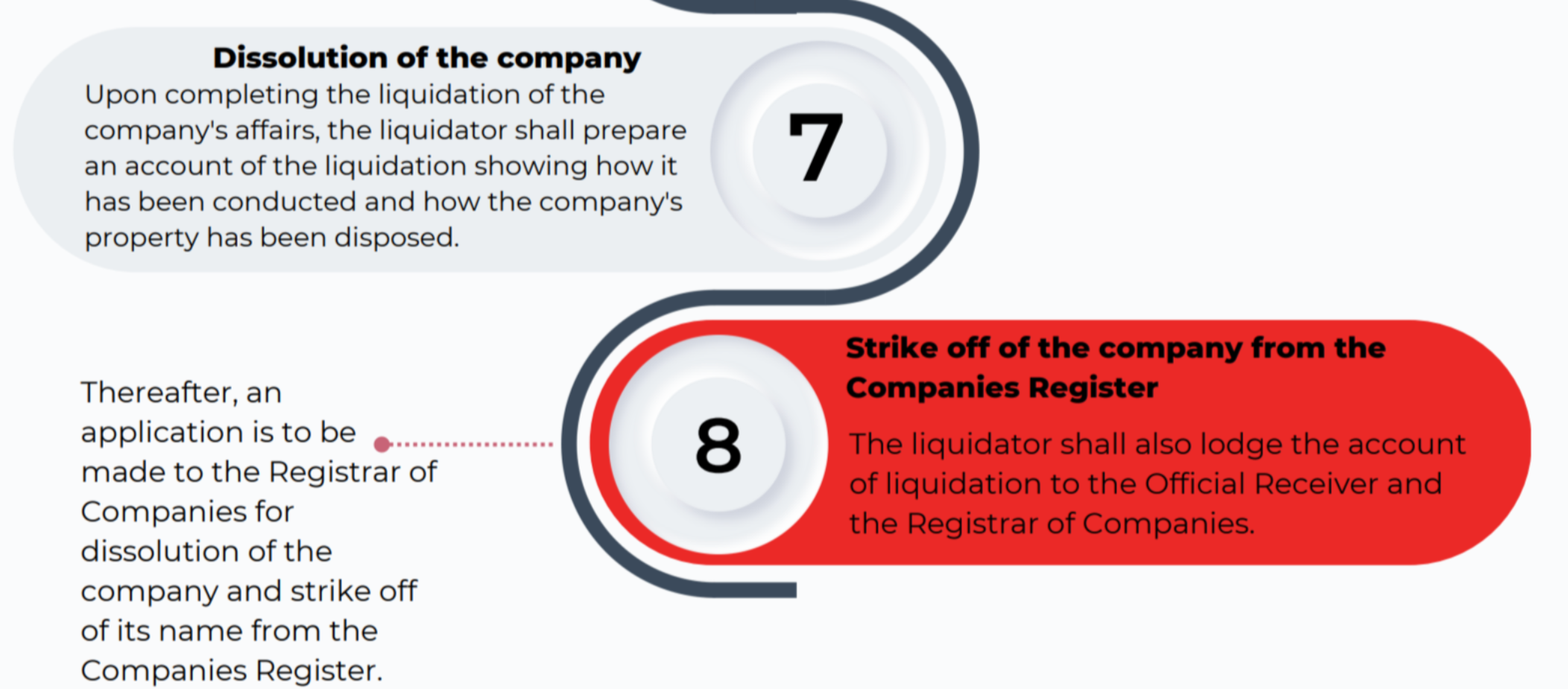
Once a liquidator is appointed, the company’s directors generally cease to exercise their management powers, which are transferred to the liquidator to the extent provided by law. The company retains its corporate status during the liquidation process until it is formally dissolved.
The purpose of liquidation is to ensure that the company’s affairs are handled transparently and that creditors receive distributions in accordance with the applicable legal priorities.
Types of Company Liquidation Under Kenyan Law
The Insolvency Act, 2015, provides for different forms of liquidation depending on the company’s financial position and the circumstances leading to the winding-up process.
1. Members’ Voluntary Liquidation
Members’ voluntary liquidation is generally available to a solvent company whose shareholders decide to bring its operations to an end.
The process typically begins when the shareholders pass a special resolution to liquidate the company and appoint a qualified liquidator. A declaration of solvency may be required under the applicable legal provisions to establish that the company can pay its debts in full within the prescribed period.
The liquidator then realises the company’s assets, settles its liabilities, and distributes any surplus to shareholders in accordance with the law.
2. Creditors’ Voluntary Liquidation
Creditors’ voluntary liquidation is generally used when a company cannot pay its debts as they fall due and liquidation is initiated without a court directly ordering the winding up.
The process involves the relevant company resolutions and creditor procedures required by law. Creditors participate in the process, including decisions concerning the appointment of the liquidator where applicable.
The liquidator takes control of the company’s affairs, identifies its assets and liabilities, receives creditor claims, and distributes available funds according to the statutory order of priority.
3. Court-Ordered Liquidation
Court-ordered liquidation occurs when proceedings are brought before the High Court and the court issues a liquidation order.
The process may be initiated through a liquidation petition by a person or entity legally entitled to present one. Depending on the circumstances, the petition may involve a creditor seeking recovery of an unpaid debt or another party with the necessary legal standing.
Following the order, the appointed liquidator administers the company’s affairs in accordance with the court’s directions and the applicable insolvency framework.
This form of liquidation is subject to the relevant court procedures, statutory requirements, and restrictions on proceedings against the company.
Businesses dealing with insolvency-related financial difficulties may also benefit from understanding the general overview of debtors’ bankruptcy proceedings in Kenya.
Appointment of a Liquidator in Kenya
The appointment of a liquidator is a central step in the company winding-up procedure. A liquidator is responsible for taking control of the company’s affairs, realising assets, examining liabilities, and distributing available funds to creditors and other entitled parties.
The appointment may arise through a members’ resolution, a creditors’ process, or a court order, depending on the type of liquidation.
Responsibilities of the Liquidator
The liquidator’s responsibilities generally include:
- Taking control of the company’s assets and relevant records.
- Investigating the company’s financial position and identifying its liabilities.
- Collecting and realising company assets.
- Receiving and examining claims submitted by creditors.
- Convening meetings of creditors where required.
- Distributing available funds according to statutory priorities.
- Preparing an account of the liquidation.
- Filing the required notices, accounts, and reports with the relevant authorities.
- Applying for the company’s formal dissolution when the process is complete.
Once the liquidator is appointed, the company generally cannot dispose of its property independently of the liquidation process. Any continuation of business must be consistent with the purpose of beneficial liquidation and the applicable legal requirements.
Company Liquidation Process: Step-by-Step Guide
The company liquidation process involves a series of legal and administrative steps. The exact procedure depends on whether the liquidation is voluntary or court-ordered and on the company’s particular circumstances.
For a more detailed explanation of the procedure, see this step-by-step guide to liquidation of companies in Kenya.
Step 1: Commencement of Liquidation Proceedings
Liquidation begins when the legally required liquidation resolution is passed or a court issues a liquidation order.
For voluntary liquidation, the relevant company decision-making procedures must be followed. For court-ordered liquidation, the process generally involves presenting a liquidation petition and obtaining the appropriate court order.
The commencement date is important because it determines when various statutory obligations and procedural requirements take effect.
Step 2: Lodging and Publication of the Liquidator’s Appointment
Following commencement, the required notice of appointment of the liquidator must be lodged with the relevant authorities.
The Business Registration Service’s step-by-step guide identifies the Official Receiver and the Registrar of Companies as recipients of the appointment notice. It also describes publication of the relevant resolution or order in the Kenya Gazette and a newspaper of nationwide circulation, as applicable.
The guide states that the appointment notice should be lodged within seven days of commencement of the proceedings. The applicable filing deadlines and publication requirements should be confirmed for the particular liquidation.
These notices help inform creditors, stakeholders, and members of the public that the company is undergoing liquidation.
Step 3: Preparation and Filing of the Statement of Affairs
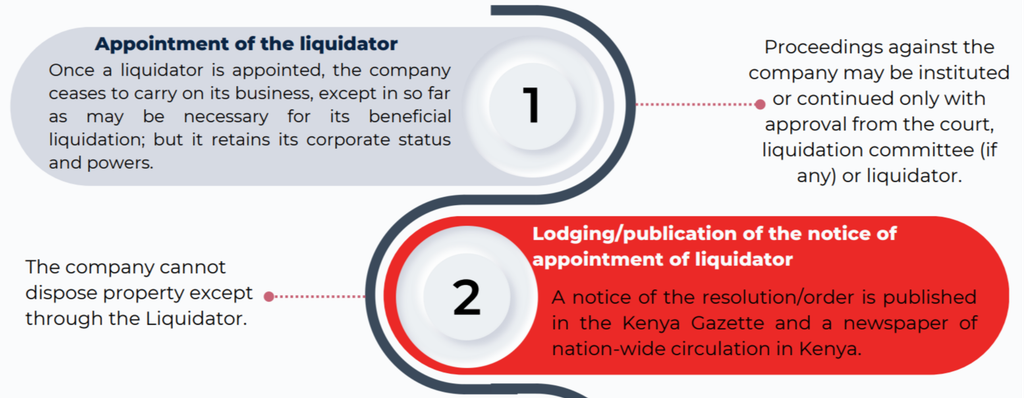
The company’s members and other relevant persons may be required to prepare a Statement of Affairs containing information about the company’s financial position.
The document generally identifies the company’s assets, liabilities, creditors, and other relevant financial information. It assists the liquidator in understanding the company’s affairs and determining what resources are available to meet outstanding obligations.
Directors and other persons with relevant knowledge should cooperate by providing accurate records, financial statements, contracts, and supporting documents.
Incomplete or inaccurate information can delay the process and complicate the assessment of creditor claims.
Step 4: Filing of Claims by Creditors
Creditors must submit their claims in accordance with the applicable insolvency rules and any instructions issued during the liquidation.
The claims process allows the liquidator to examine the amounts owed, assess supporting evidence, and determine which claims can be admitted for distribution purposes.
Creditors may need to provide invoices, loan agreements, contracts, account statements, judgments, or other evidence supporting their claims.
Under the Insolvency Act and the relevant regulations, proof-of-debt procedures help establish the liabilities to be addressed during liquidation. Creditors should comply with any applicable deadlines and evidentiary requirements.
Step 5: Convening Meetings of Creditors
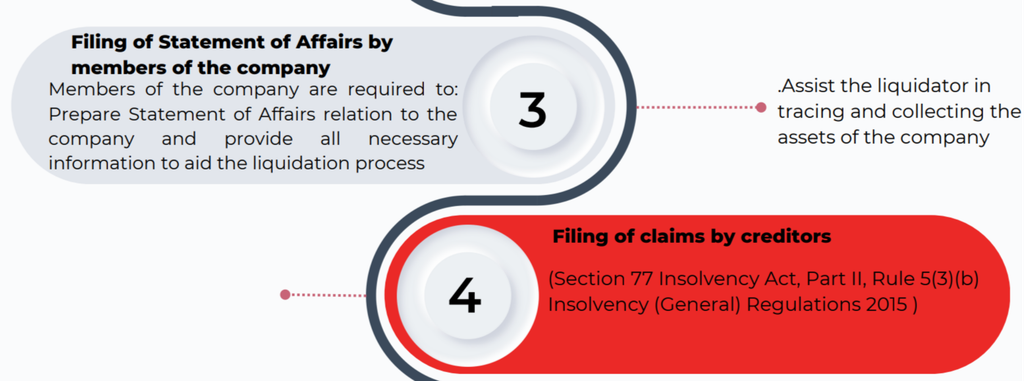
The liquidator may convene the first and subsequent meetings of creditors where required by the applicable procedure.
These meetings provide an opportunity to consider the company’s financial position, review relevant proposals, and make decisions on matters reserved for creditors.
The Business Registration Service guide explains that proposals are decided through voting by creditors who have filed proof-of-debt forms. Voting rights and outcomes depend on the applicable statutory rules, including any relevant creditor classification requirements.
Creditors should review the information provided before participating in decisions that affect the liquidation.
Step 6: Realisation of Company Assets
Company assets must be identified, secured, collected, and realised as necessary to meet the company’s liabilities.
The process may involve selling property, recovering outstanding debts, collecting money held in bank accounts, and dealing with other assets belonging to the company.
The liquidator is responsible for administering these assets in accordance with the law. Directors and other relevant persons should not independently transfer or dispose of company property outside the authorised process.
Proper documentation of asset valuations, sales, recoveries, and expenses helps maintain transparency and accountability.
Step 7: Declaration of Dividends and Distribution to Creditors
After assessing creditor claims and determining the funds available for distribution, the liquidator distributes the proceeds in accordance with the applicable statutory priorities.
The Insolvency Act provides rules governing the treatment of different categories of claims. Depending on the circumstances, these may include secured claims, preferential debts, and unsecured claims.
The Business Registration Service guide refers to the Second Schedule of the Insolvency Act in explaining distributions.
Creditors should not assume that all claims will be paid in full. The amount received depends on the assets realised, the costs of the liquidation, the nature and priority of each claim, and the funds available.
Step 8: Preparation and Filing of the Liquidation Account
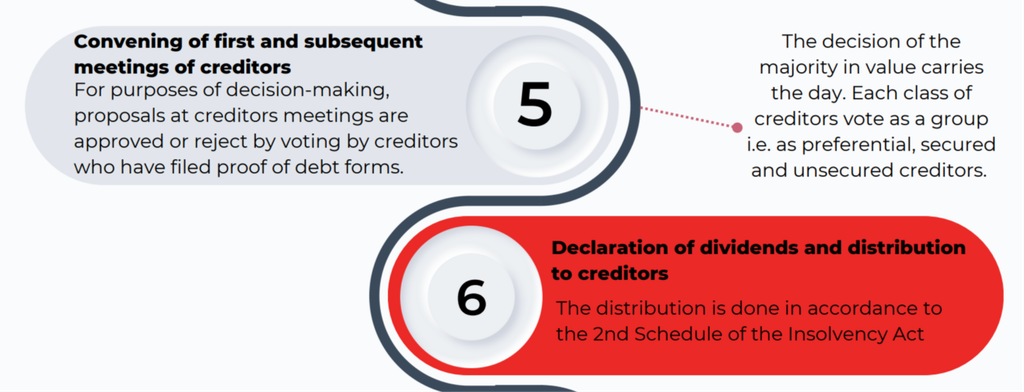
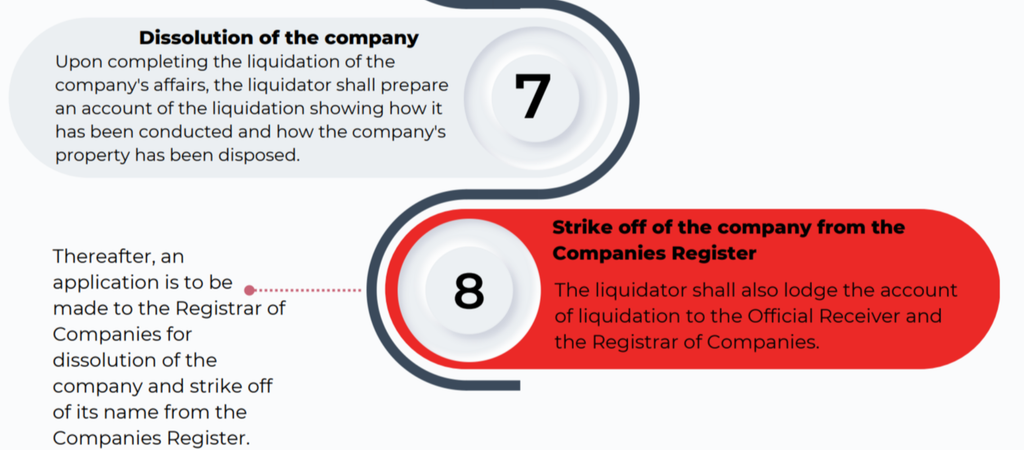
Once the company’s affairs have been dealt with, the liquidator prepares an account showing how the liquidation was conducted and how the company’s property was disposed of.
The account provides a record of the assets realised, liabilities addressed, expenses incurred, and distributions made.
The liquidator must lodge the required liquidation account and other documents with the relevant authorities, including the Official Receiver and the Registrar of Companies, as required by the applicable procedure.
This stage establishes an account of the liquidator’s work and supports the formal conclusion of the process.
Step 9: Company Dissolution and Strike-Off
After completing the liquidation and satisfying the applicable requirements, an application is made for the company’s dissolution and removal of its name from the Companies Register.
The precise filing procedure depends on the applicable legislation and the circumstances of the liquidation. Relevant records and filing requirements can be checked through the Business Registration Service website.
Dissolution marks the formal legal conclusion of the company’s existence. It should not be confused with merely ceasing business operations or submitting an ordinary company deregistration application.
The company’s records and liquidation documents should be retained in accordance with the relevant legal and regulatory requirements.
Liquidation Legal Requirements in Kenya
Compliance with liquidation legal requirements is essential to ensure that the process is conducted properly and that the interests of creditors, shareholders, and other stakeholders are addressed.
The principal legal framework includes the Insolvency Act, 2015, together with applicable regulations and relevant provisions of Kenyan company law.
Corporate Resolutions and Court Orders
Depending on the type of liquidation, the process may require a shareholder special resolution, a creditors’ decision, or a court order.
For members’ voluntary liquidation, the company must follow the prescribed procedures for approving liquidation and appointing a liquidator.
For court-ordered liquidation, the relevant petition, court proceedings, and resulting orders must be complied with.
Financial Records and Disclosure
The company must provide the information required for the liquidation, including relevant financial records and details of its assets and liabilities.
Company financial statements, accounting records, creditor information, and supporting documents may be needed to establish the company’s financial position and facilitate the liquidator’s work.
Directors and other relevant persons should avoid withholding records or providing misleading information.
Where company records are needed for verification or compliance purposes, users can consult this guide on how to download certificates and other records on BRS in Kenya.
Creditor Rights and Legal Priorities
Liquidation proceedings operate for the benefit of creditors collectively, subject to the applicable legal framework.
Creditors must submit claims through the prescribed process, while the liquidator assesses those claims and administers distributions according to statutory priorities.
Legal restrictions may also apply to proceedings against the company once liquidation has commenced. Depending on the circumstances, court, liquidator, or liquidation committee approval may be necessary before certain proceedings can be instituted or continued.
Tax and Regulatory Obligations
Liquidation does not automatically eliminate outstanding tax obligations or other regulatory responsibilities.
The company and liquidator should identify outstanding taxes, filing obligations, and any required clearances. A tax clearance certificate may be relevant in certain administrative or tax-related circumstances, but it should not be assumed to be a universal prerequisite for every form of liquidation.
The applicable requirements should be confirmed with the relevant tax and company registration authorities.
Company Liquidation vs. Company Deregistration in Kenya
Company liquidation and company deregistration are related but distinct procedures.
Liquidation involves administering the company’s assets and liabilities, dealing with creditor claims, and distributing available funds under the applicable legal framework.
Deregistration or strike-off generally concerns removing a company’s name from the Companies Register through the appropriate statutory procedure. It may be available in circumstances where a company qualifies for administrative removal without requiring a full liquidation.
A company with unresolved debts, disputed liabilities, or other circumstances requiring formal insolvency proceedings may need a liquidation procedure rather than an ordinary strike-off.
When Is Liquidation Appropriate?
Liquidation may be appropriate when the company’s affairs require a formal process for collecting assets, resolving creditor claims, and distributing available funds.
It may also be necessary where insolvency proceedings have been initiated or a court has issued the relevant order.
When Is Company Strike-Off Appropriate?
Company strike-off may be suitable for a company that qualifies under the applicable legal requirements and can use the relevant administrative process.
However, strike-off should not be treated as a substitute for addressing outstanding debts or complying with legal obligations. Directors should confirm that the company is eligible before pursuing this route.
Common Challenges During the Liquidation Process
Liquidation can become complicated when a company has incomplete records, disputed debts, insufficient assets, or competing creditor claims.
Common challenges include:
- Missing or inaccurate accounting records.
- Disputes concerning ownership or valuation of assets.
- Failure by creditors to provide adequate proof of debt.
- Delays in selling assets or recovering outstanding receivables.
- Disagreements about creditor priorities and distributions.
- Outstanding tax or regulatory obligations.
- Failure to submit notices, reports, or other required documents on time.
These issues can increase costs and extend the time required to complete the liquidation.
Companies can reduce avoidable delays by maintaining proper records, cooperating with the liquidator, identifying creditors early, and obtaining appropriate professional advice. Businesses considering restructuring rather than immediate liquidation may also wish to review the company administration process in Kenya.
How Long Does Company Liquidation Take in Kenya?
There is no single timeline that applies to every company liquidation in Kenya.
The duration depends on factors such as the company’s financial complexity, the number of creditors, the value and liquidity of its assets, the existence of disputes, and whether court proceedings are involved.
A company with straightforward affairs and readily realisable assets may be easier to wind up than one with complex financial arrangements, ongoing litigation, or disputed ownership of property.
Timely submission of creditor claims, accurate financial disclosure, and compliance with filing requirements can help reduce unnecessary delays. However, the liquidation should not be considered complete until the applicable statutory procedures have been satisfied.
Frequently Asked Questions
1. What are the main steps in company liquidation in Kenya?
The main steps generally include commencing liquidation proceedings, appointing a liquidator, lodging and publishing the required notices, preparing a Statement of Affairs, receiving creditor claims, convening meetings where required, realising assets, distributing funds, filing the liquidation account, and applying for dissolution and removal from the Companies Register.
2. Who can appoint a liquidator in Kenya?
The appointment depends on the type of liquidation. Shareholders may appoint a liquidator through the appropriate voluntary liquidation procedure, creditors may participate in the appointment process for creditors’ voluntary liquidation, and the High Court may appoint or remove a liquidator in accordance with the law.
3. Can a company be deregistered without liquidation in Kenya?
Yes, a company may qualify for a strike-off or other dissolution procedure without undergoing a full liquidation. However, eligibility depends on the applicable legal requirements and the company’s circumstances. Companies with unresolved liabilities or insolvency issues should obtain appropriate advice before pursuing deregistration.